
Penny Dreadfuls, 1900 · page 35 of 398
Moths by Ouida — page 35: what you’re looking at
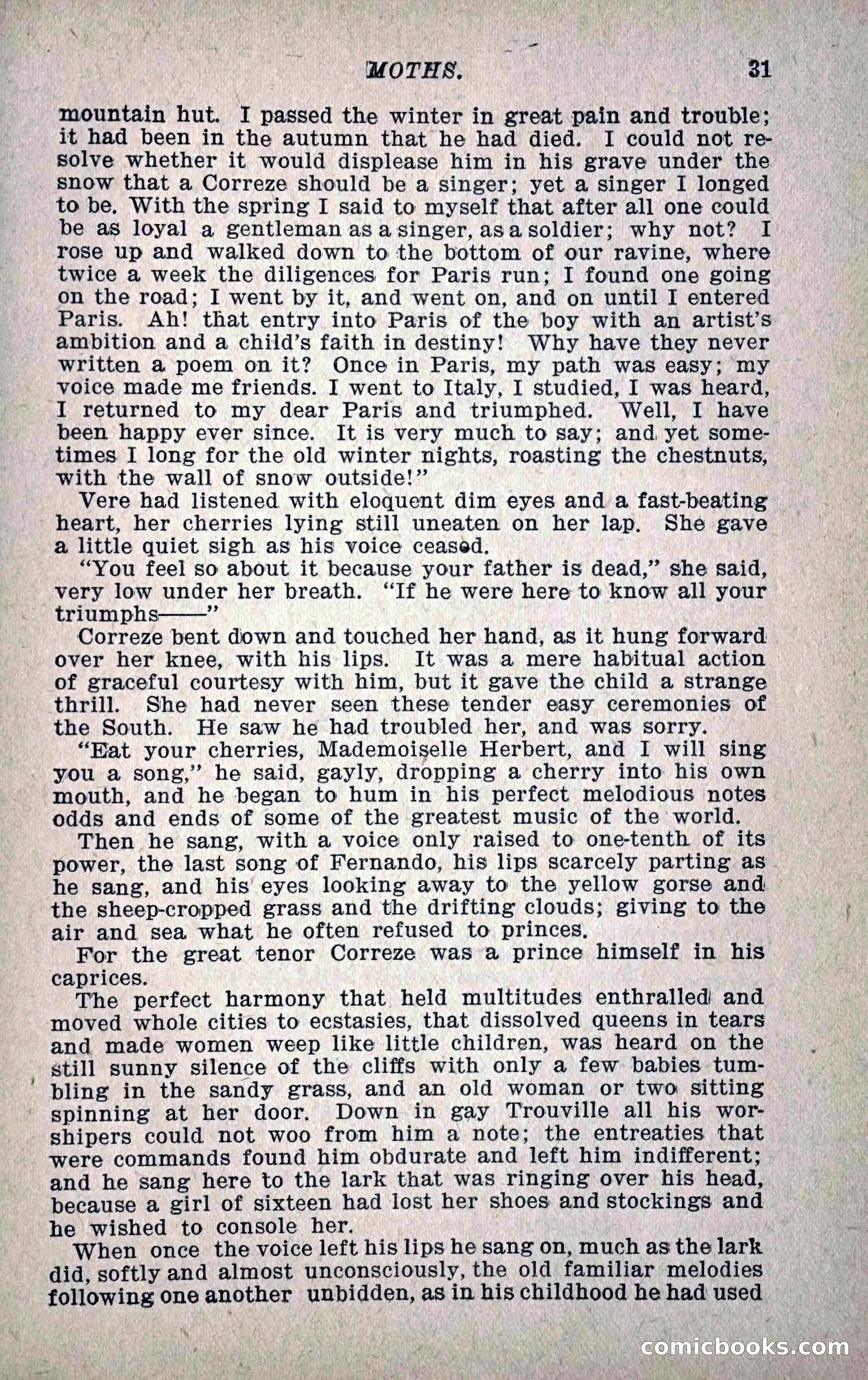
A restored page from Penny Dreadfuls, 1900. Page through the whole issue in the reader above.
📄 Transcribed text from this page (OCR, searchable)
Machine-transcribed from the original scan — historical spelling and the odd misread are preserved.
MOTHS. 31 mountain hut. I passed the winter in great pain and trouble; it had been in the autumn that he had died. I could not re- solve whether it would displease him in his grave under the snow that a Correze should be a singer; yet a singer I longed to be. With the spring I said to myself that after all one could be as loyal a gentleman asasinger, asasoldier; why not? I rose up and walked down to the bottom of our ravine, where twice a week the diligences for Paris run; I found one going on the road; I went by it, and went on, and on until I entered Paris. Ah! that entry into Paris of the boy with an artist’s ambition and a child’s faith in destiny! Why have they never written a poem on it? Once in Paris, my path was easy; my voice made me friends. I went to Italy, I studied, I was heard, I returned to my dear Paris and triumphed. Well, I have been happy ever since. It is very much to say; and yet some- times. I long for the old winter nights, roasting the chestnuts, with the wall of snow outside!” Vere had listened with eloquent dim eyes and a fast-beating heart, her cherries lying still uneaten on her lap. She gave a little quiet sigh as his voice ceased. “You feel so about it because your father is dead,” she said, very low under her breath. “If he were here to know all your triumphs ny Correze bent down and touched her hand, as it hung forward over her knee, with his lips. It was a mere habitual action of graceful courtesy with him, but it gave the child a strange thrill. She had never seen these tender easy ceremonies of the South. He saw he had troubled her, and was sorry. “Hat your cherries, Mademoiselle Herbert, and I will sing _ you a song,” he said, gayly, dropping a cherry into his own mouth, and he began to hum in his perfect melodious notes odds and ends of some of the greatest music of the world. Then he sang, with a voice only raised to one-tenth of its power, the last song of Fernando, his lips scarcely parting as . he sang, and his eyes looking away to the yellow gorse and the sheep-cropped grass and the drifting clouds; giving to the air and sea what he often refused to princes, : For the great tenor Correze was a prince himself in his caprices. The perfect harmony that held multitudes enthralled and moved whole cities to ecstasies, that dissolved queens in tears and made women weep like little children, was heard on the still sunny silence of the cliffs with only a few babies tum- bling in the sandy grass, and an old woman or two sitting spinning at her door, Down in gay Trouville all his wor- shipers could not woo from him a note; the entreaties that were commands found him obdurate and left him indifferent; and he sang here to the lark that was ringing over his head, because a girl of sixteen had lost her shoes and stockings and he wished to console her. When once the voice left his lips he sang on, much as the lark did, softly and almost unconsciously, the old familiar melodies following one another unbidden, as in his childhood he had used {e(@) ‘ , d . } (ero an G 9700 cS