
Penny Dreadfuls, 1900 · page 363 of 398
Moths by Ouida — page 363: what you’re looking at
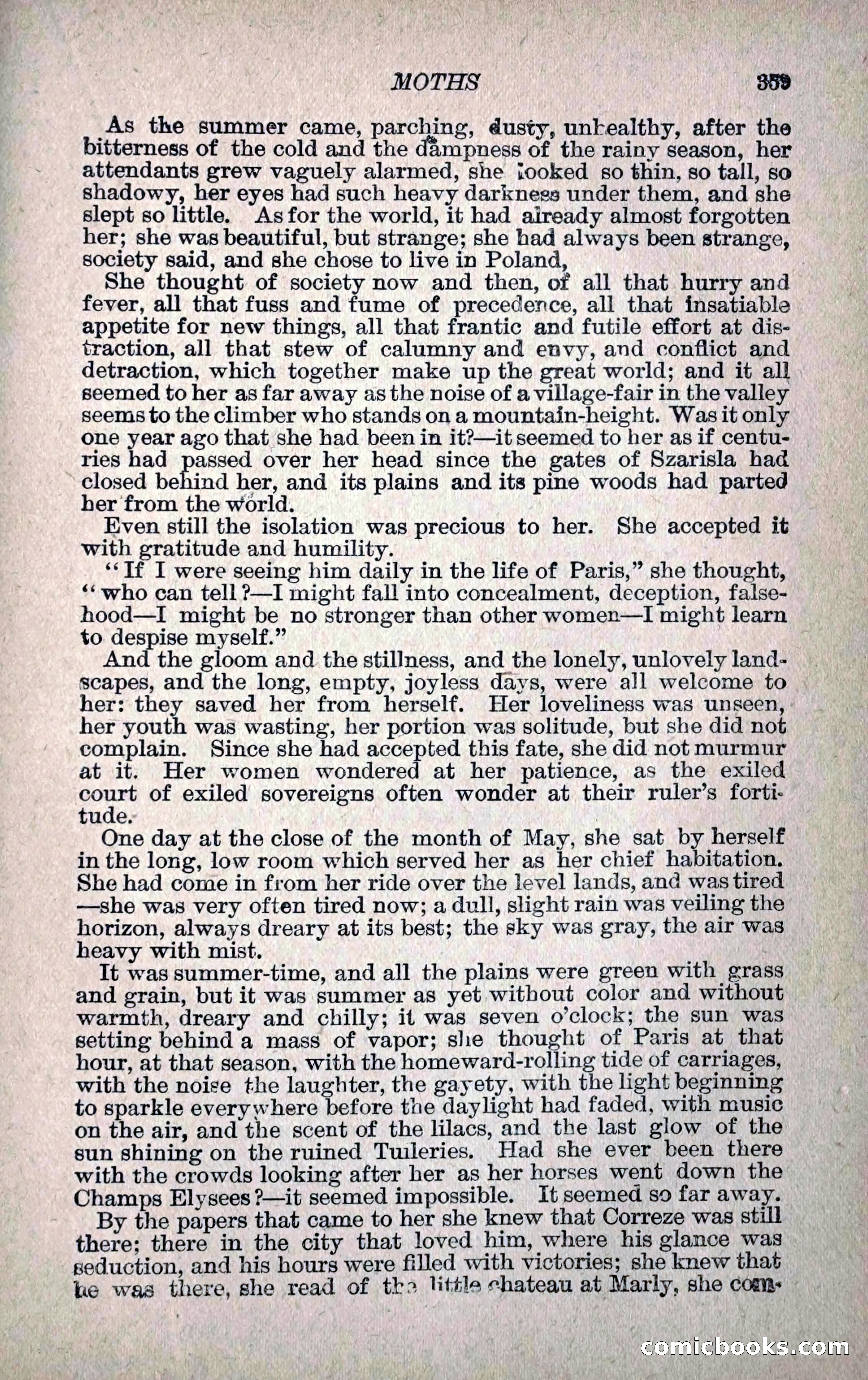
A restored page from Penny Dreadfuls, 1900. Page through the whole issue in the reader above.
📄 Transcribed text from this page (OCR, searchable)
Machine-transcribed from the original scan — historical spelling and the odd misread are preserved.
MOTHS oue As the summer came, parching, dusty, unkealthy, after the bitterness of the cold and the dampness of the rainy season, her attendants grew vaguely alarmed, she iooked so thin, so tall, so shadowy, her eyes had such heavy darkness under them, and she slept so little. Asfor the world, it had aiready almost forgotten her; she was beautiful, but strange; she had always been strange, society said, and she chose to live in Poland, She thought of society now and then, of all that hurry and | fever, all that fuss and fume of precedence, all that insatiable appetite for new things, all that frantic and futile effort at dis- traction, all that stew of calumny and envy, and conflict and detraction, which together make up the great world; and it all seemed to her as far away asthe noise of a village-fair in the valley seems to the climber who stands on a mountain-height. Wasit only one year ago that she had been in it?—it seemed to her as if centu- ries had passed over her head since the gates of Szarisla had closed hating her, and its plains and its pine woods had parted her from the world. Even still the isolation was precious to her. She accepted it with gratitude and humility. ‘‘If I were seeing him daily in the life of Paris,” she thought, ‘who can tell ?—I might fall into concealment, deception, false- hood—I might be no stronger than other women—I might learn to despise myself.” And the gloom and the stillness, and the lonely, unlovely land- scapes, and the long, empty, joyless days, were all welcome to her: they saved her from herself. Her loveliness was unseen, : her youth was wasting, her portion was solitude, but she did not complain. Since she had accepted this fate, she did not murmur at it. Her women wondered at her patience, as the exiled aah of exiled sovereigns often wonder at their ruler’s forti- tude. | One day at the close of the month of May, she sat by herself in the long, low room which served her as her chief habitation. She had come in from her ride over the level lands, and was tired —she was very often tired now; a dull, slight rain was veiling the horizon, always dreary at its best; the sky was gray, the air was heavy with mist. | It was summer-time, and all the plains were green with grass and grain, but it was summer as yet without color and without warmth, dreary and chilly; it was seven o’clock; the sun was setting behind a mass of vapor; she thought of Paris at that hour, at that season, with the homeward-rolling tide of carriages, with the noise the laughter, the gayety, with the light beginning to sparkle everywhere before the daylight had faded, with music on the air, and the scent of the lilacs, and the last glow of the sun shining on the ruined Tuileries. Had she ever been there with the crowds looking after her as her horses went down the Champs Elysees ?—it seemed impossible. It seemed so far away. By the papers that came to her she knew that Correze was still there; there in the city that loved him, where his glance was seduction, and his hours were filled with victories; she knew that he was there, she read of tho little chateau at Marly, she com: (Go) Gcomicbooks