
Penny Dreadfuls, 1900 · page 377 of 398
Moths by Ouida — page 377: what you’re looking at
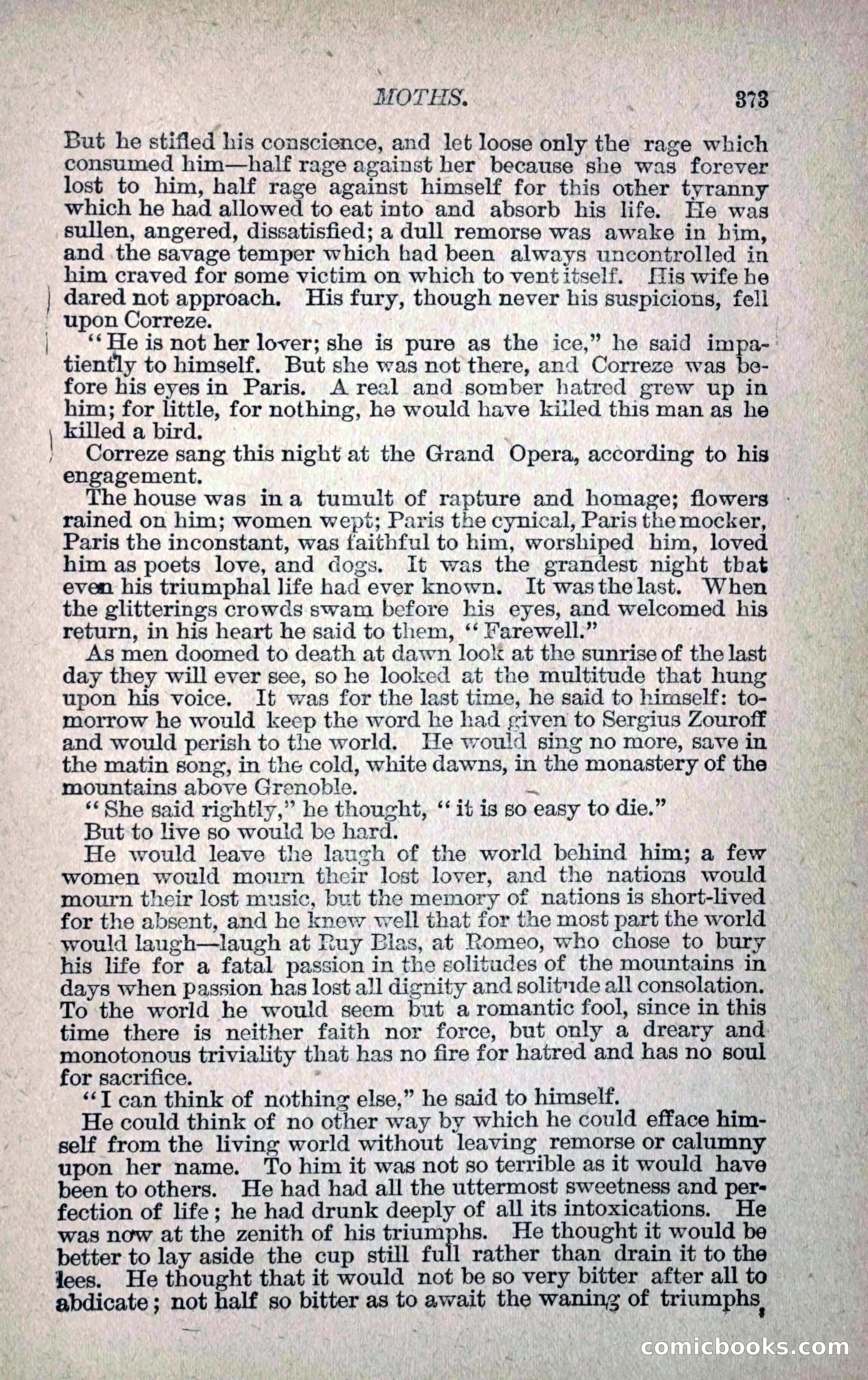
A restored page from Penny Dreadfuls, 1900. Page through the whole issue in the reader above.
📄 Transcribed text from this page (OCR, searchable)
Machine-transcribed from the original scan — historical spelling and the odd misread are preserved.
eee a ~ MOTHS. 373, But he stifled his conscience, and let loose only the rage which consumed him—half rage against her because she was forever lost to him, half rage against himself for this other tyranny which he had allowed to eat into and absorb his life. He was sullen, angered, dissatisfied; a dull remorse was awake in him, and the savage temper which had been always uncontrolled in him craved for some victim on which to ventitself. lis wife he dared not approach. His fury, though never his suspicions, fell upon Correze. ‘* He is not her lover; she is pure as the ice,” he said impa-' tiently to himself. But she was not there, and Correze was be- fore his eyesin Paris. A real and somber hatred grew up in him; for little, for nothing, he would have killed this man as he killed a bird. | Correze sang this night at the Grand Opera, according to his engagement, The house was ina tumult of rapture and homage; flowers - rained on him; women wept; Paris the cynical, Paris the mocker, Paris the inconstant, was faithful to him, worshiped him, loved him as poets love, and dogs. It was the grandest night tbat even his triumphal life had ever known. It wasthelast. When the glitterings crowds swam before his eyes, and welcomed his return, in his heart he said to them, ‘* Farewell.” As men doomed to death at dawn look at the sunrise of the last day they will ever see, so he looked at the multitude that hung upon his voice. It was for the last time, he said to himself: to- morrow he would keep the word he had given to Sergius Zouroff and would perish to the world. He would sing no more, save in the matin song, in the cold, white dawns, in the monastery of the mountains above Grenoble. be ‘‘ She said rightly,” he thought, ‘‘ it is so easy to die.” But to live so would be hard. He would leave the laugh of the world behind him; a few women would mourn their lost lover, and the nations would mourn their lost music, but the memory of nations is short-lived for the absent, and he knew well that for the most part the world - would laugh—laugh at Ruy Blas, at Romeo, who chose to bury his life for a fatal passion in the solitudes of the mountains in days when passion has lost all dignity and solitnde all consolation. To the world he would seem but a romantic fool, since in this time there is neither faith nor force, but only a dreary and: monotonous triviality that has no fire for hatred and has no soul for sacrifice. ‘‘T can think of nothing else,” he said to himself. He could think of no other way by which he could efface him- self from the living world without leaving remorse or calumny upon her name. To him it was not so terrible as it would have been to others. He had had all the uttermost sweetness and per- fection of life; he had drunk deeply of all its intoxications. He was now at the zenith of his yen tan He thought it would be better to lay aside the cup still full rather than drain it to the Jees. He thought that it would not be so very bitter after all to abdicate ; not half so bitter as to await the waning of triumphs, SS (Ei 0) Comicboo