
Penny Dreadfuls, 1900 · page 66 of 398
Moths by Ouida — page 66: what you’re looking at
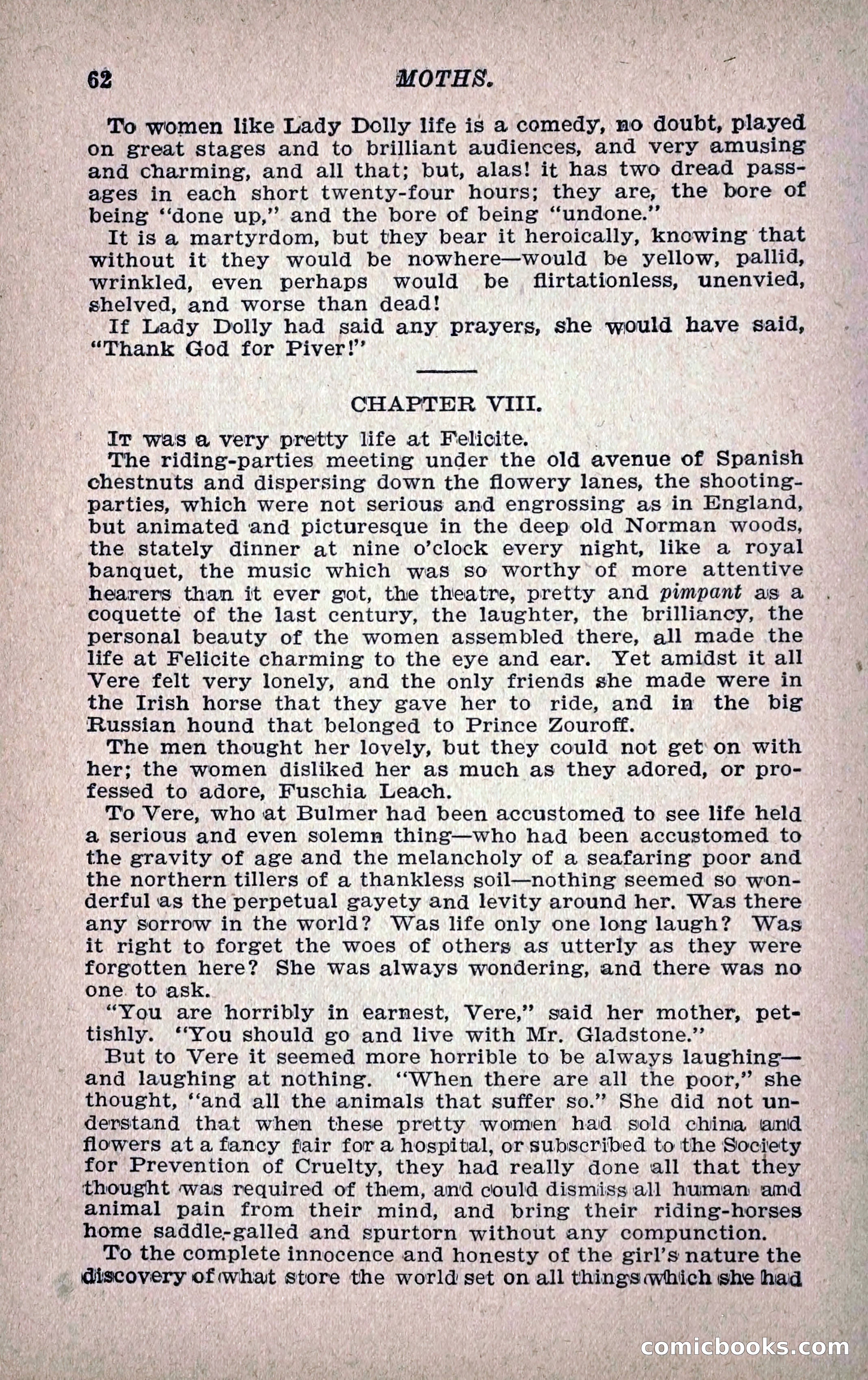
A restored page from Penny Dreadfuls, 1900. Page through the whole issue in the reader above.
📄 Transcribed text from this page (OCR, searchable)
Machine-transcribed from the original scan — historical spelling and the odd misread are preserved.
62 MOTHS. To women like Lady Dolly life is a comedy, no doubt, played on great stages and to brilliant audiences, and very amusing and charming, and all that; but, alas! it has two dread pass- ages in each short twenty-four hours; they are, the bore of being ‘‘done up,’’ and the bore of being “undone.”’ It is a martyrdom, but they bear it heroically, knowing that without it they would be nowhere—would be yellow, pallid, wrinkled, even perhaps would be flirtationless, unenvied, shelved, and worse than dead! If Lady Dolly had said any prayers, she would have said, “Thank God for Piver!’ CHAPTER VIII. It was avery pretty life at Felicite. : The riding-parties meeting under the old avenue of Spanish chestnuts and dispersing down the flowery lanes, the shooting- parties, which were not serious and engrossing as in England, but animated and picturesque in the deep old Norman woods, the stately dinner at nine o’clock every night, like a royal banquet, the music which was so worthy of more attentive hearers than it ever got, the theatre, pretty and pimpant as a coquette of the last century, the laughter, the brilliancy, the personal beauty of the women assembled there, all made the life at Felicite charming to the eye and ear. Yet amidst it all Vere felt very lonely, and the only friends she made were in the Irish horse that they gave her to ride, and in the big Russian hound that belonged to Prince Zouroff. The men thought her lovely, but they could not get’ on with her; the women disliked her as much as they adored, or pro- fessed to adore, Fuschia Leach. Too Vere, who at Bulmer had been accustomed to see life held a serious and even solemn thing—who had been accustomed to the gravity of age and the melancholy of a seafaring poor and the northern tillers of a thankless soil—nothing seemed so won- derful as the perpetual gayety and levity around her. Was there any sorrow in the world? Was life only one long laugh? Was it right to forget the woes of others as utterly as they were forgotten here? She was always wondering, and there was no one. to ask. “You are horribly in earnest, Vere,’’ said her mother, pet- tishly. ‘‘You should go and live with Mr. Gladstone.”’’ But to Vere it seemed more horrible to be always laughing— and laughing at nothing. ‘‘When there are all the poor,” she thought, ‘‘and all the animals that suffer so.’”? She did not un- derstand that when these pretty women had sold china anid flowers ata fancy fair for a hospital, or subscribed to the Society for Prevention of Cruelty, they had really done all that they thought was required of them, and could dismiss all human amd animal pain from their mind, and bring their riding-horses | home saddle-galled and spurtorn without any compunction. To the complete innocence and honesty of the girl’s nature the _ discovery of what store the world set on all things which she had m Eom G 900 <S co