
Penny Dreadfuls, 1850 · page 217 of 397
The Mysteries of the Court of London — page 217: what you’re looking at
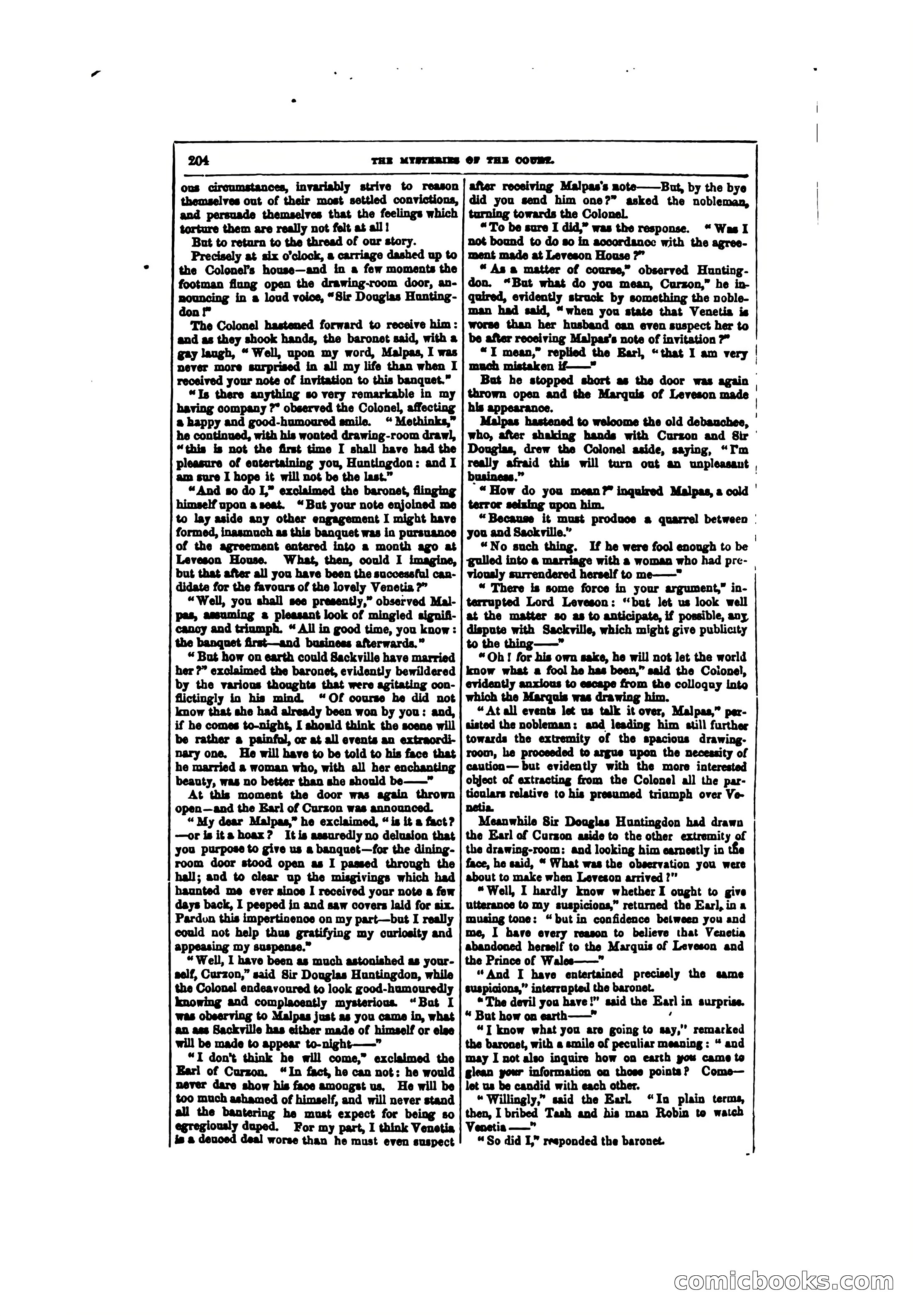
A restored page from Penny Dreadfuls, 1850. Page through the whole issue in the reader above.
📄 Transcribed text from this page (OCR, searchable)
Machine-transcribed from the original scan — historical spelling and the odd misread are preserved.
204 THE MYSTERIES OF THE COURT. a aaa aaa Ra ER a ous circumstances, invariably strive to reason | after receiving Malpas's note——But, by the bye themselves out of their most settled convictions, and persuade themselves that the feelings which | turning torture them are really not felt at all! But to return to the thread of our story. Precisely at six o'clock, a carriage dashed up to the Colonel’s house—and in a few moments the footman flung open the drawing-room door, an- nouncing in a loud voice, “Sir Douglas Hunting- don I” The Colonel hastened forward to receive him : and as they shook hands, the baronet said, with a gay laugh, “ Well, upon my word, Malpas, I was never more surprised in all my life than when I received your note of invitation to this banquet.” “Is there anything so very remarkable in my having company ?* observed the Colonel, affecting a happy and good-humoured smile. “Methinks,” he continued, with his wonted drawing-room drawl, “this is not the first time I shall have had the pleasure of entertaining you, Huntingdon: and I am sure I hope it will not be the last.” “And so do I,” exclaimed the baronet, flinging himself upon aseat. “But your note enjoined me to lay aside any other engagement I might have formed, inasmuch as this banquet was in pursuance of the agreement entered into a month ago at Leveson House. What, then, could I imagine, but that after all you have been the successful can- didate for the favours of the lovely Venetia ?” “Well, you shall see presently,” observed Mal- pas, assuming a pleasant look of mingled signifi- cancy and triumph. “All in good time, you know: the banquet first—and business afterwards.” “ But how on earth could Sackville have married her ?” exclaimed the baronet, evidently bewildered by the various thoughts that were agitating oon- flictingly in his mind. “Of course he did not know that she had already been won by you: and, if he comes to-night, I should think the scene will be rather a painfol, or at all events an extraordi- nary one. He will have to be told to his face that he married a woman who, with all her enchanting beauty, was no better than she should bo——” At this moment the door was again thrown open—and the Earl of Curzon was announced. “ My dear Malpas,” he exclaimed, “ is it a fact? —or is ita hoax? It is assuredly no delusion that you purpose to give us a banquet—for the dining- room door stood open as I passed through the hall; aod to clear up the misgivings which had haunted me ever since I received your note a few days back, I peeped in and saw covers laid for six. Pardon this impertinence on my part—but I really could not help thus gratifying my curiosity and appeasing my suspense.” “Well, I have been as much astonished as your- self, Curzon,” said Sir Douglas Huntingdon, while the Colonel endeavoured to look good-humouredly knowing and complacently mysterious. “But I was observing to Malpas just as you came in, what an ass Sackville has either made of himself or else will be made to appear to-night——” “I don't think he will come,” exclaimed the Earl of Curzon. “In fact, ho can not: he would never dare show his face amongst us, He will be too much ashamed of himself, and will never stand all the bantering he must expect for being so egregiously duped. For my part, I think Venetia is a deuced deal worse than he must even suspect did you send him one?” asked the nobleman, towards the Colonel. “To be sure I did,” was the response. “Was I not bound to do so in accordance with the agree- ment made at Leveson House ” “ As a matter of course,” observed Hunting- don. “But what do you mean, Curzon,” he in- quired, evidently strack by something the noble- man had said, “when you state that Venetia is worse than her husband can even suspect her to be after receiving Malpas’s note of invitation ” “I mean,” replied the Earl, “that I am very | much mistaken if—* Bat he stopped short as the door was again | thrown open and the Marquis of Leveson made his appearance. | Malpas hastened to weloome the old debauchee, who, after shaking hands with Curzon and Sir | Douglas, drew the Colonel aside, saying, “I'm really afraid this will turn out an unpleasaut , business.” : “How do you mean?” inquired Malpas, a cold ' terror seizing upon him. “Because it must produce a quarrel between | you and Sackville.” | “No such thing. If he were fool enough to be ‘galled into « marriage with a woman who had pre- viously surrendered herself to me——" “ There is some force in your argument,” in- terrupted Lord Leveson: “but let us look well at the matter so as to anticipate, if possible, any dispute with Sackville, which might give publicity to the thing——” “Oh! for his own sake, he will not let the world know what a fool he has been,” said the Coionel, evidently anxious to escape from the colloquy into which the Marquis was drawing him. “At all events let us talk it over, Malpas,” per- sisted the nobleman: and leading him still further towards the extremity of the spacious drawing- room, he proceeded to argue upon the necessity of caution— but evidently with the more interested object of extracting from the Colonel all the par- ticulars relative to his presumed triamph over Vo- netia. Meanwhile Sir Douglas Huntingdon had drawn the Earl of Curzon aside to the other extremity of the drawing-room: and looking him earnestly in face, he said, “ What was the observation you were about to make when Leveson arrived ?” “Well, I hardly know whether I ought to give utterance to my suspicions,” returned the Earl, ina musing tone: “but in confidence between you and me, I have every reason to believe that Venetia abandoned herself to the Marquis of Leveson and the Prince of Walee——” “And I have entertained precisely the eame suspicions,” interrapted the baronet. “The devil you have!” said the Earl in surprise. “ But how on earth——” ‘ “I know what you are going to say,” remarked the baronet, with a smile of peculiar meaning: “ and may I not aleo inquire how on earth you came to glean your information oa those points? Come— let us be candid with each other. “ Willingly,” said the Earl “In plain terms, then, I bribed Tash and his man Robin to watch Venetia ——” “So did I,” reeponded the baronet. comliclbooks.com