
Penny Dreadfuls, 1860 · page 156 of 400
The Mysteries of the Court of London — page 156: what you’re looking at
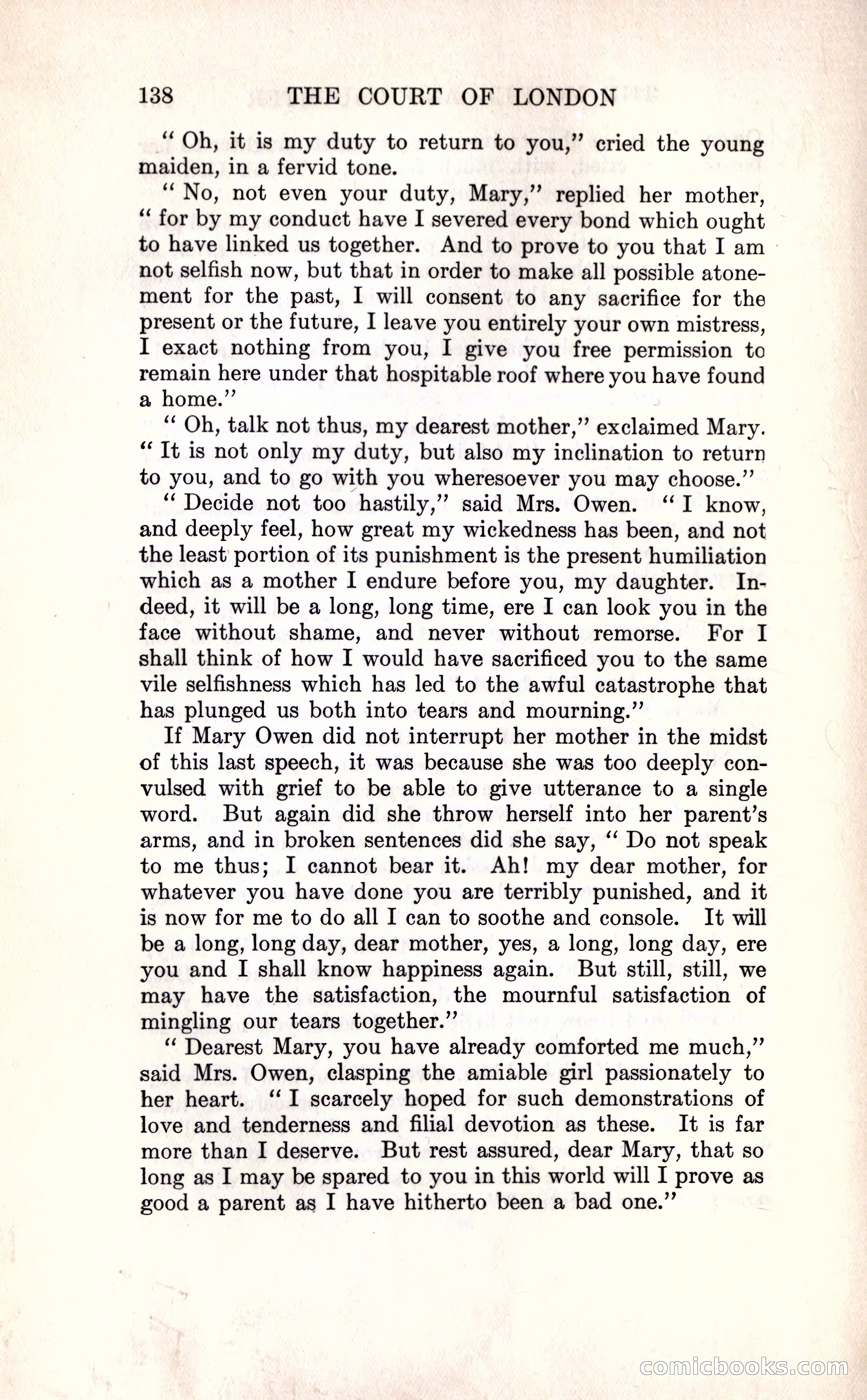
A restored page from Penny Dreadfuls, 1860. Page through the whole issue in the reader above.
📄 Transcribed text from this page (OCR, searchable)
Machine-transcribed from the original scan — historical spelling and the odd misread are preserved.
138 THE COURT OF LONDON “Oh, it is my duty to return to you,” cried the young maiden, in a fervid tone. ‘No, not even your duty, Mary,” replied her mother, ‘for by my conduct have I severed every bond which ought to have linked us together. And to prove to you that I am not selfish now, but that in order to make all possible atone- ment for the past, I will consent to any sacrifice for the present or the future, I leave you entirely your own mistress, I exact nothing from you, I give you free permission to remain here under that hospitable roof where you have found a home.”’ ‘Oh, talk not thus, my dearest mother,” exclaimed Mary. “It is not only my duty, but also my inclination to return to you, and to go with you wheresoever you may choose.”’ ‘‘ Decide not too hastily,” said Mrs. Owen. ‘I know, and deeply feel, how great my wickedness has been, and not the least’ portion of its punishment is the present humiliation which as a mother I endure before you, my daughter. In- deed, it will be a long, long time, ere I can look you in the face without shame, and never without remorse. For I shall think of how I would have sacrificed you to the same vile selfishness which has led to the awful catastrophe that has plunged us both into tears and mourning.”’ If Mary Owen did not interrupt her mother in the midst of this last speech, it was because she was too deeply con- vulsed with grief to be able to give utterance to a single word. But again did she throw herself into her parent’s arms, and in broken sentences did she say, ‘“‘ Do not speak to me thus; I cannot bear it. Ah! my dear mother, for whatever you have done you are terribly punished, and it is now for me to do all I can to soothe and console. It will be a long, long day, dear mother, yes, a long, long day, ere you and I shall know happiness again. But still, still, we may have the satisfaction, the mournful satisfaction of mingling our tears together.”’ “Dearest Mary, you have already comforted me much,”’ said Mrs. Owen, clasping the amiable girl passionately to her heart. ‘‘ I scarcely hoped for such demonstrations of love and tenderness and filial devotion as these. It is far more than I deserve. But rest assured, dear Mary, that so long as I may be spared to you in this world will I prove as good a parent as I have hitherto been a bad one.’’ CORDICLOOO© S CO