
Penny Dreadfuls, 1860 · page 208 of 400
The Mysteries of the Court of London — page 208: what you’re looking at
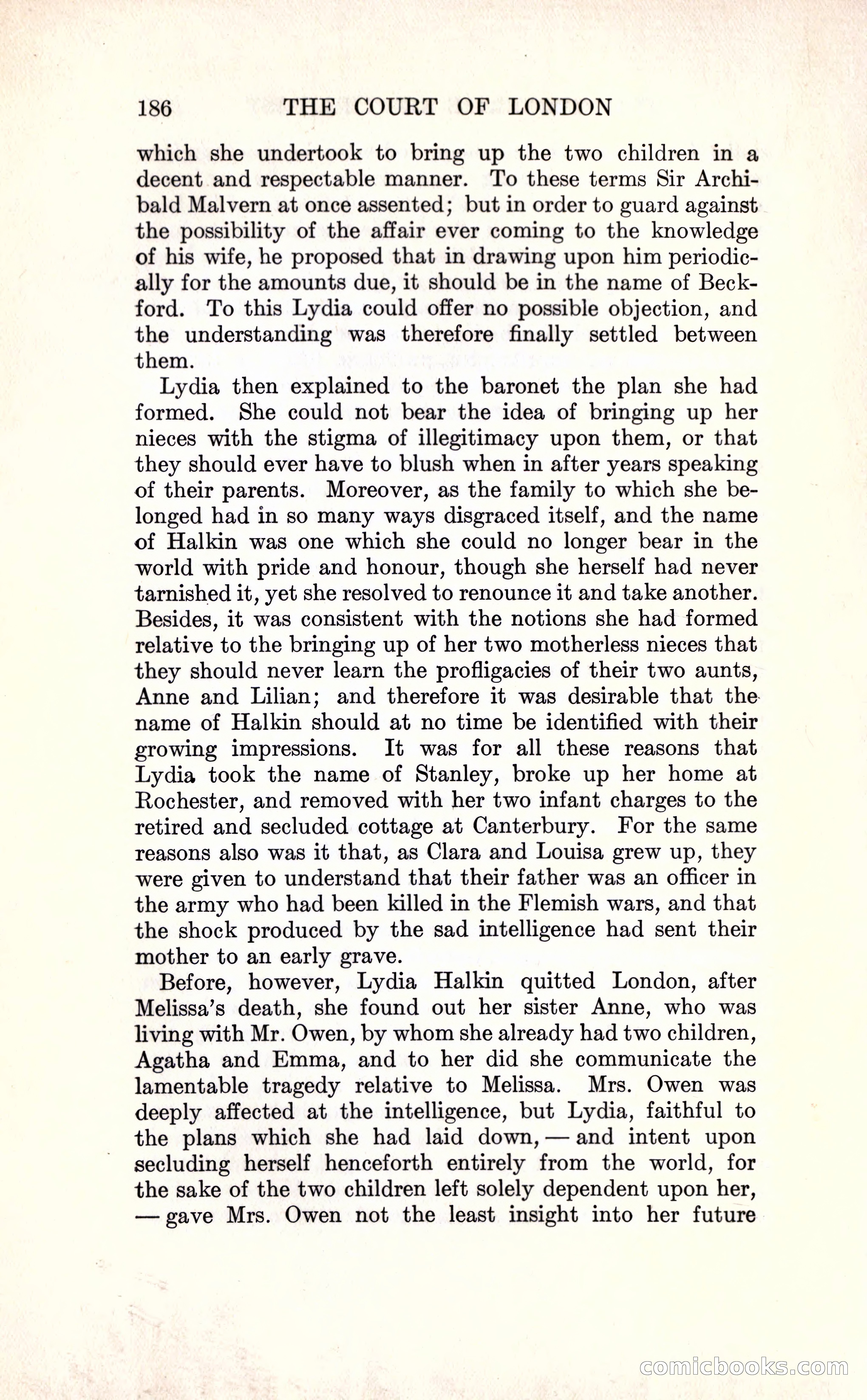
A restored page from Penny Dreadfuls, 1860. Page through the whole issue in the reader above.
📄 Transcribed text from this page (OCR, searchable)
Machine-transcribed from the original scan — historical spelling and the odd misread are preserved.
186 THE COURT OF LONDON which she undertook to bring up the two children in a decent and respectable manner. To these terms Sir Archi- bald Malvern at once assented; but in order to guard against the possibility of the affair ever coming to the knowledge of his wife, he proposed that in drawing upon him periodic- ally for the amounts due, it should be in the name of Beck- ford. To this Lydia could offer no possible objection, and the understanding was therefore finally settled between them. Lydia then explained to the baronet the plan she had formed. She could not bear the idea of bringing up her nieces with the stigma of illegitimacy upon them, or that they should ever have to blush when in after years speaking of their parents. Moreover, as the family to which she be- longed had in so many ways disgraced itself, and the name of Halkin was one which she could no longer bear in the world with pride and honour, though she herself had never tarnished it, yet she resolved to renounce it and take another. Besides, it was consistent with the notions she had formed relative to the bringing up of her two motherless nieces that they should never learn the profligacies of their two aunts, Anne and Lilian; and therefore it was desirable that the name of Halkin should at no time be identified with their growing impressions. It was for all these reasons that Lydia took the name of Stanley, broke up her home at Rochester, and removed with her two infant charges to the retired and secluded cottage at Canterbury. For the same reasons also was it that, as Clara and Louisa grew up, they were given to understand that their father was an officer in the army who had been killed in the Flemish wars, and that the shock produced by the sad intelligence had sent their mother to an early grave. Before, however, Lydia Halkin quitted London, after Melissa’s death, she found out her sister Anne, who was living with Mr. Owen, by whom she already had two children, Agatha and Emma, and to her did she communicate the lamentable tragedy relative to Melissa. Mrs. Owen was deeply affected at the intelligence, but Lydia, faithful to the plans which she had laid down, — and intent upon secluding herself henceforth entirely from the world, for the sake of the two children left solely dependent upon her, —gave Mrs. Owen not the least insight into her future COMmicloe (Cl)