
Penny Dreadfuls, 1860 · page 212 of 400
The Mysteries of the Court of London — page 212: what you’re looking at
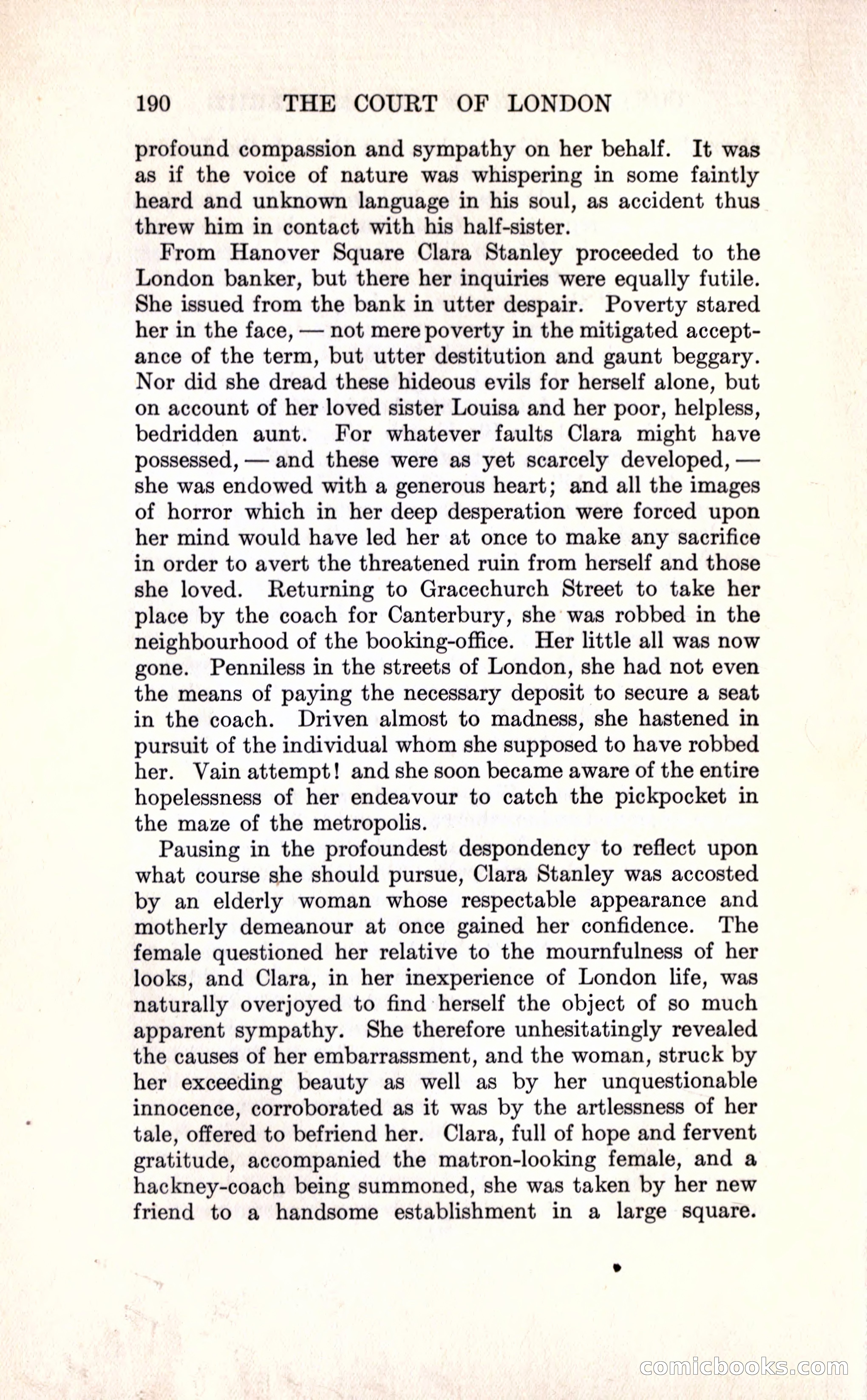
A restored page from Penny Dreadfuls, 1860. Page through the whole issue in the reader above.
📄 Transcribed text from this page (OCR, searchable)
Machine-transcribed from the original scan — historical spelling and the odd misread are preserved.
190 THE COURT OF LONDON profound compassion and sympathy on her behalf. It was as if the voice of nature was whispering in some faintly heard and unknown language in his soul, as accident thus threw him in contact with his half-sister. From Hanover Square Clara Stanley proceeded to the London banker, but there her inquiries were equally futile. She issued from the bank in utter despair. Poverty stared her in the face, — not mere poverty in the mitigated accept- ance of the term, but utter destitution and gaunt beggary. Nor did she dread these hideous evils for herself alone, but on account of her loved sister Louisa and her poor, helpless, bedridden aunt. For whatever faults Clara might have possessed, — and these were as yet scarcely developed, — she was endowed with a generous heart; and all the images of horror which in her deep desperation were forced upon her mind would have led her at once to make any sacrifice in order to avert the threatened ruin from herself and those she loved. Returning to Gracechurch Street to take her place by the coach for Canterbury, she was robbed in the neighbourhood of the booking-office. Her little all was now gone. Penniless in the streets of London, she had not even the means of paying the necessary deposit to secure a seat in the coach. Driven almost to madness, she hastened in pursuit of the individual whom she supposed to have robbed her. Vain attempt! and she soon became aware of the entire hopelessness of her endeavour to catch the pickpocket in the maze of the metropolis. Pausing in the profoundest despondency to reflect upon what course she should pursue, Clara Stanley was accosted by an elderly woman whose respectable appearance and motherly demeanour at once gained her confidence. The female questioned her relative to the mournfulness of her looks, and Clara, in her inexperience of London life, was naturally overjoyed to find herself the object of so much apparent sympathy. She therefore unhesitatingly revealed the causes of her embarrassment, and the woman, struck by her exceeding beauty as well as by her unquestionable innocence, corroborated as it was by the artlessness of her tale, offered to befriend her. Clara, full of hope and fervent gratitude, accompanied the matron-looking female, and a hackney-coach being summoned, she was taken by her new friend to a handsome establishment in a large square. cConmmiclooolk C@