
Penny Dreadfuls, 1860 · page 216 of 400
The Mysteries of the Court of London — page 216: what you’re looking at
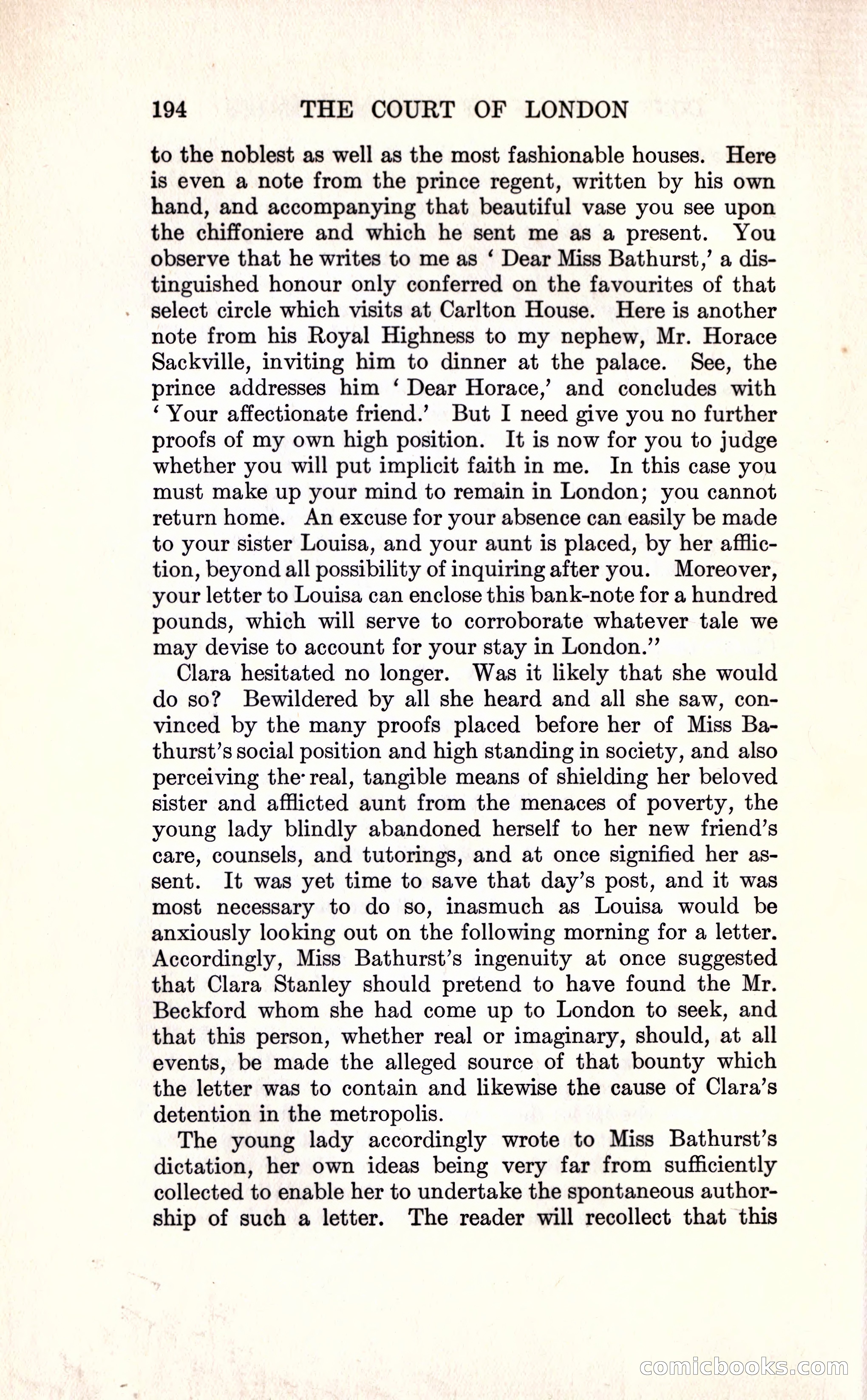
A restored page from Penny Dreadfuls, 1860. Page through the whole issue in the reader above.
📄 Transcribed text from this page (OCR, searchable)
Machine-transcribed from the original scan — historical spelling and the odd misread are preserved.
194 THE COURT OF LONDON to the noblest as well as the most fashionable houses. Here is even a note from the prince regent, written by his own hand, and accompanying that beautiful vase you see upon the chiffoniere and which he sent me as a present. You observe that he writes to me as ‘ Dear Miss Bathurst,’ a dis- tinguished honour only conferred on the favourites of that select circle which visits at Carlton House. Here is another note from his Royal Highness to my nephew, Mr. Horace Sackville, inviting him to dinner at the palace. See, the prince addresses him ‘ Dear Horace,’ and concludes with ‘Your affectionate friend.’ But I need give you no further proofs of my own high position. It is now for you to judge whether you will put implicit faith in me. In this case you must make up your mind to remain in London; you cannot return home. An excuse for your absence can easily be made to your sister Louisa, and your aunt is placed, by her afflic- tion, beyond all possibility of inquiring after you. Moreover, your letter to Louisa can enclose this bank-note for a hundred pounds, which will serve to corroborate whatever tale we may devise to account for your stay in London.” Clara hesitated no longer. Was it likely that she would do so? Bewildered by all she heard and all she saw, con- vinced by the many proofs placed before her of Miss Ba- thurst’s social position and high standing in society, and also perceiving the: real, tangible means of shielding her beloved sister and afflicted aunt from the menaces of poverty, the young lady blindly abandoned herself to her new friend’s care, counsels, and tutorings, and at once signified her as- sent. It was yet time to save that day’s post, and it was most necessary to do so, inasmuch as Louisa would be anxiously looking out on the following morning for a letter. Accordingly, Miss Bathurst’s ingenuity at once suggested that Clara Stanley should pretend to have found the Mr. Beckford whom she had come up to London to seek, and that this person, whether real or imaginary, should, at all events, be made the alleged source of that bounty which the letter was to contain and likewise the cause of Clara’s detention in the metropolis. The young lady accordingly wrote to Miss Bathurst’s dictation, her own ideas being very far from sufficiently collected to enable her to undertake the spontaneous author- ship of such a letter. The reader will recollect that this Conmnicloookks (C(O) iin