
Penny Dreadfuls, 1860 · page 231 of 400
The Mysteries of the Court of London — page 231: what you’re looking at
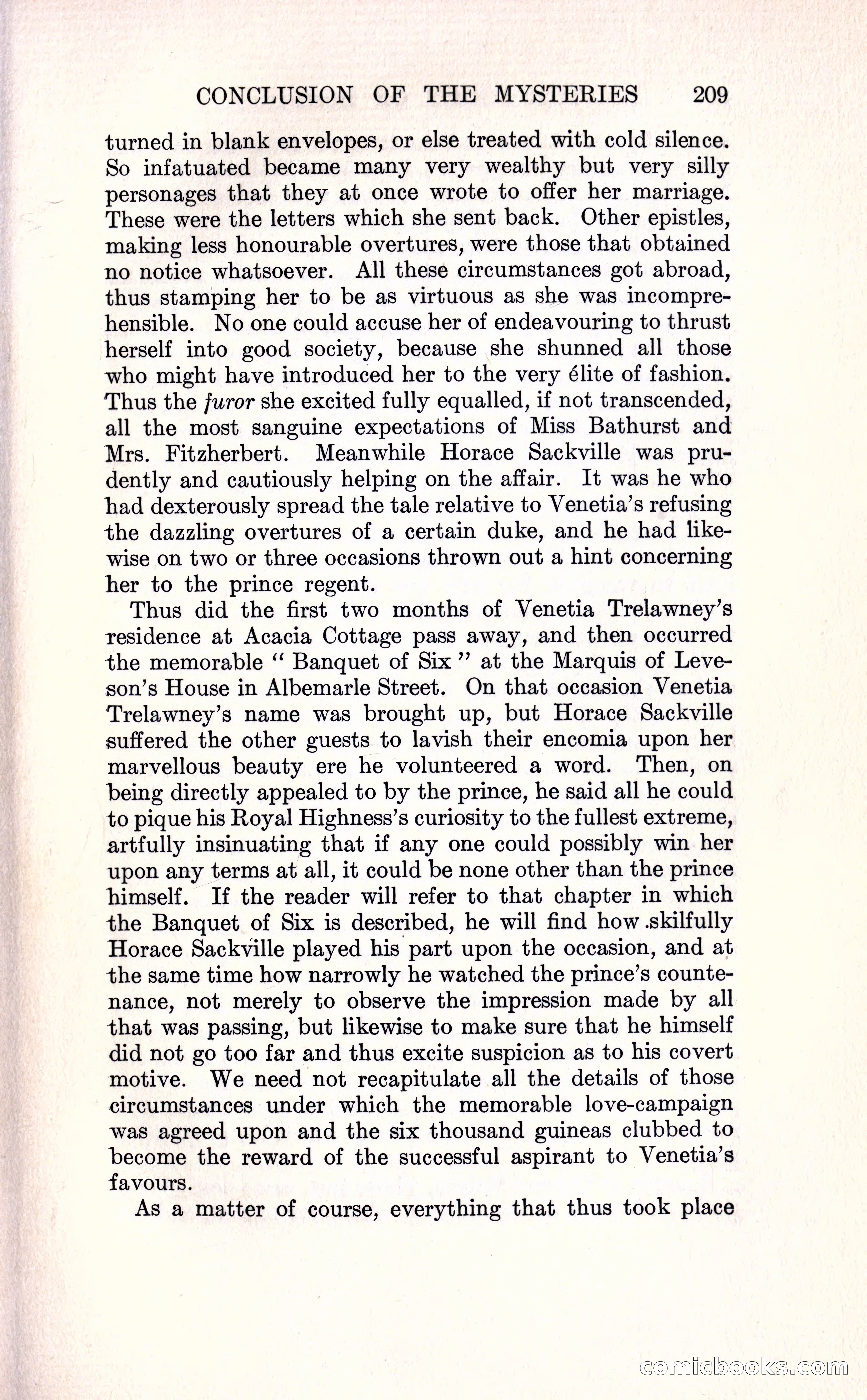
A restored page from Penny Dreadfuls, 1860. Page through the whole issue in the reader above.
📄 Transcribed text from this page (OCR, searchable)
Machine-transcribed from the original scan — historical spelling and the odd misread are preserved.
CONCLUSION OF THE MYSTERIES 209 turned in blank envelopes, or else treated with cold silence. So infatuated became many very wealthy but very silly personages that they at once wrote to offer her marriage. These were the letters which she sent back. Other epistles, making less honourable overtures, were those that obtained no notice whatsoever. All these circumstances got abroad, thus stamping her to be as virtuous as she was incompre- hensible. No one could accuse her of endeavouring to thrust herself into good society, because she shunned all those who might have introduced her to the very élite of fashion. Thus the furor she excited fully equalled, if not transcended, all the most sanguine expectations of Miss Bathurst and Mrs. Fitzherbert. Meanwhile Horace Sackville was pru- dently and cautiously helping on the affair. It was he who had dexterously spread the tale relative to Venetia’s refusing the dazzling overtures of a certain duke, and he had like- wise on two or three occasions thrown out a hint concerning her to the prince regent. Thus did the first two months of Venetia Trelawney’s residence at Acacia Cottage pass away, and then occurred the memorable ‘“‘ Banquet of Six ”’ at the Marquis of Leve- son’s House in Albemarle Street. On that occasion Venetia Trelawney’s name was brought up, but Horace Sackville suffered the other guests to lavish their encomia upon her marvellous beauty ere he volunteered a word. Then, on being directly appealed to by the prince, he said all he could to pique his Royal Highness’s curiosity to the fullest extreme, artfully insinuating that if any one could possibly win her upon any terms at all, it could be none other than the prince himself. If the reader will refer to that chapter in which the Banquet of Six is described, he will find how skilfully Horace Sackville played his part upon the occasion, and at the same time how narrowly he watched the prince’s counte- nance, not merely to observe the impression made by all that was passing, but likewise to make sure that he himself did not go too far and thus excite suspicion as to his covert motive. We need not recapitulate all the details of those circumstances under which the memorable love-campaign was agreed upon and the six thousand guineas clubbed to become the reward of the successful aspirant to Venetia’s favours. As a matter of course, everything that thus took place (CS) nn) Goo So!