
Penny Dreadfuls, 1860 · page 345 of 400
The Mysteries of the Court of London — page 345: what you’re looking at
A restored page from Penny Dreadfuls, 1860. Page through the whole issue in the reader above.
📄 Transcribed text from this page (OCR, searchable)
Machine-transcribed from the original scan — historical spelling and the odd misread are preserved.
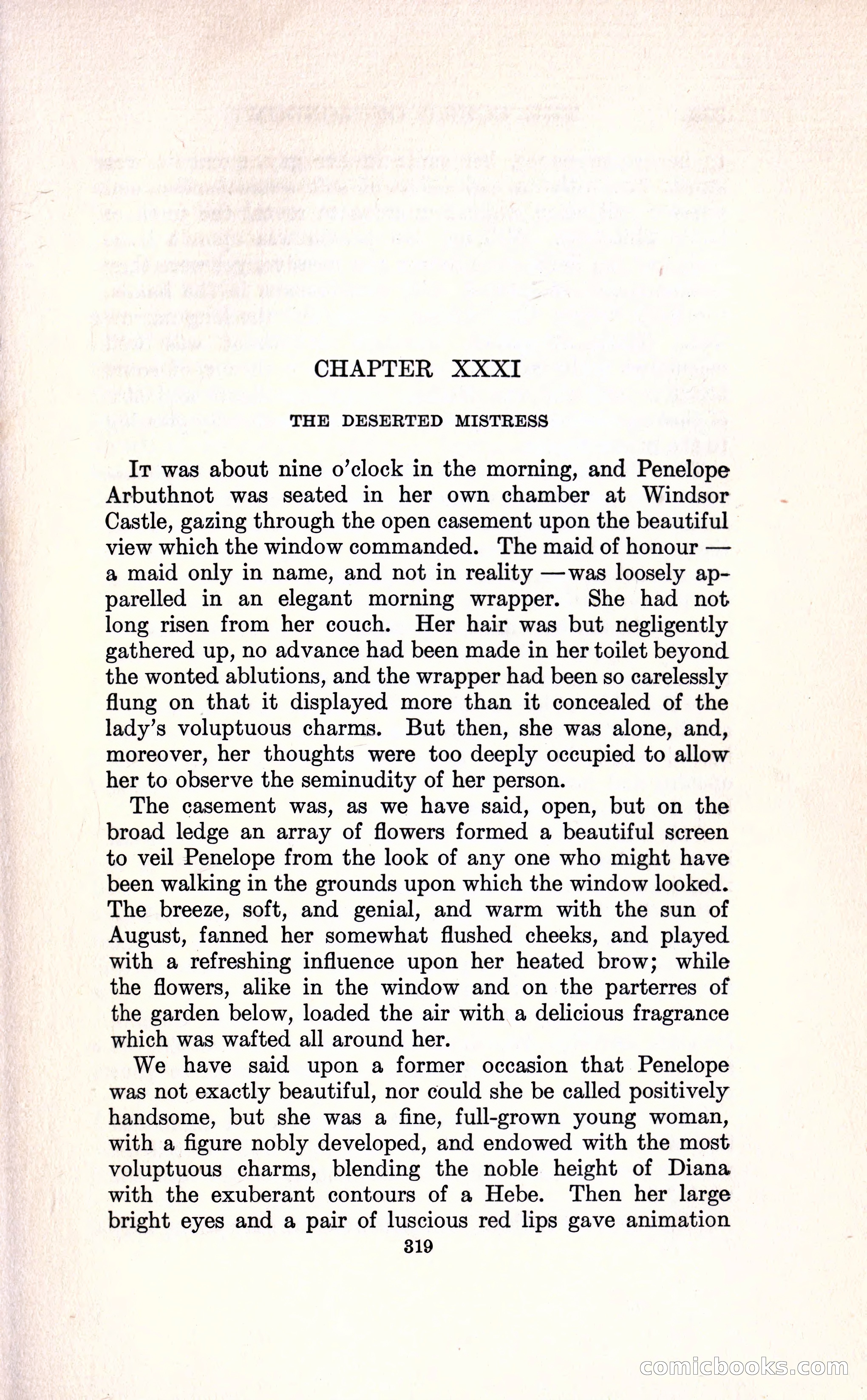
CHAPTER XXXI THE DESERTED MISTRESS It was about nine o’clock in the morning, and Penelope Arbuthnot was seated in her own chamber at Windsor Castle, gazing through the open casement upon the beautiful view which the window commanded. The maid of honour — a maid only in name, and not in reality —was loosely ap- parelled in an elegant morning wrapper. She had not long risen from her couch. Her hair was but negligently gathered up, no advance had been made in her toilet beyond the wonted ablutions, and the wrapper had been so carelessly flung on that it displayed more than it concealed of the lady’s voluptuous charms. But then, she was alone, and, moreover, her thoughts were too deeply occupied to allow her to observe the seminudity of her person. The casement was, as we have said, open, but on the broad ledge an array of flowers formed a beautiful screen to veil Penelope from the look of any one who might have been walking in the grounds upon which the window looked. The breeze, soft, and genial, and warm with the sun of August, fanned her somewhat flushed cheeks, and played with a refreshing influence upon her heated brow; while the flowers, alike in the window and on the parterres of the garden below, loaded the air with a delicious fragrance which was wafted all around her. We have said upon a former occasion that Penelope was not exactly beautiful, nor could she be called positively handsome, but she was a fine, full-grown young woman, with a figure nobly developed, and endowed with the most voluptuous charms, blending the noble height of Diana with the exuberant contours of a Hebe. Then her large bright eyes and a pair of luscious red lips gave animation 3819 (C(O) nn) (C 0)(0)©) <Si nin