
Penny Dreadfuls, 1860 · page 387 of 400
The Mysteries of the Court of London — page 387: what you’re looking at
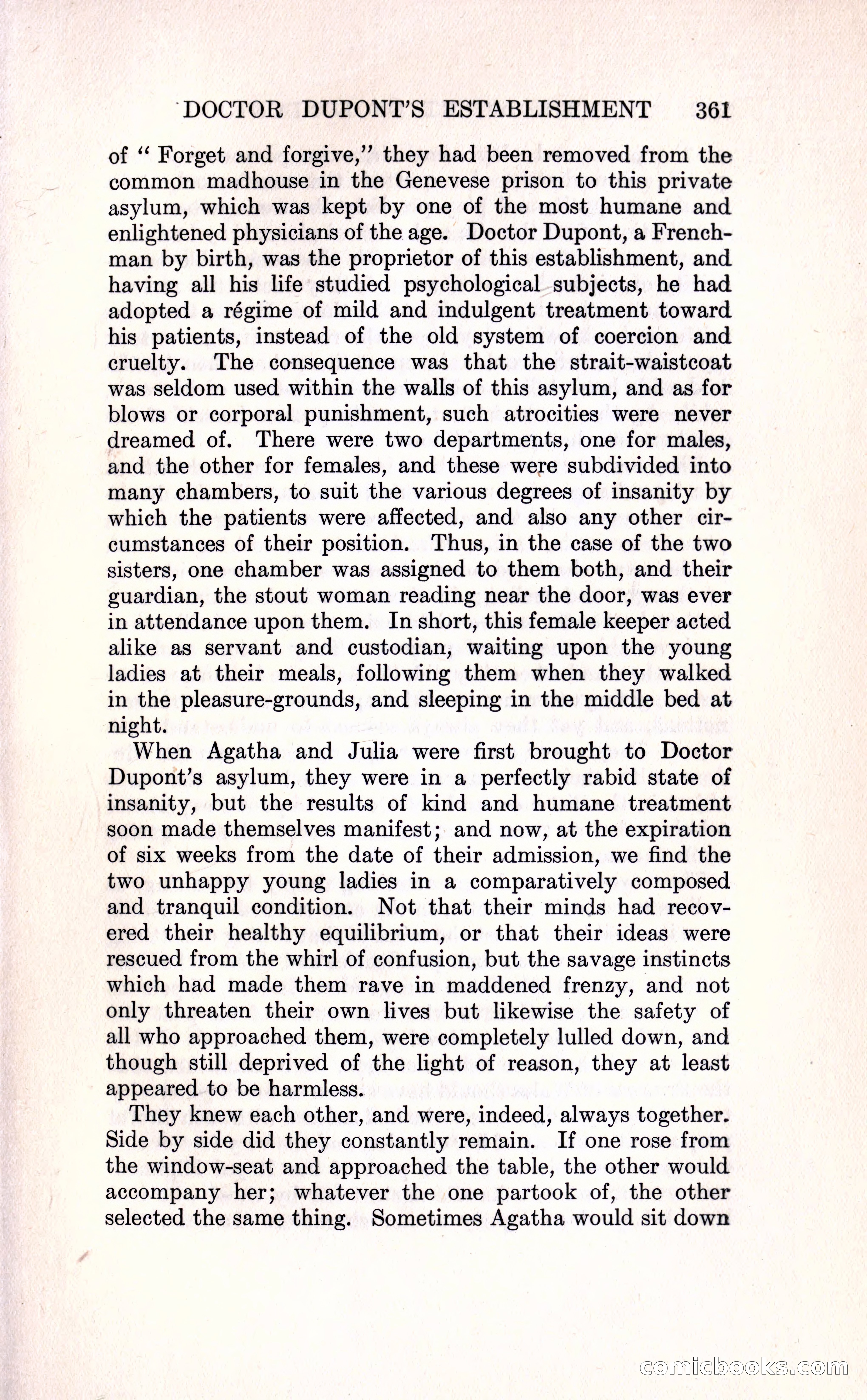
A restored page from Penny Dreadfuls, 1860. Page through the whole issue in the reader above.
📄 Transcribed text from this page (OCR, searchable)
Machine-transcribed from the original scan — historical spelling and the odd misread are preserved.
“DOCTOR DUPONT’S ESTABLISHMENT — 361 of ‘“‘ Forget and forgive,’ they had been removed from the common madhouse in the Genevese prison to this private asylum, which was kept by one of the most humane and enlightened physicians of the age. Doctor Dupont, a French- man by birth, was the proprietor of this establishment, and having all his life studied psychological subjects, he had adopted a régime of mild and indulgent treatment toward his patients, instead of the old system of coercion and cruelty. The consequence was that the strait-waistcoat was seldom used within the walls of this asylum, and as for blows or corporal punishment, such atrocities were never dreamed of. There were two departments, one for males, and the other for females, and these were subdivided into many chambers, to suit the various degrees of insanity by which the patients were affected, and also any other cir- cumstances of their position. Thus, in the case of the two sisters, one chamber was assigned to them both, and their guardian, the stout woman reading near the door, was ever in attendance upon them. In short, this female keeper acted alike as servant and custodian, waiting upon the young ladies at their meals, following them when they walked in the pleasure-grounds, and sleeping in the middle bed at night. When Agatha and Julia were first brought to Doctor Dupont’s asylum, they were in a perfectly rabid state of insanity, but the results of kind and humane treatment soon made themselves manifest; and now, at the expiration of six weeks from the date of their admission, we find the two unhappy young ladies in a comparatively composed and tranquil condition. Not that their minds had recov- ered their healthy equilibrium, or that their ideas were rescued from the whirl of confusion, but the savage instincts which had made them rave in maddened frenzy, and not only threaten their own lives but likewise the safety of all who approached them, were completely lulled down, and though still deprived of the light of reason, they at least appeared to be harmless. They knew each other, and were, indeed, always together. Side by side did they constantly remain. If one rose from the window-seat and approached the table, the other would accompany her; whatever the one partook of, the other selected the same thing. Sometimes Agatha would sit down (C(O) nn) (C 0)(0)©) <Si