
Penny Dreadfuls, 1849 · page 107 of 394
The Mysteries of the Court of London — page 107: what you’re looking at
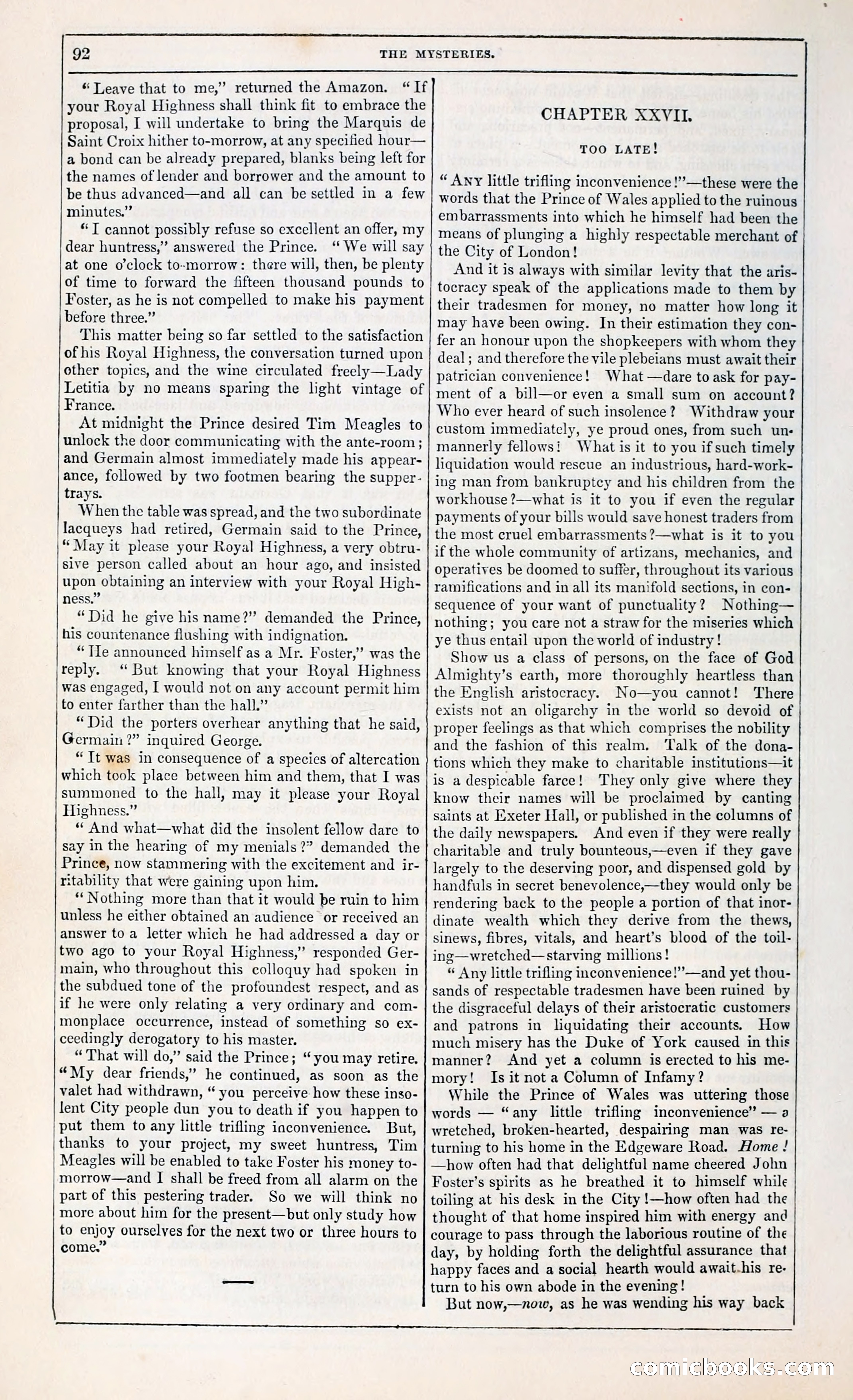
A restored page from Penny Dreadfuls, 1849. Page through the whole issue in the reader above.
📄 Transcribed text from this page (OCR, searchable)
Machine-transcribed from the original scan — historical spelling and the odd misread are preserved.
‘ Leave that to me,’ returned the Amazon. proposal, I will undertake to bring the Marquis de Saint Croix hither to-morrow, at any specified hour— a bond can be already prepared, blanks being left for the names of lender and borrower and the amount to be thus advanced—and all can be settled in a few minutes.” *T cannot possibly refuse so excellent an offer, my dear huntress,”’ answered the Prince. ‘“ We will say at one o'clock to-morrow: there will, then, be plenty of time to forward the fifteen thousand pounds to Foster, as he is not compelled to make his payment before three.” This matter being so far settled to the satisfaction of his Royal Highness, the conversation turned upon other topics, and the wine circulated freely—Lady Letitia by no means sparing the light vintage of France. At midnight the Prince desired Tim Meagles to unlock the door communicating with the ante-room ; and Germain almost immediately made his appear- ance, followed by two footmen bearing the supper- trays. ‘When the table was spread, and the two subordinate lacqueys had retired, Germain said to the Prince, “May it please your Royal Highness, a very obtru- sive person called about an hour ago, and insisted upon obtaining an interview with your Royal High- ness.” “Did he give his name?” demanded the Prince, his countenance flushing with indignation. “ Te announced himself as a Mr. Foster,’ was the reply. “ But knowing that your Royal Highness was engaged, I would not on any account permit him to enter farther than the hall.” “Did the porters overhear anything that he said, Germain ?” inquired George. “It was in consequence of a species of altercation which took place between him and them, that I was summoned to the hall, may it please your Royal Highness.” “* And what—what did the insolent fellow dare to say in the hearing of my menials?” demanded the Prince, now stammering with the excitement and ir- ritability that were gaining upon him. “Nothing more than that it would be ruin to him unless he either obtained an audience or received an answer to a letter which he had addressed a day or two ago to your Royal Highness,” responded Ger- main, who throughout this colloquy had spoken in the subdued tone of the profoundest respect, and as if he were only relating a very ordinary and com- monplace occurrence, instead of something so ex- ceedingly derogatory to his master. “That will do,” said the Prince; “you may retire. “My dear friends,” he continued, as soon as the valet had withdrawn, “ you perceive how these inso- lent City people dun you to death if you happen to put them to any little trifling inconvenience. But, thanks to your project, my sweet huntress, Tim Meagles will be enabled to take Foster his money to- morrow—and I shall be freed from all alarm on the part of this pestering trader. So we will think no more about him for the present—but only study how to enjoy ourselves for the next two or three hours to come.” 66 If your Royal Highness shall think fit to embrace the THE MYSTERIES. CHAPTER XXVIIL TOO LATE! “ Any little trifling inconvenience !””—these were the words that the Prince of Wales applied to the ruinous embarrassments into which he himself had been the means of plunging a highly respectable merchant of the City of London! And it is always with similar levity that the aris- tocracy speak of the applications made to them by their tradesmen for money, no matter how long it may have been owing. In their estimation they con- fer an honour upon the shopkeepers with whom they deal ; and therefore the vile plebeians must await their patrician convenience! What —dare to ask for pay- ment of a bill—or even a small sum on account? Who ever heard of such insolence? Withdraw your custom immediately, ye proud ones, from such uns mannerly fellows! What is it to you if such timely liquidation would rescue an industrious, hard-work- ing man from bankruptcy and his children from the workhouse ?—what is it to you if even the regular payments of your bills would save honest traders from the most cruel embarrassments ?—what is it to you if the whole community of artizans, mechanics, and operatives be doomed to suffer, throughout its various ramifications and in all its manifold sections, in con- sequence of your want of punctuality? Nothing— nothing; you care not a straw for the miseries which ye thus entail upon the world of industry! Show us a class of persons, on the face of God Almighty’s earth, more thoroughly heartless than the English aristocracy. No—you cannot! There exists not an oligarchy in the world so devoid of proper feelings as that which comprises the nobility and the fashion of this realm. ‘Talk of the dona- tions which they make to charitable institutions—it is a despicable farce! They only give where they know their names will be proclaimed by canting saints at Exeter Hall, or published in the columns of the daily newspapers. And even if they were really charitable and truly bounteous,—even if they gave largely to the deserving poor, and dispensed gold by handfuls in secret benevolence,—they would only be rendering back to the people a portion of that inor- dinate wealth which they derive from the thews, sinews, fibres, vitals, and heart’s blood of the toil- ing—wretched— starving millions! “ Any little trifling inconvenience!”—and yet thou- sands of respectable tradesmen have been ruined by the disgraceful delays of their aristocratic customers and patrons in liquidating their accounts. How much misery has the Duke of York caused in this manner? And yet a column is erected to his me- mory! Is it not a Column of Infamy? While the Prince of Wales was uttering those words — “any little trifling inconvenience” — a wretched, broken-hearted, despairing man was re- turning to his home in the Edgeware Road. Home ! —how often had that delightful name cheered John Foster’s spirits as he breathed it to himself while toiling at his desk in the City !—how often had the thought of that home inspired him with energy and courage to pass through the laborious routine of the day, by holding forth the delightful assurance that happy faces and a social hearth would await-his re- turn to his own abode in the evening! But now,—now, as he was wending his way back a i COLMA EloOOKS. EO