
Penny Dreadfuls, 1849 · page 114 of 394
The Mysteries of the Court of London — page 114: what you’re looking at
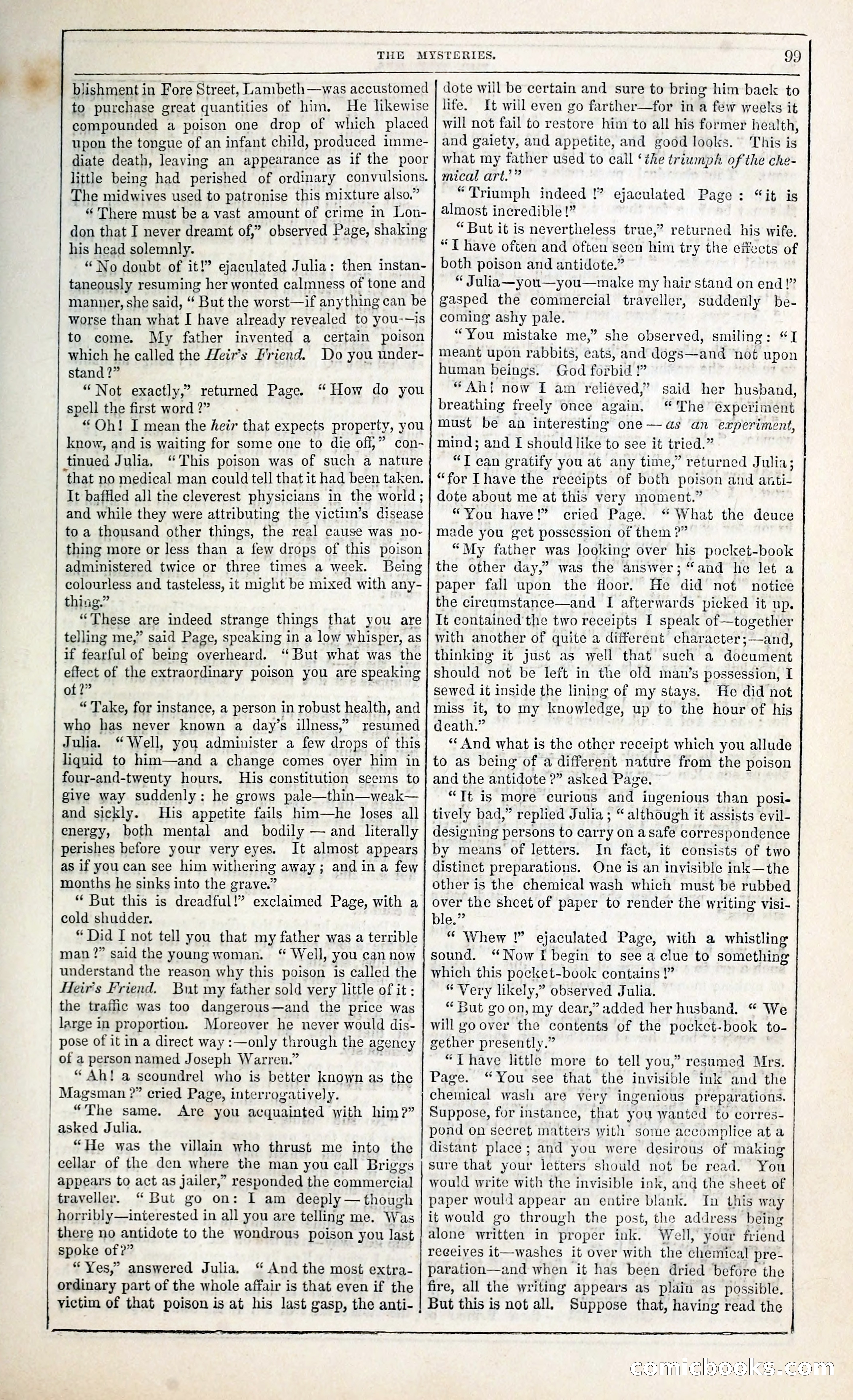
A restored page from Penny Dreadfuls, 1849. Page through the whole issue in the reader above.
📄 Transcribed text from this page (OCR, searchable)
Machine-transcribed from the original scan — historical spelling and the odd misread are preserved.
THE MYSTERIES. blishment in Fore Street, Lanibeth—was accustomed to purchase great quantities of him. He likewise compounded a poison one drop of which placed upon the tongue of an infant child, produced imme- diate death, Teayi ing an appearance as if the poor little being had perished of ordinary convulsions. The midwives used to patronise this mixture also.” _ There must be a vast amount of crime in Lon- don that I never dreamt of,” observed Page, shaking his head solemnly. “No doubt of it!” ejaculated Julia: then instan- taneously resuming her wonted calmness of tone and manner, she said, “ But the worst—if anything can be worse than what I have already revealed to you-—is to come. My father invented a certain poison which he called the Heir’s Friend. Do you under- stand ?” “ Not exactly,” returned Page. spell the first word ?” “ Oh! I mean the heir that expects property, you know, and is waiting for some one to die off,” con- tinued Julia, “ This poison was of such a nature ‘that no medical man could tell that it had been taken. It baffled all the cleverest physicians in the world; and while they were attributing the victim’s disenee to a thousand other things, the real cause was ho- thing more or less than a few drops of this poison administered twice or three times a week. Being colourless and tasteless, it might be mixed with any- thing.” “These are indeed strange things that you are telling me,” said Page, speaking in a low whisper, as if fearfulof being overheard. ‘“ But what was the effect of the extraordinary poison you are speaking of ?” “ Take, for instance, a person in robust health, and who has never known a day’s illness,” resumed Julia. “Well, you administer a few drops of this liquid to him—and a change comes over him in four-and-twenty hours. His constitution seems to give way suddenly: he grows pale—thin—weak— and sickly. His appetite fails him—he loses all energy, both mental and bodily — and literally perishes before your very eyes. It almost appears as if you can see him withering away; and in a few months he sinks into the grave.” “ But this is dreadful!” exclaimed Page, with a cold shudder. “ Did I not tell you that my father was a terrible man?” said the young woman. “ Well, you can now understand the reason why this poison is called the feir's Friend. But my father sold very little of it: the traffic was too dangerous—and the price was large in proportion. Moreover he never would dis- pose of it in a direct way :—only through the agency of a person named Joseph Warren.” “Ah! a scoundrel who is better known as the Magsman ?” cried Page, interrogatively. eel The same. Are you acquainted with him?” asked Julia. “How do you “He was the villain who thrust me into the cellar of the den where the man you call Briggs appears to act as jailer,” responded the commercial traveller. “ But go on: I am deeply — though horribly—interested in all you are telling me. Was there no antidote to the wondrous poison you last spoke of 2?” “Yes,” answered Julia. “ And the most extra- ordinary part of the whole affair is that even if the victim of that poison is at his last gasp, the anti- 99 dote will be certain and sure to bring him back to life. It will even go farther—for in a few weeks it will not fail to restore him to all his former health, and gaiety, and appetite, and good looks.” This is what my father used to call ‘the triumph of the che- mical art.’” “Triumph indeed !” ejaculated Page : almost incredible!” “ But it is nevertheless true,” returned his wife. “IT have often and often seen him try the effects of both poison and antidote.” * Julia—you—you—make my hair stand on end!” gasped the commercial traveller, suddenly be- coming ashy pale. “You mistake me,” she observed, smiling: “I meant upon rabbits, cats, and dog sand not upon human beings. God forbid !” “Ahi now I am relieved,’ said her husband, breatuing freely once again, “The experiment must be an interesting one—as an experiment, mind; and I should like to see it tried.” “I can gratify you at any time,” returned Julia; “for [have the receipts of both poison and anti- dote about me at this very moment.” “You have!” cried Page. ™ What the deuce made you get possession of them ?” “My father was looking over his pocket-book the other day,” was the answer; “and he let a paper fall upon the floor. He did not notice the circumstance—and I afterwards picked it up. It contained the two receipts I speak of—together with another of quite a different character;—and, thinking it just as well that such a document should not be left in the old man’s possession, I sewed it inside the lining of my stays. He did not miss it, to my knowledge, up to the hour of his death.” ‘And what is the other receipt which you allude to as being of a different nature from the poison ee the antidote >” asked Page. “It is more curious and ingenious than posi- tively bad,” replied Julia ; “ although It assists eyvil- desiguing persons to carry ona safe correspondence by means of letters. In fact, it consists of two distinct preparations. One is an invisible ink—the other is the chemical wash which must be rubbed over the sheet of paper to render the writing visi- ble.” “ Whew !” ejaculated Page, with a whistling sound. “Now I begin to see a clue to something which this pocket-book contains !” “Very likely,” observed Julia. “ But goon, my dear,’ added her husband. “ We will goover the contents of the pocket-book to- gether presently.” “{ have little more to tell you,” resumed Mrs. Page. “You see that the invisible ink and the chemical wash are very ingenious preparations. Suppose, for instance, that you wanted to corres- pond on secret matters with some accomplice ata distant place; and you were desirous of making sure that your letters should not be read. You would write with the invisible ink, and the sheet of paper would appear an eutire blank. In this way it would go through the post, the address being alone written in proper ink. Well, your friend receives it—washes it over with the chemical pre- paration—and when it has been dried before the fire, all the writing appears as plain as possible. But this is not all. Suppose that, having read the “it is Clooolks. conn com