
Penny Dreadfuls, 1849 · page 116 of 394
The Mysteries of the Court of London — page 116: what you’re looking at
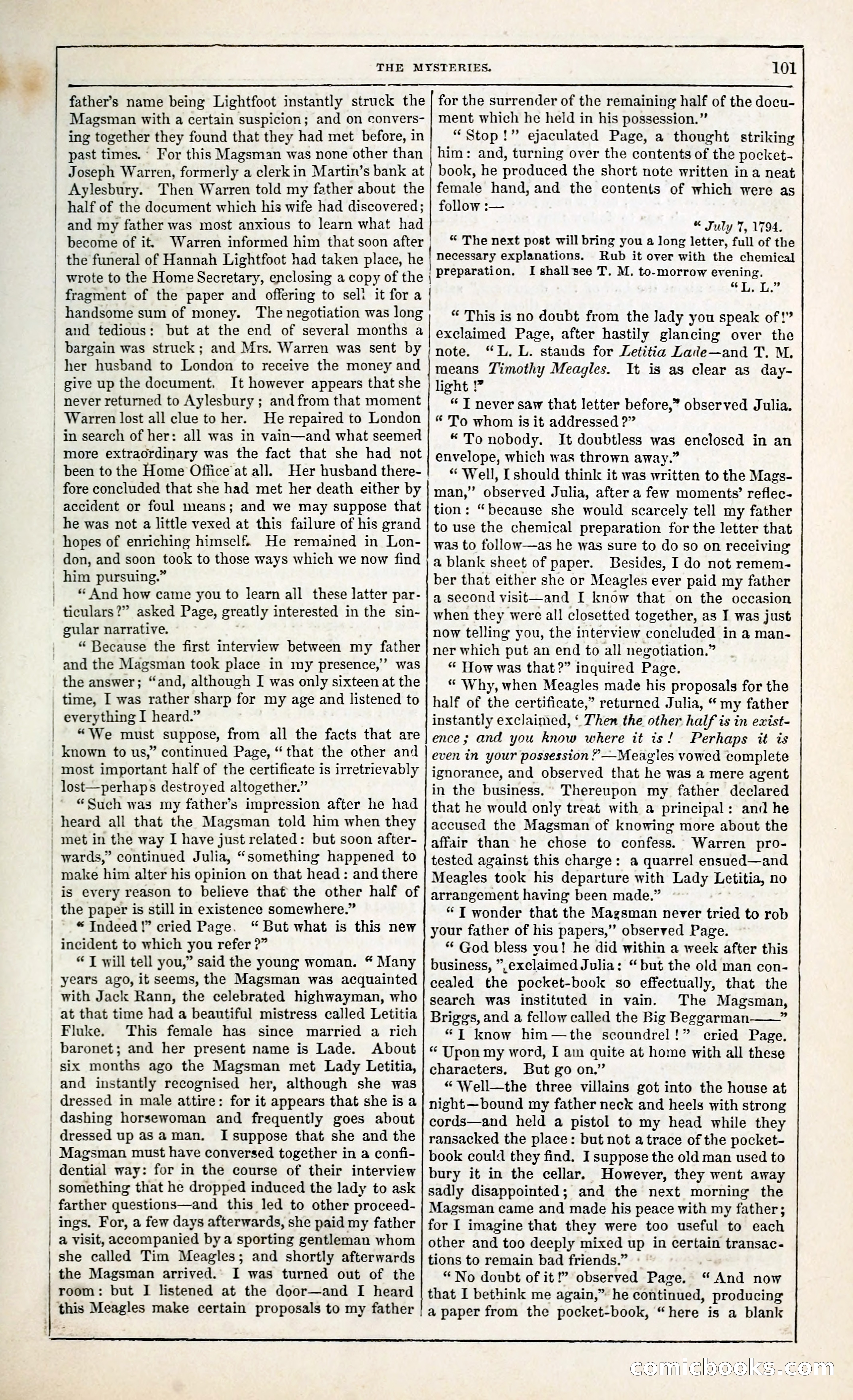
A restored page from Penny Dreadfuls, 1849. Page through the whole issue in the reader above.
📄 Transcribed text from this page (OCR, searchable)
Machine-transcribed from the original scan — historical spelling and the odd misread are preserved.
THE MYSTERIES. father’s name being Lightfoot instantly struck the Magsman with a certain suspicion; and on convers- ing together they found that they had met before, in past times. For this Magsman was none other than Joseph Warren, formerly a clerk in Martin’s bank at Aylesbury. Then Warren told my father about the half of the document which his wife had discovered; and my father was most anxious to learn what had become of it. Warren informed him that soon after the funeral of Hannah Lightfoot had taken place, he wrote to the Home Secretary, fragment of the paper and offering to seli it for a handsome sum of money. The negotiation was long and tedious: but at the end of several months a bargain was struck; and Mrs. Warren was sent by her husband to London to receive the money and give up the document, It however appears that she never returned to Aylesbury ; and from that moment Warren lost all clue to her. He repaired to London in search of her: all was in vain—and what seemed more extraordinary was the fact that she had not been to the Home Office’at all. Her husband there- fore concluded that she had met her death either by accident or foul means; and we may suppose that _he was not a little vexed at this failure of his grand hopes of enriching himself. He remained in Lon- don, and soon took to those ways which we now find him pursuing.” “ And how came you to learn all these latter par- ticulars?” asked Page, greatly interested in the sin- gular narrative. “ Because the first interview between my father and the Magsman took place in my presence,” was the answer; “and, although I was only sixteen at the time, I was rather sharp for my age and listened to everything I heard.” “We must suppose, from all the facts that are known to us,” continued Page, “that the other and _most important half of the certificate is irretrievably _lost—perhaps destroyed altogether.” “Such was my father’s impression after he had heard all that the Magsman told him when they met in the way I have just related: but soon after- wards,” continued Julia, “something happened to make him alter his opinion on that head: and there is every reason to believe that the other half of the paper is still in existence somewhere.” “Indeed!” cried Page. “ But what is this new _ incident to which you refer ?” * J will tell you,” said the young woman. * Many years ago, it seems, the Magsman was acquainted with Jack Rann, the celebrated highwayman, who at that time had a beautiful mistress called Letitia Fluke. This female has since married a rich baronet; and her present name is Lade. About six months ago the Magsman met Lady Letitia, and instantly recognised her, although she was dressed in male attire: for it appears that she is a dashing horsewoman and frequently goes about dressed up as a man. I suppose that she and the Magsman must have conversed together in a confi- dential way: for in the course of their interview something that he dropped induced the lady to ask farther questions—and this led to other proceed- “he & rr ings. For, a few days afterwards, she paid my father a visit, accompanied bya sporting gentleman whom she called Tim Meagles; and shortly afterwards the Magsman arrived. I was turned out of the room: but I listened at the door—and I heard this Meagles make certain proposals to my father enclosing a copy of the preparation. 101 for the surrender of the remaining half of the docu- ment which he held in his possession.” “Stop!” ejaculated Page, a thought striking him: and, turning over the contents of the pocket- book, he produced the short note written ina neat female hand, and the contents of which were as follow :— “ July T, 1794. “ The next post will bring you a long letter, full of the necessary explanations. Rub it over with the chemical I shall see T. M. to-morrow evening. 74 L. Li. ” “ This is no doubt from the lady you speak of!” exclaimed Page, after hastily glancing over the note. “L. L. stands for Letitia Lade—and T. M. means Timothy Meagles. It is as clear as day- light !” “ T never saw that letter before,” observed Julia. “To whom is it addressed ?” “To nobody. It doubtless was enclosed in an envelope, which was thrown away.” * Well, [should think it was written to the Mags- man,” observed Julia, after a few moments’ reflec- tion: “because she would scarcely tell my father to use the chemical preparation for the letter that was to follow—as he was sure to do so on receiving a blank sheet of paper. Besides, I do not remem- ber that either she or Meagles ever paid my father a second visit—and I know that on the occasion when they were all closetted together, as I was just now telling you, the interview concluded in a man- ner which put an end to all negotiation.” * How was that?” inquired Page. * Why, when Meagles made his proposals for the half of the certificate,” returned Julia, “ my father instantly exclaimed, ‘ Then the other half is in exist- ence; and you know where it is! Perhaps it is even in your possession ? —Meagles vowed complete ignorance, and observed that he was a mere agent in the business. Thereupon my father declared that he would only treat with a principal: and he accused the Magsman of knowing more about the affair than he chose to confess. Warren pro- tested against this charge: a quarrel ensued—and Meagles took his departure with Lady Letitia, no arrangement having been made.” “T wonder that the Magsman never tried to rob your father of his papers,” observed Page. * God bless vou! he did within a week after this business, ”,exclaimed Julia: “ but the old man con- cealed the pocket-book so effectually, that the search was instituted in vain. The Magsman, Briggs, and a fellow called the Big Beggarman “JT know him—the scoundrel!” cried Page. “ Upon my word, I am quite at home with all these characters. But go on.” “ Well—the three villains got into the house at night—bound my father neck and heels with strong cords—and held a pistol to my head while they ransacked the place: but not a trace of the pocket- book could they find. I suppose the old man used to bury it in the cellar. However, they went away sadly disappointed; and the next morning the Magsman came and made his peace with my father; for I imagine that they were too useful to each other and too deeply mixed up in certain transac- tions to remain bad friends.” - “No doubt of it!” observed Page. “And now that I bethink me again,” he continued, producing a paper from the pocket-book, “here is a blank com Clooolks. conn