
Penny Dreadfuls, 1849 · page 146 of 394
The Mysteries of the Court of London — page 146: what you’re looking at
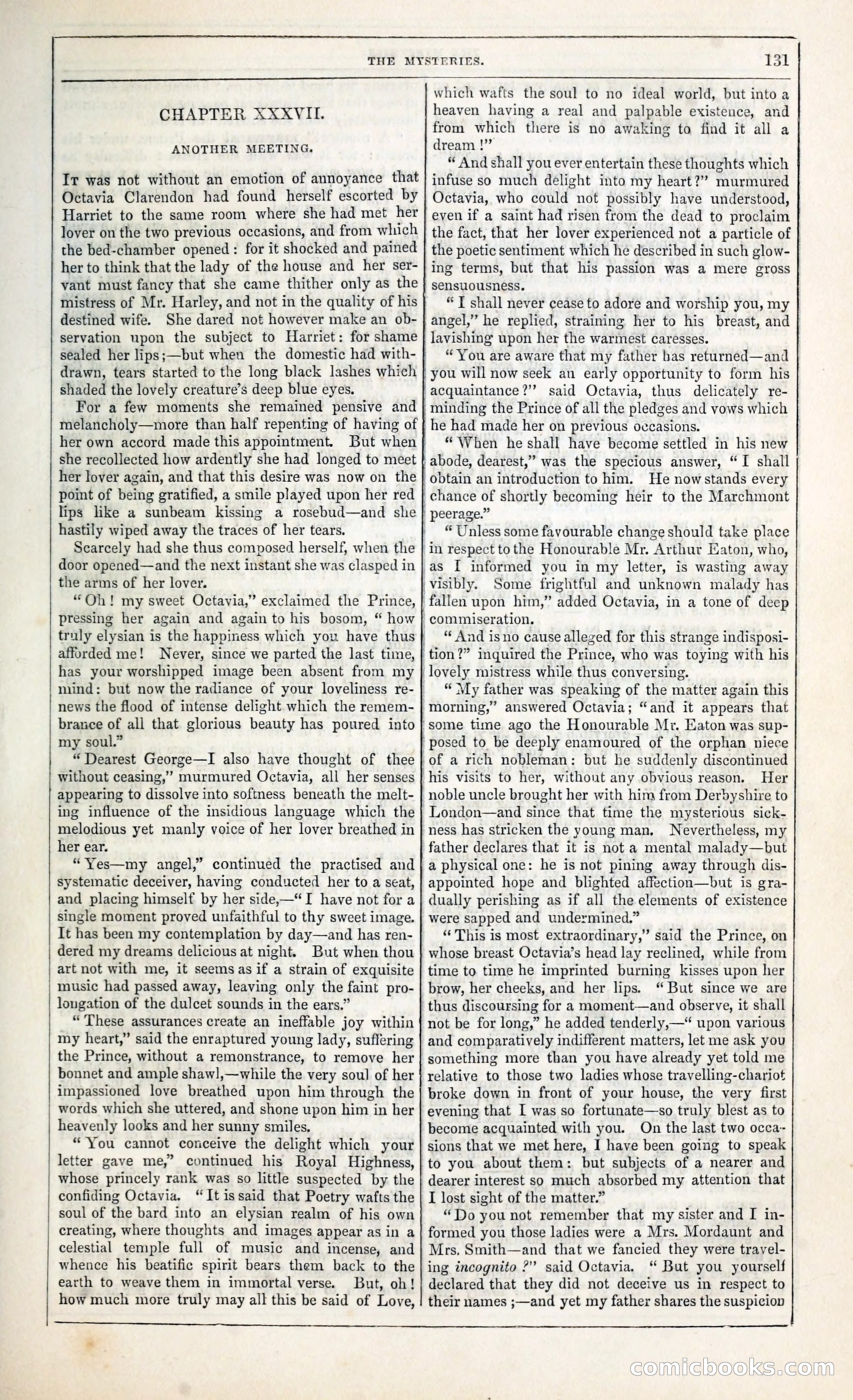
A restored page from Penny Dreadfuls, 1849. Page through the whole issue in the reader above.
📄 Transcribed text from this page (OCR, searchable)
Machine-transcribed from the original scan — historical spelling and the odd misread are preserved.
THE MYSTERIES. 131 CHAPTER XXXVII. ANOTHER MEETING. It was not without an emotion of annoyance that Octavia Clarendon had found herself escorted by Harriet to the same room where she had met her lover on the two previous occasions, and from which the bed-chamber opened: for it shocked and pained her to think that the lady of the house and her ser- yant must fancy that she came thither only as the mistress of Mr. Harley, and not in the quality of his destined wife. She dared not however make an ob- servation upon the subject to Harriet: for shame sealed her lips;—but when the domestic had with- } you will now seek an early opportunity to form his acquaintance ?’’ said Octavia, thus delicately re- minding the Prince of all the pledges and vows which he had made her on previous oecasions. drawn, tears started to the long black lashes which shaded the lovely creature’s deep blue eyes. For a few moments she remained pensive and melancholy—more than half repenting of having of her own accord made this appointment. But when she recollected how ardently she had longed to meet her lover again, and that this desire was now on the point of being gratified, a smile played upon her red lips hke a sunbeam kissing a rosebud—and she hastily wiped away the traces of her tears. Scarcely had she thus composed herself, when the door opened—and the next instant she was clasped in the arms of her lover. “Oh! my sweet Octavia,” exclaimed the Prince, pressing her again and again to his bosom, “ how truly elysian is the happiness which you have thus } tion?” inquired the Prince, who was toying with his lovely mistress while thus conversing. afforded me! Never, since we parted the last time, has your worshipped image been absent from my mind: but now the radiance of your loveliness re- news the flood of intense delight which the remem- brance of all that glorious beauty has poured into my soul.” “ Dearest George—I also have thought of thee without ceasing,” murmured Octavia, all her senses | appearing to dissolve into softness beneath the melt- ing influence of the insidious language which the melodious yet manly voice of her lover breathed in her ear. “Yes—my angel,” continued the practised and systematic deceiver, having conducted her to a seat, and placing himself by her side,—*I have not for a single moment proved unfaithful to thy sweet image. It has been my contemplation by day—and has ren- dered my dreams delicious at night. But when thou art not with me, it seems as if a strain of exquisite music had passed away, leaving only the faint pro- longation of the dulcet sounds in the ears.” “These assurances create an ineffable joy within my heart,” said the enraptured young lady, suffering the Prince, without a remonstrance, to remove her bonnet and ample shaw],—while the very soul of her impassioned love breathed upon him through the words which she uttered, and shone upon him in her heavenly looks and her sunny smiles, “You cannot conceive the delight which your letter gave me,’ continued his Royal Highness, whose princely rank was so little suspected by the confiding Octavia. “Itissaid that Poetry wafts the soul of the bard into an elysian realm of his own creating, where thoughts and images appear as in a celestial temple full of music and incense, and whence his beatific spirit bears them back to the earth to weave them in immortal verse. But, oh! how much more truly may all this be said of Love, eS sp which wafts the soul to no ideal world, but into a heaven having a real and palpable existence, and from which there is no awaking to find it all a dream !” “ And shall you ever entertain these thoughts which infuse so much delight into my heart?” murmured Octavia, who could not possibly have understood, even if a saint had risen from the dead to proclaim the fact, that her lover experienced not a particle of | the poetic sentiment which he described in such glow- ing terms, but that his passion was a mere gross sensuousness. “TI shall never cease to adore and worship you, my angel,” he replied, straining her to his breast, and lavishing upon her the warmest caresses. “You are aware that my father has returned—and “When he shall have become settled in his new /abode, dearest,” was the specious answer, “I shall obtain an introduction to him. He nowstands every chance of shortly becoming heir to the Marchmont ' peerage.” “ Unless some favourable change should take place in respect tothe Honourable Mr. Arthur Eaton, who, as I informed you in my letter, is wasting away visibly. Some frightful and unknown malady has fallen upon him,” added Octavia, in a tone of deep /commiseration. ‘And isno cause alleged for this strange indisposi- “ My father was speaking of the matter again this morning,’ answered Octavia; “and it appears that “some time ago the Honourable Mr. Eaton was sup- posed to be deeply enamoured of the orphan niece of a rich nobleman: but he suddenly discontinued his visits to her, without any obvious reason. Her noble uncle brought her with him from Derbyshire to London—and since that time the mysterious sick- ness has stricken the young man, Nevertheless, my father declares that it is not a mental malady—but a physical one: he is not pining away through dis- appointed hope and blighted affection—but is gra- dually perishing as if all the elements of existence were sapped and undermined,” “This is most extraordinary,” said the Prince, on whose breast Octavia’s head lay reclined, while from time to time he imprinted burning kisses upon her brow, her cheeks, and her lips. “ But since we are thus discoursing for a moment—and observe, it shall not be for long,” he added tenderly,—* upon various and comparatively indifferent matters, let me ask you something more than you have already yet told me relative to those two ladies whose travelling-chariot broke down in front of your house, the very first evening that I was so fortunate—so truly blest as to become acquainted with you. On the last two occa- sions that we met here, I have been going to speak to you about them: but subjects of a nearer and dearer interest so much absorbed my attention that I lost sight of the matter.” “Do you not remember that my sister and [ in- formed you those ladies were a Mrs. Mordaunt and Mrs, Smith—and that we fancied they were trayel- ing incognito ?” said Octavia, “ But you yourself declared that they did not deceive us in respect to their names ;—and yet my father shares the suspicion Com Clooolks.,. conn