
Penny Dreadfuls, 1849 · page 149 of 394
The Mysteries of the Court of London — page 149: what you’re looking at
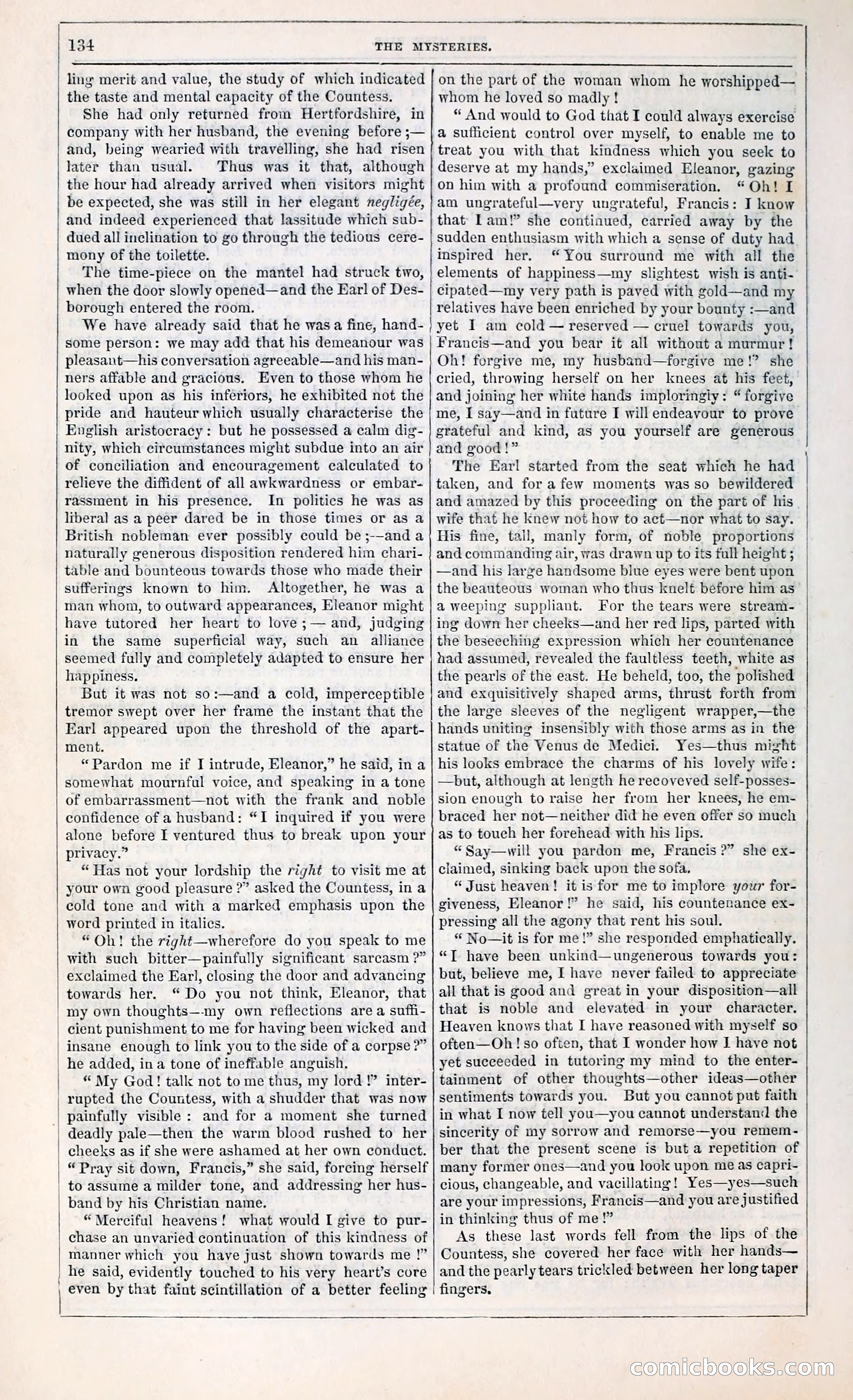
A restored page from Penny Dreadfuls, 1849. Page through the whole issue in the reader above.
📄 Transcribed text from this page (OCR, searchable)
Machine-transcribed from the original scan — historical spelling and the odd misread are preserved.
a a A A A A A a a 134 ling merit and value, the study of which indicated the taste and mental capacity of the Countess. She had only returned from Hertfordshire, in company with her husband, the evening before ;— and, being wearied with travelling, she had risen later than usual. Thus was it that, although the hour had already arrived when visitors might be expected, she was still in her elegant negligée, and indeed experienced that lassitude which sub- dued all inclination to go through the tedious cere- mony of the toilette. The time-piece on the mantel had struck two, when the door slowly opened—and the Earl of Des- borough entered the room. We have already said that he was a fine, hand- some person: we may add that his demeanour was pleasant—his conversation agreeable—and his man- ners affable and gracious. Even to those whom he looked upon as his inferiors, he exhibited not the pride and hauteur which usually characterise the English aristocracy: but he possessed a calm dig- nity, which circumstances might subdue into an air of conciliation and encouragement ealculated to relieve the diffident of all awkwardness or embar- rassment in his presence. In politics he was as liberal as a peer dared be in those times or as a British nobleman ever possibly could be ;--and a naturally generous disposition rendered him chari- table and bounteous towards those who made their sufferings known to him. Altogether, he was a man whom, to outward appearances, Eleanor might have tutored her heart to love ;— and, judging in the same superficial way, such an alliance seemed fully and completely adapted to ensure her happiness. But it was not so:—and a cold, imperceptible tremor swept over her frame the instant that the Earl appeared upon the threshold of the apart- ment. “Pardon me if I intrude, Eleanor,” he said, in a somewhat mournful voice, and speaking in a tone of embarrassment—not with the frank and noble confidence of a husband: “I inquired if you were alone before I ventured thus to break upon your privacy.” “Has not your lordship the right to visit me at your own good pleasure ?” asked the Countess, in a cold tone and with a marked emphasis upon the word printed in italics. “Oh! the right—wherefore do you speak to me with such bitter—painfully significant sarcasm ?” exclaimed the Earl, closing the door and advancing towards her. “ Do you not think, Eleanor, that my own thoughts—-my own reflections area suffi- cient punishment to me for having been wicked and | insane enough to link you to the side of a corpse ?” he added, in a tone of ineffable anguish, * My God! talk not to me thus, my lord !” inter- rupted the Countess, with a shudder that was now painfully visible : and for a moment she turned deadly pale—then the warm blood rushed to her cheeks as if she were ashamed at her own conduct. “Pray sit down, Francis,” she said, forcing herself _to assume a milder tone, and addressing her hus- band by his Christian name. “Merciful heavens! what would I give to pur- chase an unvaried continuation of this kindness of manner which you have just shown towards me !” he said, evidently touched to his very heart’s core | even by that faint scintillation of a better feeling A a a = Sa SN a once veneer hanes er AM A a a a aI TS a a as aaa << —— THE MYSTERIES, on the part of the woman whom he worshipped— whom he loved so madly! “ And would to God that I could always exercise a sufficient control over myself, to enable me to treat you with that kindness which you seek to deserve at my hands,” exclaimed Eleanor, gazing on him with a profound commiseration. “Oh! I am ungrateful—very ungrateful, Francis: I know that Lam!” she continued, carried away by the sudden enthusiasm with which a sense of duty had Inspired her. “You surround me with all the elements of happiness—my slightest wish is anti- cipated—my very path is paved with gold—and my relatives have been enriched by your bounty :—and yet I am cold — reserved — cruel towards you, Francis—and you bear it all without a murmur! On! forgive me, my husband—forgive me!? she cried, throwing herself on her knees at his feet, and joining her white hands imploringty: “ forgive me, I say—and in future I will endeavour to prove grateful and kind, as you yourself are generous and good!” The Earl started from the seat which he had taken, and for a few moments was so bewildered and amazed by this proceeding on the part of his wife that he knew not how to act—nor what to say. His fine, tall, manly form, of noble proportions and commanding air, was drawn up to its full height ; —and his large handsome blue eyes were bent upon the beauteous woman who thus knelt before him as a weeping suppliant. For the tears were stream- ing down her cheeks—and her red lips, parted with the beseeching expression which her countenance had assumed, revealed the faultless teeth, white as the pearls of the east. He beheld, too, the polished and exquisitively shaped arms, thrust forth from the large sleeves of the negligent wrapper,—the hands uniting insensibly with those arms as in the statue of the Venus de Medici. Yes—thus might his looks embrace the charms of his lovely wife: —hbut, although at length he recoveved self-posses- sion enough to raise her from her knees, he em- braced her not—neither did he even offer so much as to touch her forehead with his lips. “ Say—will you pardon me, Francis ?” she ex- claimed, sinking back upon the sofa. “ Just heaven! it is for me to implore your for- giveness, Eleanor!” he said, his countenance ex- pressing all the agony that rent his soul. “ No—it is for me!” she responded emphatically. “T have been unkind—ungenerous towards you: but, believe me, I have never failed to appreciate all that is good and great in your disposition—all that is noble and elevated in your character. Heaven knows that I have reasoned with myself so often—Oh! so often, that I wonder how IJ have not yet succeeded in tutoring my mind to the enter- tainment of other thoughts—other ideas—other sentiments towards you. But you cannot put faith in what I now tell you—you cannot understand the sincerity of my sorrow and remorse—you remem- ber that the present scene is but a repetition of many former ones—and you look upon me as capri- cious, changeable, and vacillating! Yes—yes—such are your impressions, Francis—and you are justified in thinking thus of me !” As these last words fell from the lips of the Countess, she covered her face with her hands— and the pearly tears trickled between her long taper fingers. EE COLMA (CloOOOKS EO