
Penny Dreadfuls, 1849 · page 153 of 394
The Mysteries of the Court of London — page 153: what you’re looking at
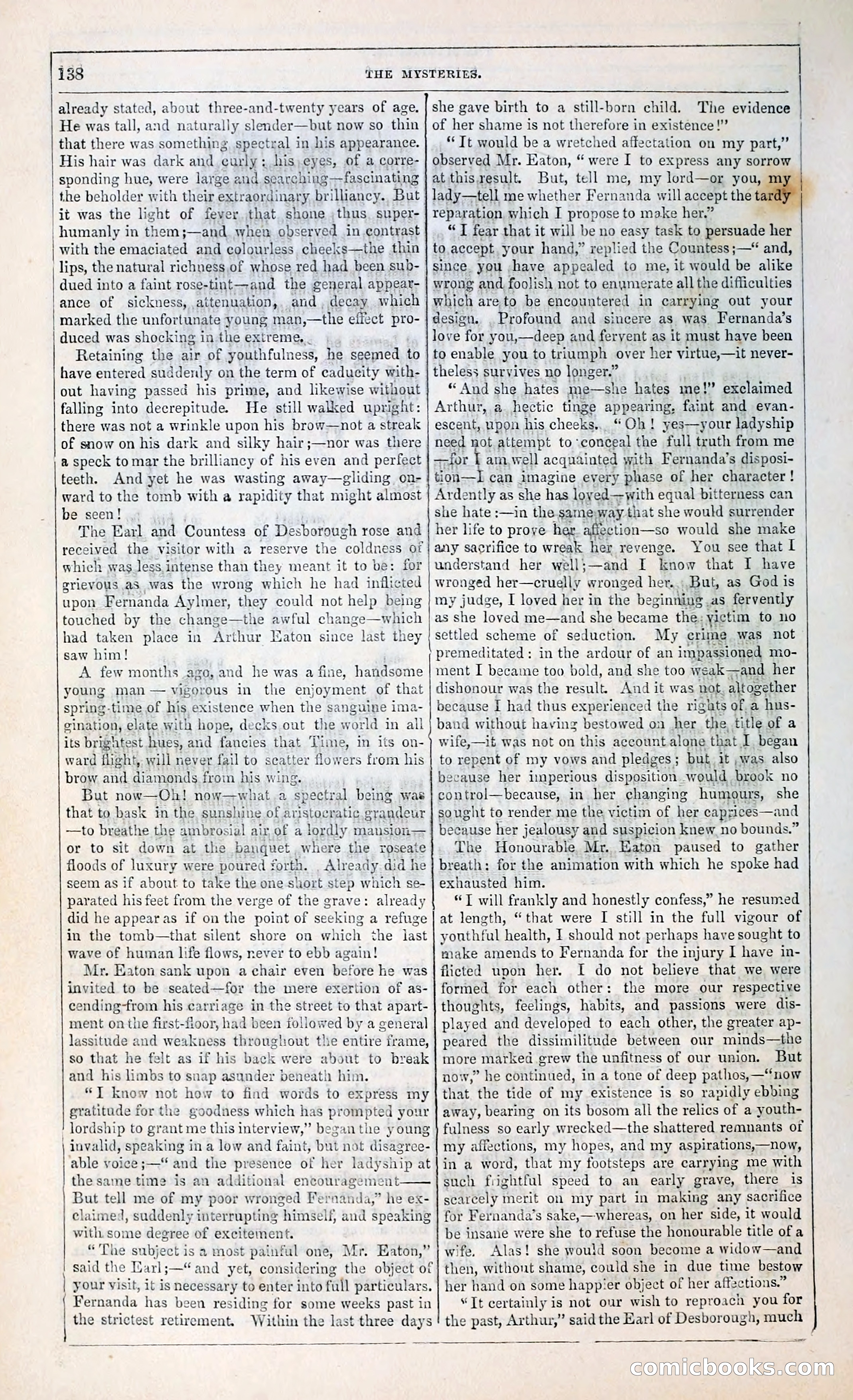
A restored page from Penny Dreadfuls, 1849. Page through the whole issue in the reader above.
📄 Transcribed text from this page (OCR, searchable)
Machine-transcribed from the original scan — historical spelling and the odd misread are preserved.
138 THE MYSTERIES. already stated, about three-and-twenty years of age. He was tall, and naturally slender—but now so thin that there was something spectral in his appearance. His hair was dark and curly ¢ his;eyes, of a corre- sponding hue, were large and searching—fascinating the beholder with their ‘extraordinary brilliancy. But it was the light of fever that shone ,thus. super- ‘humanly in them;—and_ whew observed in contrast ee = Or OV renee ee with the emaciated and colourless cheeks—the thin lips, the natural richness of whose red had been sub- dued into a faint rose-tint—and the general appear- ance of sickness, attenuation, and , decay which | marked the unfortunate young man,—the effect pro- duced was shocking in the extreme, . Retaining the air of youthfulness, he seemed to have entered sud idenly on the term of caducity with- out having passed his prime, and likewise without falling into decrepitude. He still walked upright: there was not a wrinkle upon his brow—not a streak of snow on his dark and silky hair;—nor was there a speck to mar the brilliancy of his even and perfect teeth. And yet he was wasting away—gliding on- ward to the tomb with a rapidity that might almost be seen! The Earl and Countess of Desborough rose and received the visitor with a reserve the “coldness or which was_less intense than they meant it to be: for grievous as was the wrong which he had inflicted upon Fernanda Aylmer, they could not help being touched by the change—the awful change—which had taken place in Arthur Eaton since last they saw him! | A few months ago, and he was a fine, handsome young man — vigorous in the enjoyment of that spring: -time of his existence when the sanguine ima eination, elate with hope, decks out the w al in all its brightest hues, and fancies that ‘ime, in its on- ward flight, will never fail to scatter flowers from his brow on diamonds from his wing But now—Oh! now—what.a ‘spectral being was that to bask in the sunshine of aristocratic grandeur —to breathe the ambrosial air, of a lordly mausion— or to sit down at the banquet where the roseate floods of luxury were poured forth. , Already did he seem as if about to take the one short step which se- parated his feet from the verge of the grave: already did he appearas if on the point of seeking a refuge in the tomb—that silent shore on which the iast wave of human life flows, never to ebb again! Mr. Eaton sank upon a chair even before he was invited to be seated—for the mere exertion of as- cending-from his carriage in the street to that apart- ment on the first-floor, had been followed by a general lassitude and weakness throughout the entire frame, so that he felt as if his back were about to break and his limbs to snap asunder beneath him. “YT Know not how to find words to express my gratitude for the goodness which has prompted your lordship to grant me this interview,” began the young invalid, speaking in a low and faint, but not disagree- able voice ;—“ and the presence of her ladyship at the same time is an additional encouragement But tell me of my poor wronged Fernanda,” he ex- claimed, suddenly interrupting himself, and speaking with. some degree of excitement. “The subject is a most painful one, Mr. Eaton,” said the arl;—“and yet, considering the object of your visit, it is necessary to enter into full particulars. | . . : . > Fernanda has been residing for some weeks past in the strictest retirement. Within the last three days am ———q“— xq“ -_——————_ —_ I ae hee SS she gave birth to a still-born child. The evidence of her shame is not therefore in existence!” ‘Tt would be a wretched affectation on my part,” observed Mr. Eaton, “ were I to express any sorrow at thisresult. But, tell me, my lord—or you, lady—tell me whether Fernanda will accept the reparation which I propose to make her,” “I fear that it will be no easy task to persuade her to.accept your hand,” zeplied the Countess;—* and, since. you ,have appealed to me, it would be alike wrong and, foolish not to enamerate all the difficulties which areto be encountered in carrying out your design. Profound and sincere as was. Fernanda’s love for you,—deep and feryent as it must have been to enable you to triumph over her virtue,—it never- theless suryives no longer.” “ And she hates me—she hates me!” exclaimed Arthur, a hectic tinge appearing, faint and evan- escent, upon his cheeks... “Oh! yes—your ladyship need not attempt to conceal the full truth from me =-for am, well acqnainted with Fernanda’s disposi- tion—I can imagine every phase of her character ! Ardently as she has loved—with equal bitterness can she hate :—in the sameway. that she would surrender her life to prove her aie. ection—so would she make any sacrifice to wreak her revenge. You see that I understand her well;—and I Know that I have wronged her—cruelly wronged her..,,But, as God is my judge, I loved her in the beginning. as fervently as she loved me—and she became the: -yictim to 10 settled scheme of seduction. My erime was not premeditated: in the ardour of an impassioned mo- ment I became too bold, and she too weak—and her dishonour was the result. And it was not. altogether because I had thus experienced the rights of.a hus- band without having bestowed on her the. title, of a wife,—it was not on this account alone that I began to open of my vows and pledges ; but. it -was also cause her lunperious disposition would brook no con anfenl- because: in her changing humours, she sought to render me the victim of her capzices—and because her jealousy and suspicion knew no bounds.” The Honourable. Mr. Eaton paused to gather breath: for the animation with which he spoke had exhausted him. “T will frankly and honestly confess,” he resumed at length, “that were I still in the full vigour of yonthful health, I should not perhaps have sought to make amends to Fernanda for the injury I have in- flicted upon her. I do not believe that we were formed for each other: the more our respective thoughts, feelings, habits, and passions were dis- played and developed to each other, the greater ap- peared the dissimilitude between our minds—the more marked erew the unfitness of our union. But now,” he continued, in a tone of deep pathos,—“now that the tide of my existence is so rapidly ebbing away, bearing on its bosom all the relics of a youth- fulness so early wrecked—the shattered remnants or my affections, my hopes, and my aspirations,—now, in a word, that my footsteps are carrying me with such frightful speed to an early grave, there is scarcely merit on my part in making any sacrifice for Fernanda’s sake,—-whereas, on her. side, it would be insane were she to refuse the honourable title of a wife. Alas! she would soon become a widow—and then, without shame, could she in due time bestow her hand on some happier object of her affections.” “Tt certainly is not our wish to reproach you for the past, Arthur,” said the Earl of Desbor ough, much —— COLMA eEhooksseom