
Penny Dreadfuls, 1849 · page 166 of 394
The Mysteries of the Court of London — page 166: what you’re looking at
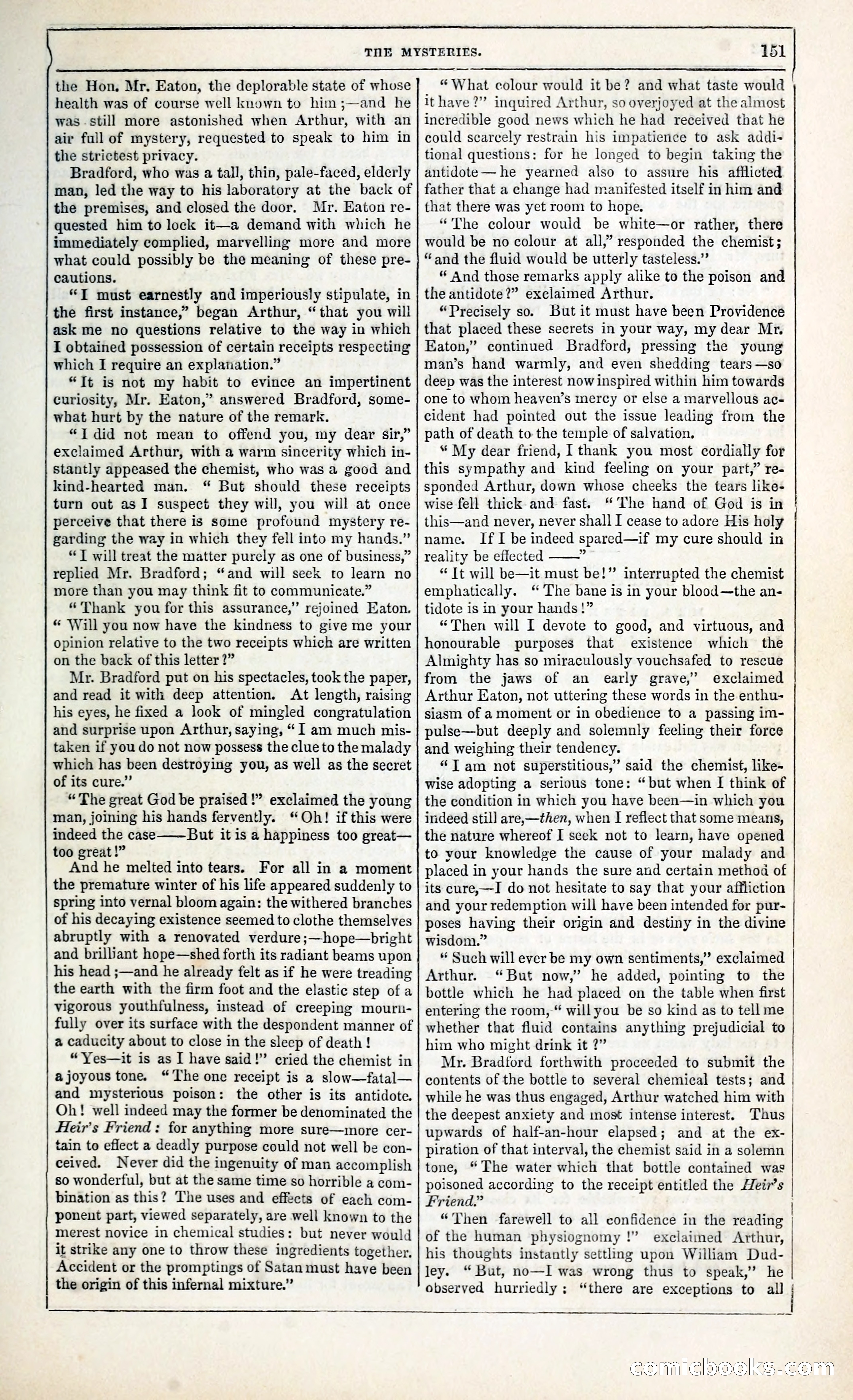
A restored page from Penny Dreadfuls, 1849. Page through the whole issue in the reader above.
📄 Transcribed text from this page (OCR, searchable)
Machine-transcribed from the original scan — historical spelling and the odd misread are preserved.
THE MYSTERIES. the Hon. Mr. Eaton, the deplorable state of whuse health was of course well known to him ;—and he was still more astonished when Arthur, with an air full of mystery, requested to speak to him in the strictest privacy. Bradford, who was a tall, thin, pale-faced, elderly man, led the way to his laboratory at the back of the premises, and closed the door. Mr. Eaton re- quested him to lock it—a demand with which he immediately complied, marvelling more and more what could possibly be the meaning of these pre- cautions. “J must earnestly and imperiously stipulate, in the first instance,’ began Arthur, “that you will ask me no questions relative to the way in which I obtained possession of certain receipts respecting which I require an explanation.” “It is not my habit to evince an impertinent curiosity, Mr. Eaton,’ answered Bradford, some- what hurt by the nature of the remark. “JT did not mean to offend you, my dear sir,” exclaimed Arthur, with a warm sincerity which in- stantly appeased the chemist, who was a good and kind-hearted man. “ But should these receipts turn out as I suspect they will, you will at once perceive that there is some profound mystery re- garding the way in which they fell into my hands.” “7 will treat the matter purely as one of business,” replied Mr. Bradford; “and will seek to learn no more than you may think fit to communicate.” “Thank you for this assurance,” rejoined Eaton. “ Will you now have the kindness to give me your opinion relative to the two receipts which are written on the back of this letter?” Mr. Bradford put on his spectacles, took the paper, and read it with deep attention. At length, raising his eyes, he fixed a look of mingled congratulation and surprise upon Arthur, saying, “I am much mis- taken if you do not now possess the clue to the malady which has been destroying you, as well as the secret of its cure.” “The great God be praised !” exclaimed the young man, joining his hands fervently. “Oh! if this were indeed the case ——But it is a happiness too great— too great!” And he melted into tears. For all in a moment the premature winter of his life appeared suddenly to spring into vernal bloom again: the withered branches of his decaying existence seemed to clothe themselves abruptly with a renovated verdure;—hope—bright and brilliant hope—shed forth its radiant beams upon his head ;—and he already felt as if he were treading the earth with the firm foot and the elastic step of a vigorous youthfulness, instead of creeping mourn- fully over its surface with the despondent manner of a caducity about to close in the sleep of death! “Yes—it is as I have said!” cried the chemist in ajoyous tone. “The one receipt is a slow—fatal— and mysterious poison: the other is its antidote. Oh! well indeed may the former be denominated the Heir’s Friend: for anything more sure—more cer- tain to eflect a deadly purpose could not well be con- ceived. Never did the ingenuity of man accomplish so wonderful, but at the same time so horrible a com- bination as this? The uses and effects of each com- ponent part, viewed separately, are well known to the merest novice in chemical studies: but never would it strike any one to throw these ingredients together. Accident or the promptings of Satan must have been the origin of this infernal mixture.” 151 “What colour would it be? and what taste would it have?” inquired Arthur, so overjoyed at the almost incredible good news which he had received that he could scarcely restrain his impatience to ask addi- tional questions: for he longed to begin taking the antidote— he yearned also to assure his afflicted father that a change had manifested itself in him and that there was yet room to hope. “The colour would be white—or rather, there would be no colour at all,” responded the chemist; “and the fluid would be utterly tasteless.” “ And those remarks apply alike to the poison and the antidote?” exclaimed Arthur. “Precisely so. But it must have been Providence that placed these secrets in your way, my dear Mr. Eaton,” continued Bradford, pressing the young man’s hand warmly, and even shedding tears—so deep was the interest now inspired within him towards one to whom heaven’s mercy or else a marvellous ac- cident had pointed out the issue leading from the path of death to the temple of salvation. “ My dear friend, I thank you most cordially for this sympathy and kind feeling on your part,” re- sponded Arthur, down whose cheeks the tears like- wise fell thick and fast. “The hand of God is in this—and never, never shall I cease to adore His holy name. If I be indeed spared—if my cure should in reality be effected t * It will be—it must be!” interrupted the chemist emphatically. “The bane is in your blood—the an- tidote is in your hands!” “Then will I devote to good, and virtuous, and honourable purposes that existence which the Almighty has so miraculously vouchsafed to rescue from the jaws of an early grave,’ exclaimed Arthur Eaton, not uttering these words in the enthu- siasm of a moment or in obedience to a passing im- pulse—but deeply and solemnly feeling their force and weighing their tendency. “Tam not superstitious,’ said the chemist, like- wise adopting a serious tone: “but when I think of the condition in which you have been—in which you indeed stil] are,—then, when I reflect that some means, the nature whereof I seek not to learn, have opened to vour knowledge the cause of your malady and placed in your hands the sure and certain method of its cure,—I do not hesitate to say that your affliction and your redemption will have been intended for pur- poses having their origin and destiny in the divine wisdom.” Such will ever be my own sentiments,” exclaimed Arthur. “But now,’ he added, pointing to the bottle which he had placed on the table when first entering the room,“ willyou be so kind as to tell me whether that fluid contains anything prejudicial to him who might drink it 2?” Mr. Bradford forthwith proceeded to submit the contents of the bottle to several chemical tests; and while he was thus engaged, Arthur watched him with the deepest anxiety and most intense interest. Thus upwards of half-an-hour elapsed; and at the ex- piration of that interval, the chemist said in a solemn tone, “The water which that bottle contained was poisoned according to the receipt entitled the Heir’s Friend.” “Then farewell to all confidence in the reading of the human physiognomy !” exclaimed Arthur, his thoughts instantly settling upon William Dud- Jey. “ But, no—I was wrong thus to speak,’ he observed hurriedly; “there are exceptions to all | Cc ne KR A | | Com Clooolkks.conn