
Penny Dreadfuls, 1849 · page 18 of 394
The Mysteries of the Court of London — page 18: what you’re looking at
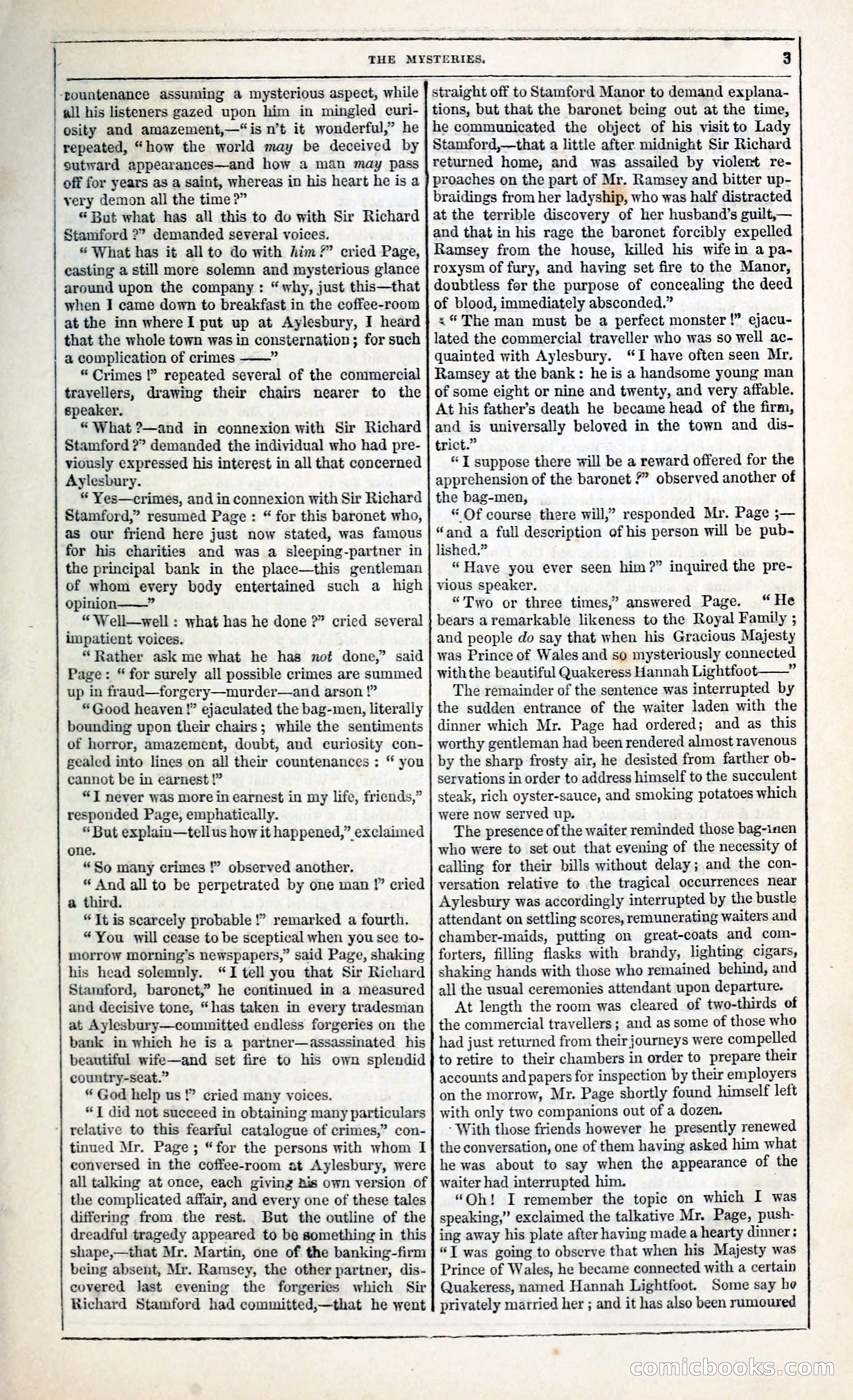
A restored page from Penny Dreadfuls, 1849. Page through the whole issue in the reader above.
📄 Transcribed text from this page (OCR, searchable)
Machine-transcribed from the original scan — historical spelling and the odd misread are preserved.
THE MYSTERIES. 3 -pountenance assuming a mysterious aspect, while all his listeners gazed upon him in mingled curi- osity and amazement,—“is n’t it wonderful,” he repeated, “how the world may be deceived by sutward appearances—and how a man may pass off for years as a saint, whereas in his heart he is a very demon all the time ?” “ But what has all this to do with Sir Richard Stamford ?” demanded several voices. * What has it allto do with him?” cried Page, casting a still more solemn and mysterious glance around upon the company: “why, just this—that when I came down to breakfast in the coffee-room at the inn where I put up at Aylesbury, I heard that the whole town was in consternation; for such a complication of crimes ——” * Crimes !” repeated several of the commercial trayellers, drawing their chairs nearer to the speaker. “What ?—and in connexion with Sir Richard Stamford ?” demanded the individual who had pre- viously expressed his interest in all that concerned Aylesbury. * Yes—crimes, and in connexion with Sir Richard Stamford,” resumed Page : “ for this baronet who, as our friend here just now stated, was famous for his charities and was a sleeping-partner in the principal bank in the place—this gentleman of whom every body entertained such a high opinion——” “'Well—well : what has he done ?” cried several impatient voices. “Rather ask me what he has not done,” said Page: “for surely all possible crimes are summed up in fraud—forgery—murder—and arson !” “Good heaven!” ejaculated the bag-men, literally bounding upon their chairs; while the sentiments of horror, amazement, doubt, and curiosity con- gealed into lines on all their countenances: “ you cannot be in earnest !” “J never was more in earnest in my life, friends,” responded Page, emphatically. * But explaiu—tellus how it happened,’ exclaimed one. “So many crimes !” observed another. * And all to be perpetrated by one man !” cried a third. “Tt is scarcely probable !” remarked a fourth. “You will cease to be sceptical when you see to- morrow morning’s newspapers,” said Page, shaking his head solemnly. “I tell you that Sir Richard Stamford, baronet,” he continued in a measured and decisive tone, “has taken in every tradesman at Aylesbury—committed endless forgeries on the bank in which he is a partner—assassinated his beautiful wife—and set fire to his own splendid country-seat.” * God help us !” cried many voices. “J did not succeed in obtaining many particulars ‘| relative to this fearful catalogue of crimes,” con- tinued Mr. Page; “for the persons with whom I conversed in the coffee-room at Aylesbury, were all talking at once, each giving Bis own version of the complicated affair, and every one of these tales differing from the rest. But the outline of the dreadful tragedy appeared to be something in this shape,—that Mr. Martin, one of the banking-firm being absent, Mr. Ramsey, the other partner, dis- eovered last evening the forgeries which Sir Richard Stamford had committed,—that he went straight off to Stamford Manor to demand explana- tions, but that the baronet being out at the time, he communicated the object of his visit to Lady Stamford,—that a little after midnight Sir Richard returned home, and was assailed by violert re- proaches on the part of Mr. Ramsey and bitter up- braidings from her ladyship, who was half distracted at the terrible discovery of her husband’s guilt,— and that in his rage the baronet forcibly expelled Ramsey from the house, killed his wife in a pa- roxysm of fury, and haying set fire to the Manor, doubtless for the purpose of concealing the deed of blood, immediately absconded.” «*The man must be a perfect monster !” ejacu- lated the commercial traveller who was so well ac- quainted with Aylesbury. “I have often seen Mr. Ramsey at the bank: he is a handsome young man of some eight or nine and twenty, and very affable. At his father’s death he became head of the firm, and is universally beloved in the town and dis- trict.” “I suppose there will be a reward offered for the apprehension of the baronet ” observed another of the bag-men, “ Of course there will,” responded Mr. Page ;— “and a full description of his person will be pub~ lished.” “Have you ever seen him?” inquired the pre- vious speaker. “Two or three times,” answered Page. “He bears aremarkable likeness to the Royal Family ; and people do say that when his Gracious Majesty was Prince of Wales and so mysteriously connected with the beautiful Quakeress Hannah Lightfoot——” The remainder of the sentence was interrupted by the sudden entrance of the waiter laden with the dinner which Mr. Page had ordered; and as this worthy gentleman had been rendered almost ravenous by the sharp frosty air, he desisted from farther ob- servations in order to address himself to the succulent steak, rich oyster-sauce, and smoking potatoes which were now served up. The presence of the waiter reminded those bag-inen who were to set out that evening of the necessity of calling for their bills without delay; and the con- versation relative to the tragical occurrences near Aylesbury was accordingly interrupted by the bustle attendant on settling scores, remunerating waiters and chamber-maids, putting on great-coats and com- forters, filling flasks with brandy, lighting cigars, shaking hands with those who remained behind, and all the usual ceremonies attendant upon departure. At length the room was cleared of two-thirds of the commercial travellers; and as some of those who had just returned from their journeys were compelled to retire to their chambers in order to prepare their accounts and papers for inspection by their employers on the morrow, Mr. Page shortly found himself left with only two companions out of a dozen. - With those friends however he presently renewed the conversation, one of them having asked him what he was about to say when the appearance of the waiter had interrupted him. | “Oh! I remember the topic on which I was speaking,” exclaimed the talkative Mr. Page, push- ing away his plate after having made a hearty dinner: “T was going to observe that when his Majesty was Prince of Wales, he became connected with a certain Quakeress, named Hannah Lightfoot. Some say he privately married her ; and it has also been rumoured ee COM Gbooksseom