
Penny Dreadfuls, 1849 · page 201 of 394
The Mysteries of the Court of London — page 201: what you’re looking at
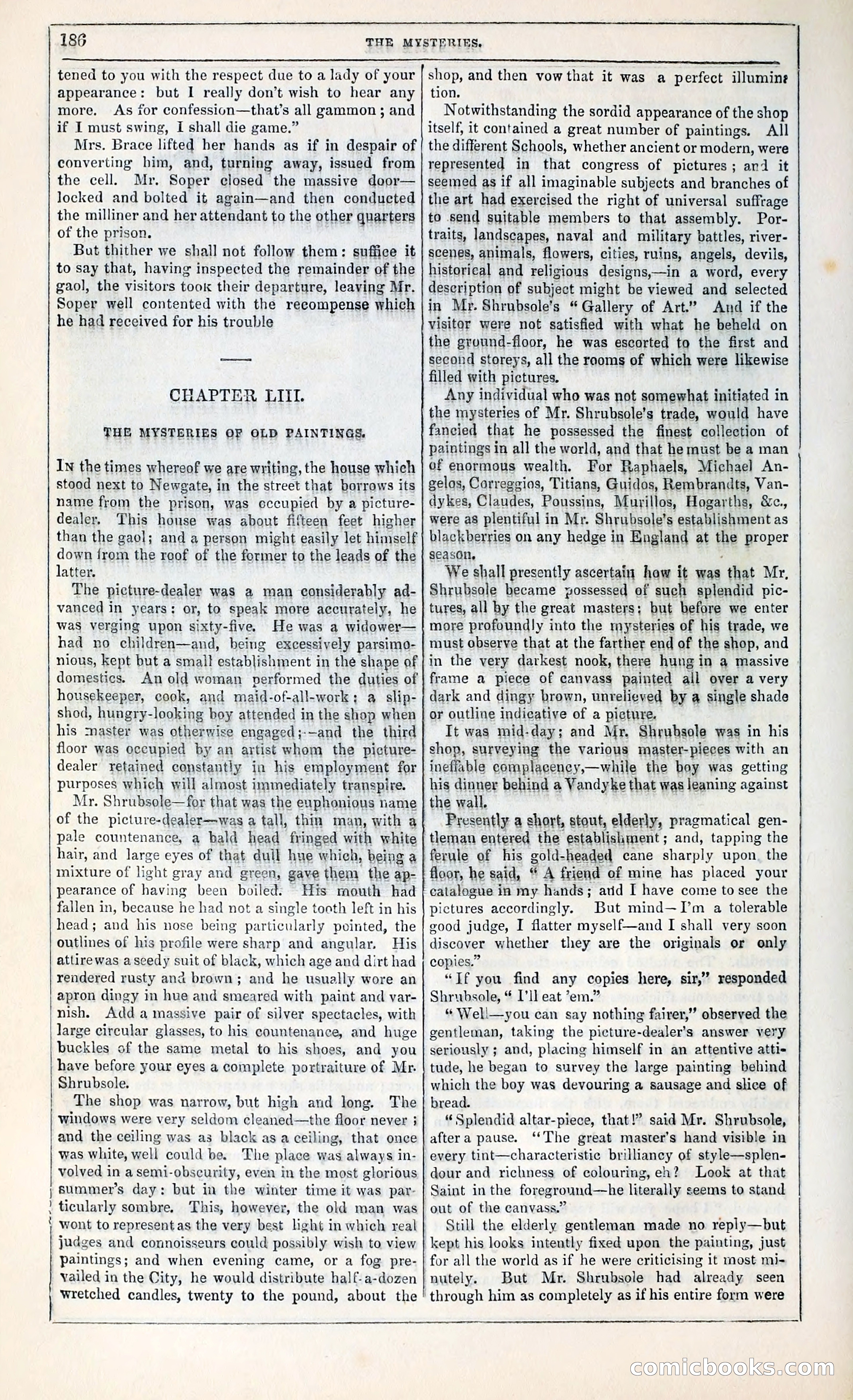
A restored page from Penny Dreadfuls, 1849. Page through the whole issue in the reader above.
📄 Transcribed text from this page (OCR, searchable)
Machine-transcribed from the original scan — historical spelling and the odd misread are preserved.
—_———_—— 186 THE MYSTERIES. Ser eer a ee ae ee a I Tn tened to you with the respect due to a lady of your appearance: but I really don’t wish to hear any more. As for confession—that’s all gammon; and if I must swing, I shall die game.” Mrs. Brace lifted her hands as if in despair of converting him, and, turning away, issued from the cell. Mr. Soper closed the massive door— locked and bolted it again—and then conducted the milliner and her attendant to the other quarters of the prison. But thither we shall not follow them: suffice it to say that, having inspected the remainder of the gaol, the visitors took their departure, leaving Mr. Soper well contented with the recompense which he had received for his trouble CHAPTER LIII THE MYSTERIES OF OLD PAINTINGS. In the times whereof we are writing, the house which stood next to Newgate, in the street that borrows its name from the prison, was eccupied by a picture- dealer, This house was about fifteen feet higher than the gaol; and a person might easily let himself down from the reof of the former to the leads of the latter. The picture-dealer was a man considerably ad- vanced in years: or, to speak more accurately, he was verging upon sixty-five. He was a widower— had no children—and, being excessively parsimo- nious, kept but a small establishment in the shape of domestics. An old woman verformed the duties of housekeeper, cook, and maid-of-all-work; a slip- shod, hungry-looking boy attended in the shop when his mnaster was otherwise engaged;-—and the third floor was occupied by an artist whom the picture- dealer retained constantly in his employment for purposes whieh will almost immediately transpire. Mr. Shrubsole—for that was the euphonious name of the picture-dealer—was a tall, thin man, with a pale countenance, a bald head fringed with white hair, and large eyes of that dull hue which, being a mixture of light gray and green, gave them the ap- pearance of having been boiled. His mouth had fallen in, because he had not a single tooth left in his head; and his nose being particularly pointed, the outlines of his profile were sharp and angular. His attirewas a seedy suit of black, which age and dirt had rendered rusty ana brown; and he usually wore an apron dingy in hue and smeared with paint and var- nish. Adda massive pair of silver spectacles, with large circular glasses, to his countenance, and huge buckles of the same metal to his shoes, and you have before your eyes a complete portraiture of Mr. Shrubsole. The shop was narrow, but high and long. The windows were very seldom cleaned—the floor never ; and the ceiling was as black as a ceiling, that once was white, well could be. The place was always in- volved in asemi-obsceurity, even in the most glorious | summer's day: but in the winter time it was par- ticularly sombre. This, however, the old man was wont to represent as the very best hght in which real judges and connoisseurs could possibly wish to view paintings; and when evening came, or a fog pre- yailed in the City, he would distribute half-a-dozen wretched candles, twenty to the pound, about the ee ee OS shop, and then vow that it was a perfect illumine tion. Notwithstanding the sordid appearance of the shop itself, it contained a great number of paintings. All the different Schools, whether ancient or modern, were represented in that congress of pictures; and it seemed as if all imaginable subjects and branches of the art had exercised the right of universal suffrage to send suitable members to that assembly. Por- traits, landscapes, naval and military battles, river- scenes, animals, flowers, cities, ruins, angels, devils, historical and religious designs,—in a word, every description of subject might be viewed and felected in Mr. Shrubsole’s “Gallery of Art.” And if the visitor were not satisfied with what he beheld on the ground-floor, he was escorted to the first and second storeys, all the raoms of which were likewise filled with pictures. Any individual who was not somewhat initiated in the mysteries of Mr. Shrubsole’s trade, would have fancied that he possessed the finest collection of paintings in all the world, and that he must be a man of enormous wealth. For Raphaels, Michael An- gelas, Correggios, Titians, Guidos, Rembrandts, Van- dykes, Claudes, Bandas. Murillos, Hogarths, &c., were as plentiful in Mr. Shrubsole’ s establishment as blackberries on any hedge in England at te proper season, We shall presently ascertain how it was ‘that Mr, Shrubsole became yossessed of such splendid pic- tures, all by the great masters; but before we enter more profoundly into the mysteries of his trade, we must observe that at the farther end of the shop, and in the very darkest nook, there hung in a massive frame a piece of canvass painted all over a very dark and dingy brown, unrelieved by a single shade or outline indicative of a picture. It was mid-day; and Mr. Shrubsole was in his shop, surveying the various master-pieces with an ineffable complaceney,—while the boy was getting his dinner behind a Vandyke that was leaning against the wall. Presently a short, stout, elderly, pragmatical gen- tleman entered the establishment ; and, tapping the ferule of his gold-headed cane sharply upon. the floor, he said, “ A friend of mine has placed your catalozue in my hands; atid I have come to see the pictures accordingly. But mind—I’m a tolerable eood judge, I flatter myself—and I shall very soon discover whether they are the originals or only copies.” “If you find any copies here, sir,’ responded Shrubsole, “ I'll eat ’em.” “ Well—you can say nothing fairer,” observed the gentleman, taking the picture-dealer’s answer very seriously ; and, placing himself in an attentive atti- tude, he began to survey the large painting behind which the boy was devouring a sausage and slice of bread. “Splendid altar-piece, that!” said Mr. Shrubsole, aftera pause. ‘‘The great master’s hand visible in every tint—characteristic brilliancy of style—splen- dour and richness of colouring, eh? Look at that Saint inthe foreground—he literally seems to stand out of the ennina se Still the elderly gentleman made no reply—but kept his looks intently fixed upon the painting, just for all the world as if he were criticising it most mi- nutely. But Mr. Shrubsole had already seen through him as completely as if his entire form were COM EloOOKS. EO