
Penny Dreadfuls, 1849 · page 23 of 394
The Mysteries of the Court of London — page 23: what you’re looking at
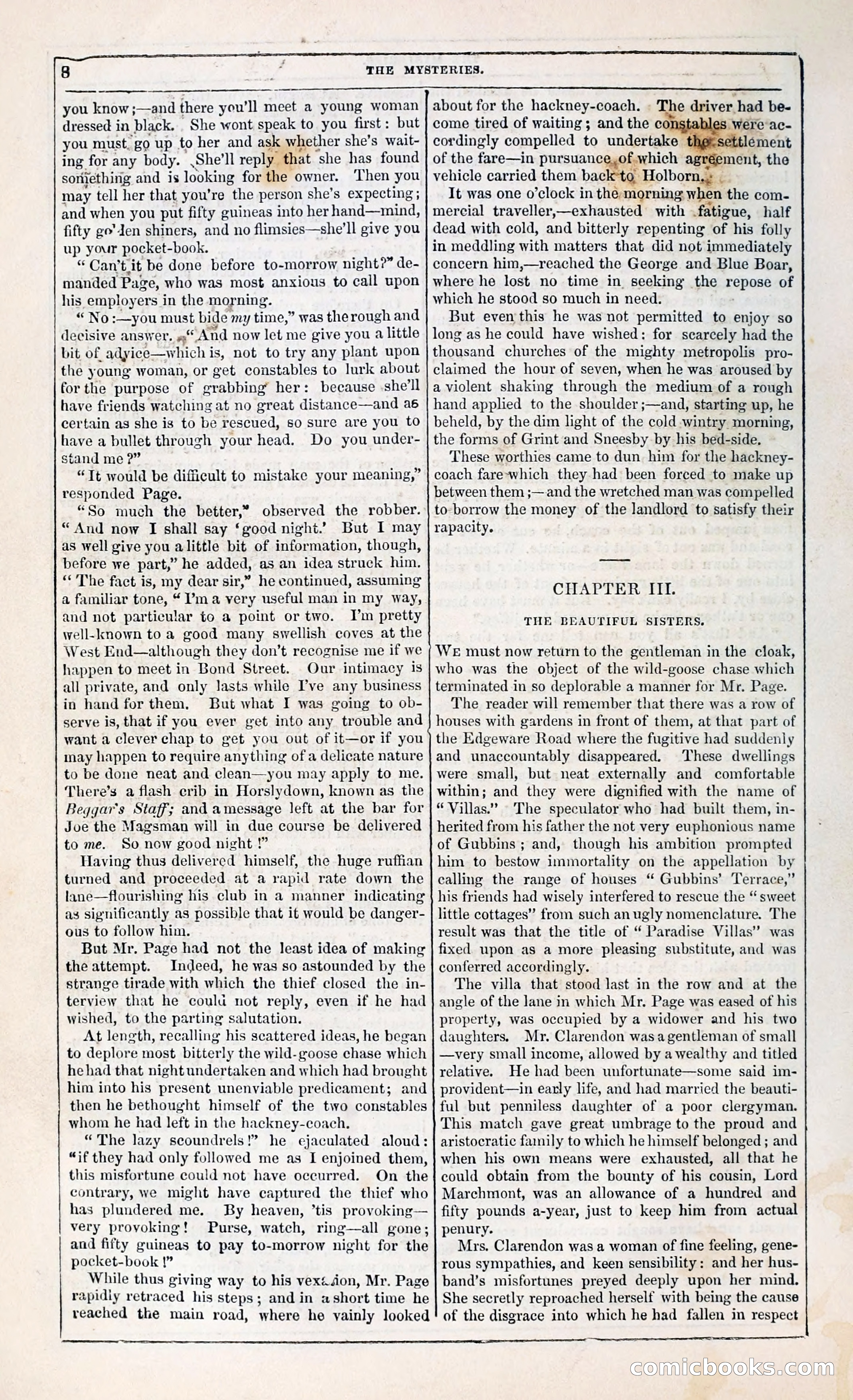
A restored page from Penny Dreadfuls, 1849. Page through the whole issue in the reader above.
📄 Transcribed text from this page (OCR, searchable)
Machine-transcribed from the original scan — historical spelling and the odd misread are preserved.
8 THE MYSTERIES. you know ;—and there you'll meet a young woman dressed in black. She wont speak to you first: but you must, go up to her and ask whether she’s wait- ing for any body. She'll reply that ‘she has found soriething and is looking for the owner. Then you may tell her that you're “the person she’s expecting ; and when you put fifty guineas into her hand mand, fifty ge’den shiners, and no flimsies—she’ll give you up your pocket-book. “Can’t.it be done before to-morrow night?” de- manded Page, who was most anxious to call upon his employers 3 in the morning. “ No :—you must bide my time,” was therough and decisive ANSWEL. gp, And now let me give you a little bit of, adyice—which i is, not to try any plant upon the young woman, or get constables to lurk about for the purpose of grabbing’ her: because she'll have friends watching at no great distance—and a6 certain as she is to be rescued, s0 sure are you to have a bullet through your head. Do you under- stand me ?” “Tt would be difficult to mistake your meaning,” responded Page. “So much the better,” observed the robber. “And now I shall say ‘good night.’ But I may as well give you alittle bit of information, though, before we part,” he added, as an idea struck him. “The fact is, my dear sir,” he continued, assuming a familiar tone, “ ’ma very useful man in my way, and not particular to a point or two. Tm pretty well-known to a good many swellish coves at the West End—although they don’t recognise me if we happen to meet in Bond Street. Our intimacy is all private, and only lasts while [ve any business in hand for them, But what I was going to ob- serve is, that if you ever get into any trouble and want a clever chap to get you out of it—or if you may happen to require anything of a delicate nature to be done neat and clean—you may apply to me. There’s a flash erib in Horslydown, known as the Beggars Staff; and amessage left at the bar for Joe the Magsman will in due course be delivered to me. So now good night !” Having thus delivered himself, the huge ruffian turned and proceeded at a rapid rate down the lane—flourishing his club in a manner indicating as significantly as possible that it would be danger- ous to follow him. But Mr. Page had not the least idea of making the attempt. Indeed, he was so astounded by the strange tirade with which the thief closed the in- terview that he could not reply, even if he had wished, to the parting salutation. At length, recalling his scattered ideas, he began to deplore most bitterly the wild-goose chase which hehad that nightundertaken and which had brought him into his present unenviable predicament; and then he bethought himself of the two constables whom he had left in the hackney-coach. “The lazy scoundrels!” he ejaculated aloud: “if they had only followed me as I enjoined them, this misfortune could not have occurred. On the contrary, we might have captured the thief who has plundered me. By heaven, ’tis provoking— very provoking! Purse, watch, ring—all gone; and fifty guineas to pay to-morrow night for the pocket-book !” While thus giving way to his vexion, Mr. Page rapidiy retraced his steps; and in ashort time he reached the main road, where he yainly looked rE ES about for the hackney-coach. . The driver had be- come tired of waiting; and the constables cordingly compelled to undertake thg®se of the fare—in pursuance,of which agréement, the vehicle carried them backtg, Holborn. | It was one o’clock in the morning when the com- mercial traveller,—exhausted with fatigue, half dead with cold, and bitterly repenting of his folly in meddling with matters that did not immediately concern him,—reached the George and Blue Boar, where he lost no time in seeking the Eepane of which he stood so much in need. But even this he was not permitted to enjoy so long as he could have wished: for scarcely had the thousand churches of the mighty metropolis pro- claimed the hour of seven, when he was aroused by a violent shaking through the medium of a rough hand applied to the shoulder ;—and, starting up, he beheld, by the dim light of the cold wintry morning, the forms of Grint and Sneesby by his bed-side. These worthies came to dun him for the hackney- coach fare-wwhich they had been forced to make up between them ;— and the wretched man was compelled to-borrow the money of the landlord to satisfy their rapacity. CHAPTER ITI. THE BEAUTIFUL SISTERS. WE must now return to the gentleman in the cloak, who was the object of the wild-goose chase which terminated in so deplorable a manner for Mr. Page. The reader will remember that there was a row of houses with gardens in front of them, at that part of the Edgeware Road where the fugitive had suddenly and unaccountably disappeared. These dwellings were small, but neat externally and comfortable within; and they were dignified with the name of “ Villas.” herited from his father the not very euphonious name The speculator who had built them, in- of Gubbins ; and, though his ambition prompted him to bestow immortality on the appellation by calling the range of houses “ Gubbins’ Terrace,” his friends had wisely interfered to rescue the “sweet little cottages” from such anugly nomenclature. The result was that the title of “ Paradise Villas’ was fixed upon as a more pleasing substitute, and was conferred accordingly. The villa that stood last in the row and at the angle of the lane in which Mr. Page was eased of his property, was occupied by a widower and his two daughters. Mr. Clarendon wasa gentleman of small —very small income, allowed by a wealthy and titled relative. He had been unfortunate—some said im- provident—in early life, and had married the beauti- ful but penniless daughter of a poor clergyman. This match gave great umbrage to the proud and aristocratic family to which he himself belonged ; and when his own means were exhausted, all that he could obtain from the bounty of his cousin, Lord Marchmont, was an allowance of a hundred and fifty pounds a-year, just to keep him from actual penury. Mrs. Clarendon was a woman of fine feeling, gene- rous sympathies, and keen sensibility: and her hus- band’s misfortunes preyed deeply upon her mind. She secretly reproached herself with being the cause of the disgrace into which he had fallen in respect COLMA El NOOKS COR)