
Penny Dreadfuls, 1849 · page 234 of 394
The Mysteries of the Court of London — page 234: what you’re looking at
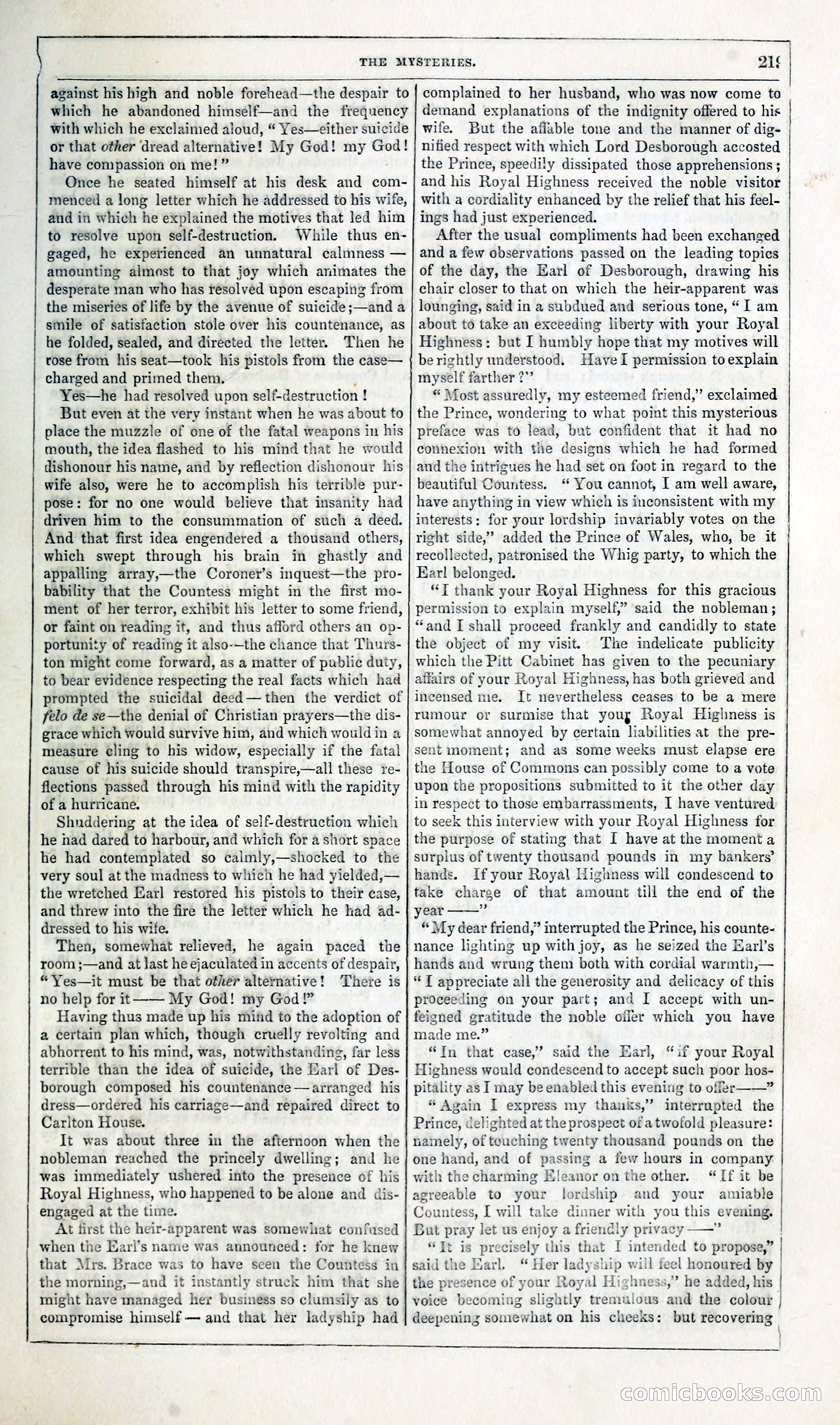
A restored page from Penny Dreadfuls, 1849. Page through the whole issue in the reader above.
📄 Transcribed text from this page (OCR, searchable)
Machine-transcribed from the original scan — historical spelling and the odd misread are preserved.
THE MYSTERIES. 2\§ against his high and noble forehead—the despair to which he abandoned himself—and the frequency with which he exclaimed aloud, “ Yes—either suicide or that other ‘dread alternative! My God! my God! have compassion on me!” Once he seated himself at his desk and com- menced a long letter which he addressed to his wife, and in which he explained the motives that led him to resolve upon self-destruction. While thus en- gaged, he experienced an unnatural calmness — amounting almost to that joy which animates the desperate man who has résolved upon escaping from the miseries of life by the avenue of suicide;—and a smile of satisfaction stole over his countenance, as he folded, sealed, and directed the letter, Then he rose from his seat—took his pistols from the case— charged and primed them. Yes—he had resolved upon self-destruction ! But even at the very instant when he was about to place the muzzle of one of the fatal weapons in his mouth, the idea flashed to his mind that he would dishonour his name, and by reflection dishonour his wife also, were he to accomplish his terrible pur- pose: for no one would believe that insanity had driven him to the consummation of such a deed. And that first idea engendered a thousand others, which swept through his brain in ghastly and appalling array,—the Coroner’s inquest—the pro- bability that the Countess might in the first mo- ment of her terror, exhibit his letter to some friend, or faint on reading it, and thus afford others an op- portunity of reading it also-—the chance that Thurs- ton might come forward, as a matter of public duty, to bear evidence respecting the real facts which had prompted the suicidal deed—then the verdict of felo de se—the denial of Christian prayers—the dis- grace which would survive him, and which wouldin a measure cling to his widow, especially if the fatal cause of his suicide should transpire,—all these re- flections passed through his mind with the rapidity of a hurricane. Shuddering at the idea of self-destruction which he nad dared to harbour, and which for a short space he had contemplated so calmly,—shocked to the very soul at the madness to which he had yielded,— the wretched Earl restored his pistols to their case, and threw into the fire the letter which he had ad- dressed to his wife. Then, somewhat relieved, he again paced the room ;—and at last he ejaculated in accents of despair, “Yes—it must be that other alternative! Theve is no help for it-—-— My God! my God!” Having thus made up his mind fo the adoption of a certain plan which, though cruelly revolting and abhorrent to his mind, was, notwithstanding, far less terrible than the idea of suicide, the Earl of Des- borough composed his countenance —arranged his dress—ordered his carriage—and repaired direct to Carlton House. It was about three in the afternoon when the nobleman reached the princely dwelling; and he was immediately ushered into the presence of his Royal Highness, who happened to be alone and dis- engaged at the time. At first the heir-apparent was somewhat confused when the Earl’s name was announced: for he knew that Mrs. Brace was to have seen the Countess in the morning,—and it instantly struck him that she might have managed her business so clumsily as to compromise himself — and that her ladyship had complained to her husband, who was now come to demand explanations of the indignity offered to his wife. nified respect with which Lord Desborough accosted the Prince, speedily dissipated those apprehensions ; and his Royal Highness received the noble visitor with a cordiality enhanced by the relief that his feel- ings had just experienced. After the usual compliments had been exchanged and a few observations passed on the leading topics of the day, the Earl of Desborough, drawing his chair closer to that on which the heir-apparent was lounging, said in a subdued and serious tone, “ I am about to take an exceeding liberty with your Royal Highness: but I humbly hope that my motives will be rightly understood. Havel permission toexplain myself farther ?”’ “ Most assuredly, my esteemed friend,” exclaimed the Prince, wondering to what point this mysterious preface was to lead, but confident that it had no connexion with the designs which he had formed and the intrigues he had set on foot in regard to the beautiful Countess. ‘ You cannot, I am well aware, have anything in view which is inconsistent with my interests: for your lordship invariably votes on the richt side,” added the Prince of Wales, who, be it recollected, patronised the Whig party, to which the Ear! belonged. “T thank your Royal Highness for this gracious permission to explain myself,” said the nobleman; “and I shall proceed frankly and candidly to state the object of my visit. ‘The indelicate publicity which the Pitt Cabinet has given to the pecuniary affairs of your Royal Highness, has both grieved and incensed me. It nevertheless ceases to be a mere rumour or surmise that youg Royal Highness is somewhat annoyed by certain liabilities at the pre- sent moment; and as some weeks must elapse ere the House of Commons can possibly come to a vote upon the propositions submitted to it the other day in respect to those embarrassments, I have ventured to seek this interview with your Royal Highness for the purpose of stating that I have at the moment a surplus of twenty thousand pounds in my bankers’ hands. If your Royal Highness will condescend to take charge of that amount till the end of the year t; “ Vy dear friend,” interrupted the Prince, his counte- nance lighting up with joy, as he seized the Karl’s hands and wrung them both with cordial warmth,— “ T appreciate all the generosity and delicacy of this proceeding on your part; and I accept with un- feigned gratitude the noble offer which you have made me.” “In that case,’ said the Earl, “if your Royal Highness would condescend to accept such poor hos- pitality as T may be enabled this evening to offer——” “ Again I express my thanks,” interrupted the Prince, delighted at the prospect of atwofold pleasure: namely, of teuching twenty thousand pounds on the one hand, and of passing a few hours in company with the charming Eleanor on the other. “If it be agreeable to your lordship and your amiable Countess, I will take dinner with you this evening. But pray let us enjoy a friendly privacy ——” “Tt is precisely this that I intended to propose, said the Marl. the presence of your Roy ral Highness,” he added, his" voice becoming slightly tremulous and the colour deepening somewhat on his cheeks: But the affable tone and the manner of dig- ” “ Fler lady ship will feel honoured by but recovering a | QE ; pee COmicboooks. CO