
Penny Dreadfuls, 1849 · page 241 of 394
The Mysteries of the Court of London — page 241: what you’re looking at
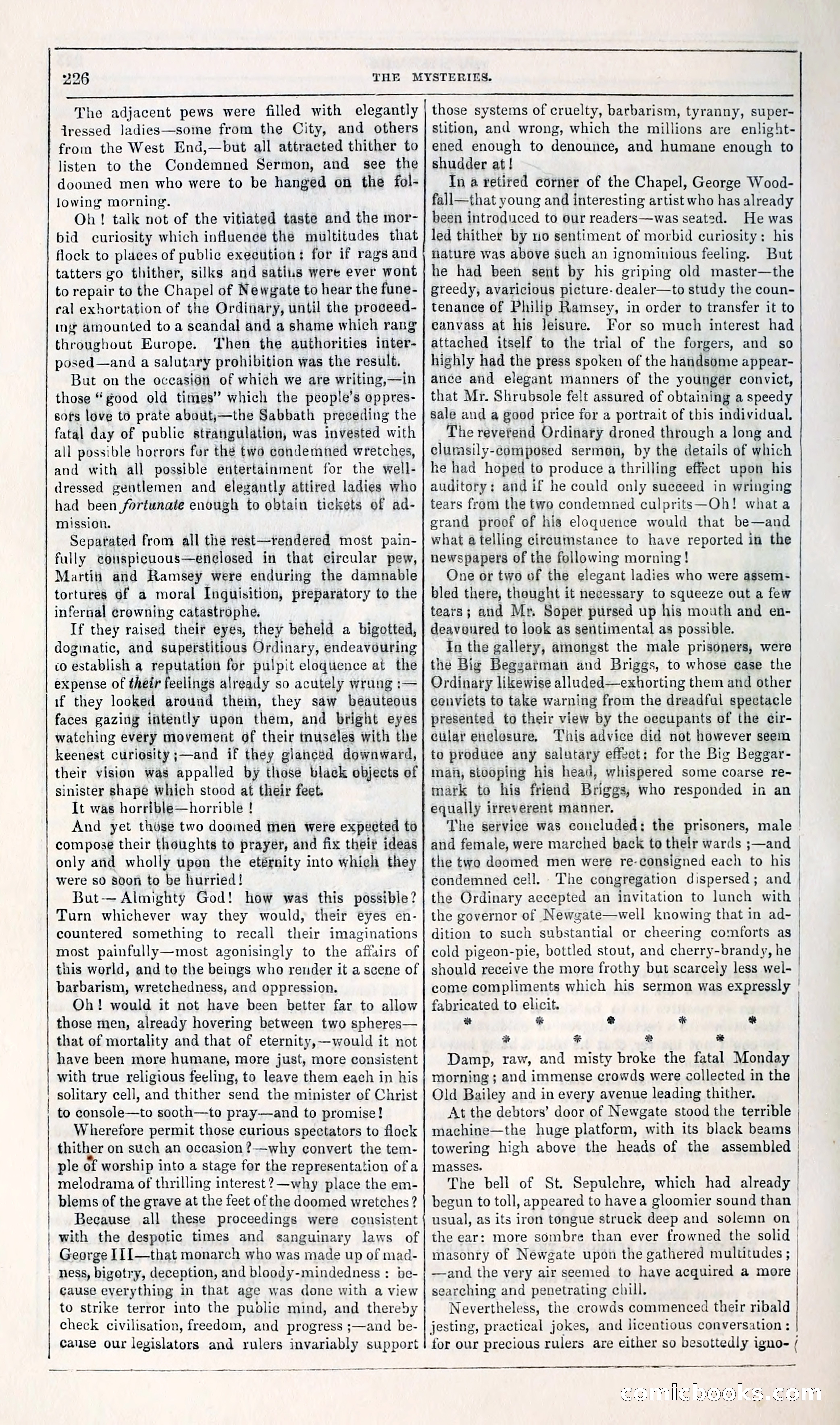
A restored page from Penny Dreadfuls, 1849. Page through the whole issue in the reader above.
📄 Transcribed text from this page (OCR, searchable)
Machine-transcribed from the original scan — historical spelling and the odd misread are preserved.
226 The adjacent pews were filled with elegantly iressed Jadies—some from the City, and others from the West Enad,—but all attracted thither to listen to the Condemned Sermon, and see the doomed men who were to be hanged on the fol- lowing morning. Oh! talk not of the vitiated taste and the mor- bid curiosity which influence the multitudes that flock to places of public execution: for if rags and tatters go thither, silks and satis were ever wont to repair to the Chapel of Newgate to hear the fune- eal exhortation of the Ordinary, until the proceed- ine amounted to a scandal and a shame which rang throughout Europe. Then the authorities inter- posed—and a salutary prohibition was the result. But on the occasion of which we are writing,—in those “good old times” which the people’s oppres- sors love to prate about;—the Sabbath preceding the fatal day of public sttangulation, was invested with all possible horrors for thé two condemned wretches, and with all possible entertainment for the well- dressed gentlemen and elegantly attired ladies who had been fortunate enough to obtain tickets of ad- mission. Separated from all the rest—rendered most pain- fully couspicuous—enclosed in that circular pew, Martiti and Ramsey were enduring the damnable tortures of a moral Inquisition, preparatory to the infernal crowning catastrophe. If they raised their eyes, they beheld a bigotted, dogmatic, and superstitious Ordinary, endeavouring co establish a reputation for pulpit eloquence at the expense of their feelings already so acutely wrung :— if they looked around them, they saw beauteous faces gazing intently upon them, and bright eyes watching every movement of their muscles with the keenest curiosity ;—and if they glanced downward, their vision was appalled by those black objects of sinister shape Which stood at their feet. It was horrible—horrible ! And yet those two doomed men were expected to compose their thoughts to prayer, and fix theit ideas only and wholly upon the eternity into whieh they were so soon to be hurried! But-—— Almighty God! how was this possible? Turn whichever way they would, their eyes en- countered something to recall their imaginations most painfully—most agonisingly to the affairs of this world, and to the beings who render it a scene of barbarism, wretchedness, and oppression. Oh! would it not have been better far to allow those men, already hovering between two spheres— that of mortality and that of eternity,—would it not have been more humane, more just, more consistent with true religious feeling, to leave them each in his solitary cell, and thither send the minister of Christ to console—to sooth—to pray—and to promise! Wherefore permit those curious spectators to flock thither on such an occasion ?—why convert the tem- ple of worship into a stage for the representation of a melodrama of thrilling interest ?—why place the em- blems of the grave at the feet of the doomed wretches ? Because all these proceedings were consistent with the despotic times and sanguinary laws of George IJ [—that monarch who was made up of mad- ness, bigotry, deception, and bloody-mindedness : be- cause everything in that age was done with a view to strike terror into the puolic mind, and thereby check civilisation, freedom, and progress ;—and be- cause our legislators and rulers invariably support oe ee ee ee CS ee THE MYSTERIES. those systems of cruelty, barbarism, tyranny, super- stition, and wrong, which the millions are enlight- ened enough to denounce, and humane enough to shudder at ! In a retired corner of the Chapel, George Wood- fall—that young and interesting artist who has already been introduced to our readers—was seated. He was led thither by no sentiment of morbid curiosity: his nature was above such an ignominious feeling. But he had been sent by his griping old master—the greedy, avaricious picture- dealer—to study the coun- tenance of Philip Ramsey, in order to transfer it to canvass at his Jeisure. For so much interest had attached itself to the trial of the forgers, and so highly had the press spoken of the handsome appear- ance and elegant manners of the younger convict, that Mr. Shrubsole felt assured of obtaining a speedy sale and a good price for a portrait of this individual. The revetend Ordinary droned through a long and clumsily-composed sermon, by the details of which he had hoped to produce a thrilling effect upon his auditory: and if he could only sueceed in wringing tears from the two condemned culprits—Oh! whata grand proof of his eloguence would that be—and what a telling circumstance to have reported in the newspapers of the following morning! One or two of the elegant ladies who were assem- bled there, theught it necessary to squeeze out a few tears; and Mr. Soper pursed up his mouth and en- deavoured to look as sentimental as possible. In the gallery, amongst the male prisoners, were the Big Beggarman and Briggs, to whose ease the Ordinary likewise alluded—exhorting them and other cenvicts to take warning from the dreadful spectacle presented to their view by the occupants of the eir- ciilar enclosure, This advice did not however seem to produce any salutary effect: for the Big Beggar- man, stooping his head, whispered some coarse re- mark to his friend Briggs, who responded in an equally irreverent manner. The service was concluded; the prisoners, male > and female, were marched back to their wards ;—and the two doomed men were re-consigned each to his condemned cell. The congregation dispersed; and the Ordinary aecepted an invitation to lunch with | the governor of Newgate—well knowing that in ad- dition to such substantial or cheering comforts as cold pigeon-pie, bottled stout, and cherry-brandy, he should receive the more frothy but scarcely less wel- come compliments which his sermon was expressly fabricated to elicit. at % Pa sit % #3 ix Damp, raw, and misty broke the fatal Monday morning ; and immense crowds were collected in the Old Bailey and in every avenue leading thither. At the debtors’ door of Newgate stood the terrible machine—the huge platform, with its black beams towering high above the heads of the assembled | masses. The bell of St. Sepulchre, which had already | begun to toll, appeared to havea gloomier sound than usual, as its iron tongue struck deep and solemn on | the ear: more sombre than ever frowned the solid masonry of Newgate upon the gathered multitudes ; —and the very air seemed to have acquired a more searching and penetrating chill. Nevertheless, the crowds commenced their ribald jesting , practical jokes, and licentious conversation : for our precious rulers are either so besottedly igno- / * oe _—-- ee AMICLOOOl KS. (EC) (C(O)