
Penny Dreadfuls, 1849 · page 246 of 394
The Mysteries of the Court of London — page 246: what you’re looking at
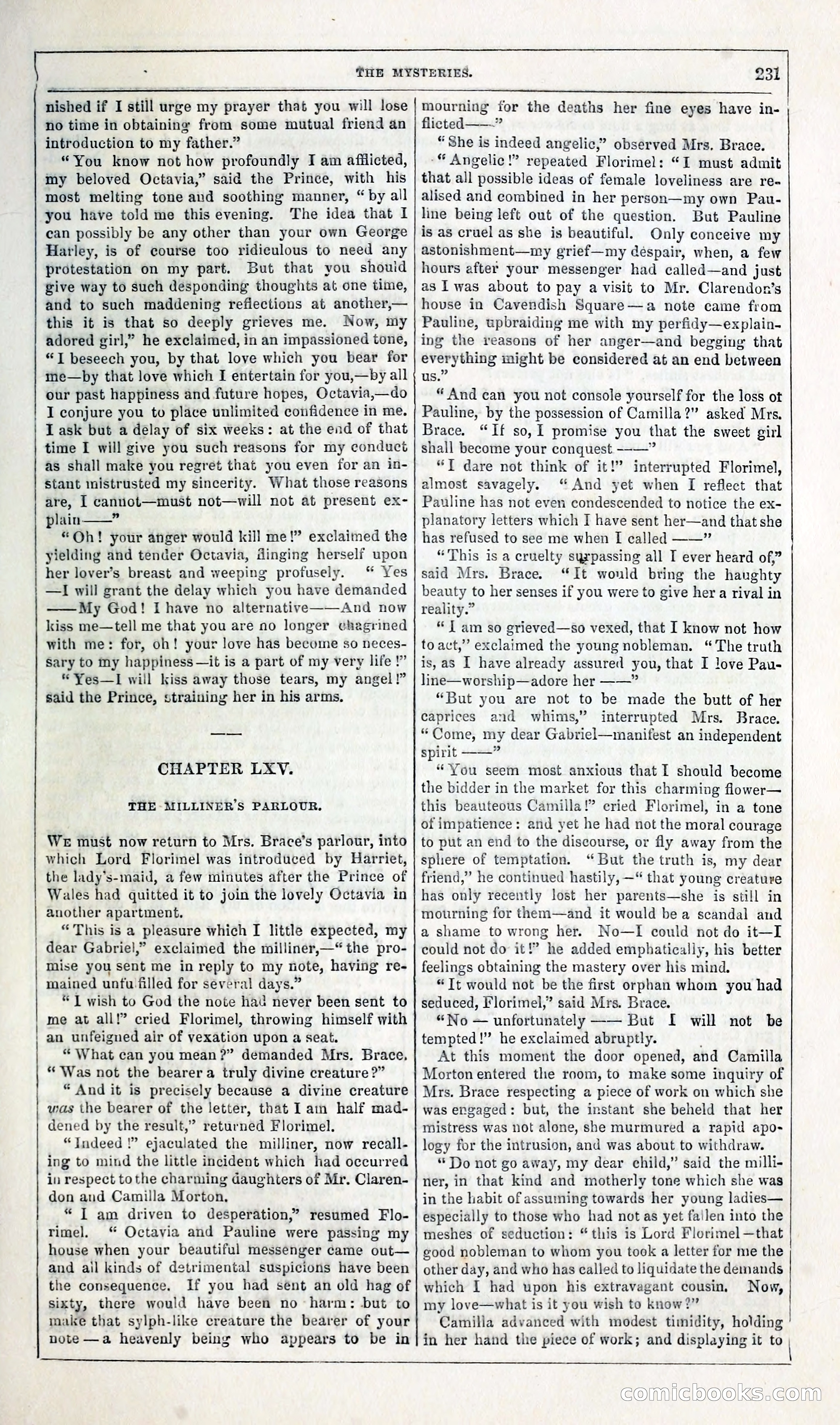
A restored page from Penny Dreadfuls, 1849. Page through the whole issue in the reader above.
📄 Transcribed text from this page (OCR, searchable)
Machine-transcribed from the original scan — historical spelling and the odd misread are preserved.
rr > THE MYSTERIES. 231 ————————— eee a ns nished if I still urge my prayer that you will lose no time in obtaining from some mutual friend an introduction to my father.” “You know not how profoundly I am afflicted, my beloved Octavia,” said the Prince, with his most melting tone and soothing manner, “ by all you have told me this evening. The idea that I can possibly be any other than your own George Harley, is of course too ridiculous to need any protestation on my part. But that you shouid give way to such desponding thoughts at one time, and to such maddening reflections at another,— this it is that so deeply grieves me. Now, my adored girl,” he exclaimed, in an impassioned tone, “TI beseech you, by that love which you bear for me—by that love which I entertain for you,—by all our past happiness and future hopes, Octavia,—do I conjure you to place unlimited confidence in me. I ask but a delay of six weeks: at the end of that time I will give you such reasons for my conduct as shall make you regret that you even for an in- stant mistrusted my sincerity. What those reasons are, | cannot—must not—will not at present ex- plain § “Oh! your anger would kill me!” exclaimed the yielding and tender Octavia, dinging herself upon her lover’s breast and weeping profusely. “ Yes —I will grant the delay which you have demanded My God! I have no alternative——And now kiss me—tell me that you are no longer chagrined with me: for, oh! your love has become so neces- Sary to my happiness—it is a part of my very life !” * Yes—lI will kiss away those tears, my angel!” said the Prince, straiuing her in his arms. CHAPTER LXV. THE MILLINER’S PARLOUR. We must now return to Mrs. Brace’s parlour, into which Lord Florimel was introduced by Harriet, the lady’s-maid, a few minutes after the Prince of Wales had quitted it to join the lovely Octavia in another apartment, “This is a pleasure which I little expected, my dear Gabriel,” exclaimed the milliner,—* the pro- mise you sent me in reply to my note, having re- mained unfu filled for several days.” * J wish to God the note had never been sent to me at all!” cried Florimel, throwing himself with an unfeigned air of yvexation upon a seat. “ What can you mean?” demanded Mrs. Brace, ** Was not the bearer a truly divine creature ?” “ And it is precisely because a divine creature was the bearer of the letter, that Iam half mad- dened by the result,” returned Florimel. “Indeed !” ejaculated the milliner, now recall- ing to mind the little incident which had occurred in respect tothe charming daughters of Mr. Claren- don aud Camilla Morton, * J am driven to desperation,” resumed Flo- rimel. “ Octavia and Pauline were passing my house when your beautiful messenger came out— and ail kinds of detrimental suspicions have been the consequence. If you had sént an old hag of sixty, there would have been no harm: but to make that sylph-like creature the bearer of your note —a heavenly being who appears to be in mourning for the deaths her fine eyes have in- flicted——.” “She is indeed angelic,” observed Mrs. Brace. -€ Angelic!” repeated Florimel: “I must admit that all possible ideas of female loveliness are re- alised and combined in her person—my own Pau- line being left out of the question. But Pauline is as cruel as she is beautiful. Only conceive my astonishment—my grief—my déspair, when, a few hours after your messenger had called—and just as Iwas about to pay a visit to Mr. Clarendon’s hovse in Cavendish Square—a note came from Pauline, upbraiding me with my perfidy—explain- ing the reasons of her anger—and begging that everything might be considered at an end between us.” “ And ean you not console yourself for the loss ot Pauline, by the possession of Camilla?” asked Mrs. Brace. “If so, 1 promise you that the sweet girl shall become your conquest --—” “JY dare not think of it!” interrupted Florimel, almost savagely. “And yet when I reflect that Pauline has not even condescended to notice the ex- planatory letters which I have sent her—and that she has refused to see me when I called ——” “This is a cruelty syrpassing all I ever heard of,” said Mrs. Brace. “It would bring the haughty beauty to her senses if you were to give her a rival in reality.” “J am so grieved—so vexed, that I know not how to act,” exclaimed the young nobleman. “The truth is, as I have already assured you, that I love Pau- line—worship—adore her ——” “But you are not to be made the butt of her caprices and whims,” interrupted Mrs. Brace. “Come, my dear Gabriel—manifest an independent spirit ——” “You seem most anxious that I should become the bidder in the market for this charming flower— this beauteous Camilla!” eried Florimel, in a tone of impatience: and yet he had not the moral courage to put an end to the discourse, or fly away from the spliere of temptation. “But the truth is, my dear friend,” he continued hastily, —“ that young creature has only recently lost her parents—she is still in mourning for them—and it would bea scandal and a shame to wrong her. No—I could not do it—I could not do it!” he added emphatically, his better feelings obtaining the mastery over his mind. “Tt would not be the first orphan whom you had seduced, Florimel,”’ said Mrs. Brace. “No — unfortunately —— But I will not be tempted!” he exclaimed abruptly. At this moment the door opened, and Camilla Morton entered the room, to make some inquiry of Mrs. Brace respecting a piece of work on which she was engaged: but, the instant she beheld that her mistress was not alone, she murmured a rapid apo- logy for the intrusion, and was about to withdraw. * Do not go away, my dear ehild,” said the milli- ner, in that kind and motherly tone which she was in the habit of assuming towards her young ladies— especially to those who had not as yet failen into the meshes of seduction: “this is Lord Florimel—that eood nobleman to whom you took a letter for me the other day, and who has called to liquidate the demands which I had upon his extravagant cousin, Now, my love—what is it you wish to know?” Camilla advanced with modest timidity, holding eS SSO eee pet et a TR A A ie I in her hand the piece of work; and displaying it to | CORnnICLOO (C ‘S.coO