
Penny Dreadfuls, 1849 · page 283 of 394
The Mysteries of the Court of London — page 283: what you’re looking at
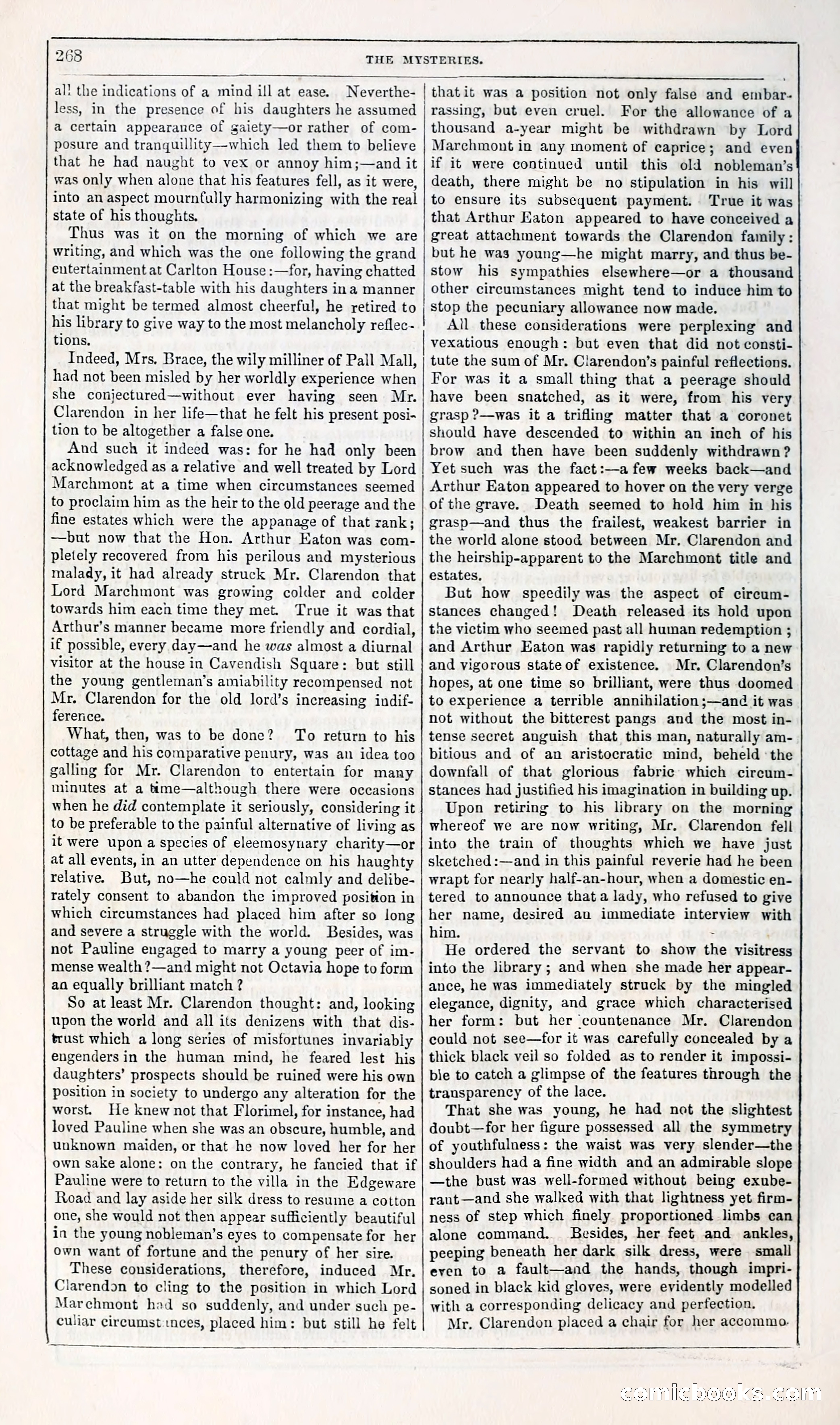
A restored page from Penny Dreadfuls, 1849. Page through the whole issue in the reader above.
📄 Transcribed text from this page (OCR, searchable)
Machine-transcribed from the original scan — historical spelling and the odd misread are preserved.
268 al! the indications of a mind ill at ease. Neverthe- less, in the presence of his daughters he assumed a certain appearance of gaiety—or rather of com- posure and tranquillity—which led them to believe that he had naught to vex or annoy him;—and it was only when alone that his features fell, as it were, into an aspect mournfully harmonizing with the real state of his thoughts. Thus was it on the morning of which we are writing, and which was the one following the grand entertainment at Carlton House :—for, having chatted at the breakfast-table with his daughters ina manner that might be termed almost cheerful, he retired to his library to give way to the most melancholy reflec- tions. Indeed, Mrs, Brace, the wily milliner of Pall Mall, had not been misled by her worldly experience when she conjectured—without ever having seen Mr. Clarendon in her life—that he felt his present posi- tion to be altogether a false one. And such it indeed was: for he had only been acknowledged as a relative and well treated by Lord Marchmont at a time when circumstances seemed to proclaim him as the heir to the old peerage and the fine estates which were the appanage of that rank; —but now that the Hon. Arthur Eaton was com- pletely recovered from his perilous and mysterious malady, it had already struck Mr. Clarendon that Lord Marchmont was growing colder and colder towards him eacn time they met. True it was that Arthur’s manner became more friendly and cordial, if possible, every day—and he was almost a diurnal visitor at the house in Cavendish Square: but still the young gentleman’s amiability recompensed not Mr. Clarendon for the old lord’s increasing indif- fererice. What, then, was to be done? To return to his cottage and his comparative penury, was an idea too galling for Mr. Clarendon to entertain for many minutes at a time—although there were occasions when he did contemplate it seriously, considering it to be preferable to the painful alternative of living as it were upon a species of eleemosynary charity—or at all events, in an utter dependence on his haughty relative. But, no—he could not calmly and delibe- rately consent to abandon the improved position in which circumstances had placed him after so long and severe a struggle with the world. Besides, was not Pauline engaged to marry a young peer of im- mense wealth ?—and might not Octavia hope to form ao equally brilliant match ? So at least Mr. Clarendon thought: and, looking upon the world and all its denizens with that dis- trust which a long series of misfortunes invariably engenders in the human mind, he feared lest his daughters’ prospects should be ruined were his own position in society to undergo any alteration for the worst. He knew not that Florimel, for instance, had loved Pauline when she was an obscure, humble, and unknown maiden, or that he now loved her for her own sake alone: on the contrary, he fancied that if Pauline were to return to the villa in the Edgeware Road and lay aside her silk dress to resume a cotton one, she would not then appear sufficiently beautiful in the young nobleman’s eyes to compensate for her Own want of fortune and the penury of her sire. These considerations, therefore, induced Mr. Clarendon to cling to the position in which Lord Marechmont had so suddenly, and under such pe- culiar cireumst.inces, placed him: but still he felt ——$_$____ | THE MYSTERIES. that it was a position not only false and embar- rassing, but even cruel. For the allowance of a thousand a-year might be withdrawn by Lord Marchmont in any moment of caprice; and even if it were continued until this old nobleman’s death, there might be no stipulation in his will to ensure its subsequent payment. True it was that Arthur Eaton appeared to have conceived a great attachment towards the Clarendon family: but he was young—he might marry, and thus be- stow his sympathies elsewhere—or a thousand other circumstances might tend to induce him to stop the pecuniary allowance now made. All these considerations were perplexing and vexatious enough: but even that did not consti- tute the sum of Mr. Clarendon’s painful reflections. For was it a small thing that a peerage should have been snatched, as it were, from his very grasp ?—was it a trifling matter that a coronet should have descended to within an inch of his brow and then have been suddenly withdrawn ? Yet such was the fact:—a few weeks back—and Arthur Eaton appeared to hover on the very verge of the grave. Death seemed to hold him in his grasp—and thus the frailest, weakest barrier in the world alone stood between Mr. Clarendon and the heirship-apparent to the Marchmont title and estates. But how speedily was the aspect of circum- stances changed! Death released its hold upon the victim who seemed past all human redemption ; and Arthur Eaton was rapidly returning to a new and vigorous stateof existence. Mr. Clarendon’s hopes, at one time so brilliant, were thus doomed to experience a terrible annihilation ;—and it was not without the bitterest pangs and the most in- tense secret anguish that this man, naturally am- bitious and of an aristocratic mind, beheld ‘the downfall of that glorious fabric which circum- stances had justified his imagination in building up. Upon retiring to his library on the morning whereof we are now writing, Mr. Clarendon fell into the train of thoughts which we have just sketched :—and in this painful reverie had he been wrapt for nearly half-an-hour, when a domestic en- tered to announce that a lady, who refused to give her name, desired an immediate interview with him. : He ordered the servant to show the yvisitress into the library ; and when she made her appear- ance, he was immediately struck by the mingled elegance, dignity, and grace which characterised her form: but her countenance Mr. Clarendon could not see—for it was carefully concealed by a thick black veil so folded as to render it impossi- bie to catch a glimpse of the features through the transparency of the lace. That she was young, he had not the slightest doubt—for her figure possessed all the symmetry of youthfulness: the waist was very slender—the shoulders had a fine width and an admirable slope —the bust was well-formed without being exube- raut—and she walked with that lightness yet firm- ness of step which finely proportioned limbs ean alone command. Besides, her feet and ankles, peeping beneath her dark silk dress, were small even to a fault—and the hands, though impri- soned in black kid gloves, were evidently modelled with a corresponding delicacy and perfection. Mr. Clarendon placed a chair for her accommo. mee ee” Cc 6)(0)(©) (Cl QO) “SE (C(O)