
Penny Dreadfuls, 1849 · page 302 of 394
The Mysteries of the Court of London — page 302: what you’re looking at
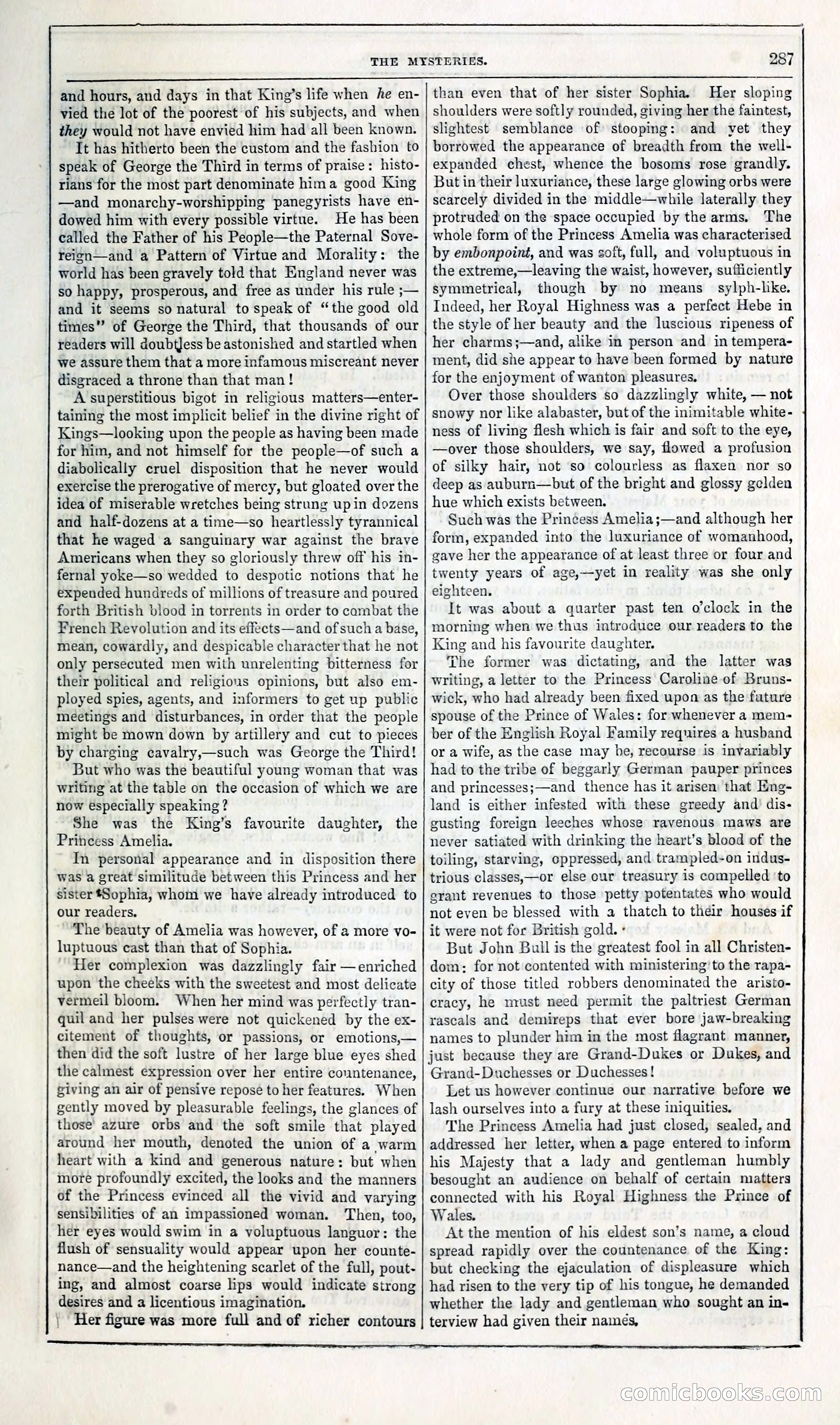
A restored page from Penny Dreadfuls, 1849. Page through the whole issue in the reader above.
📄 Transcribed text from this page (OCR, searchable)
Machine-transcribed from the original scan — historical spelling and the odd misread are preserved.
THE MYSTERIES. } and hours, and days in that King’s life when he en- vied the lot of the poorest of his subjects, and when they would not have envied him had all been known. It has hitherto been the custom and the fashion to speak of George the Third in terms of praise: histo- rians for the most part denominate hima good King —and monarchy-worshipping panegyrists have en- dowed him with every possible virtue. He has been called the Father of his People—the Paternal Sove- reisn—and a Pattern of Virtue and Morality: the world has been gravely told that England never was so happy, prosperous, and free as under his rule ;— and it seems so natural to speak of “the good old times” of George the Third, that thousands of our readers will doubtless be astonished and startled when we assure them that a more infamous miscreant never disgraced a throne than that man! A superstitious bigot in religious matters—enter- taining the most implicit belief in the divine right of Kings—looking upon the people as having been made for him, and not himself for the people—of such a diabolically cruel disposition that he never would exercise the prerogative of mercy, but gloated over the idea of miserable wretches being strung upin dozens and half-dozens at a time—so heartlessly tyrannical that he waged a sanguinary war against the brave Americans when they so gloriously threw off his in- fernal yoke—so wedded to despotic notions that he expended hundreds of millions of treasure and poured forth British blood in torrents in order to cambat the French Revolution and its effects—and of such a base, mean, cowardly, and despicable character that he not only persecuted men with unrelenting bitterness for their political and religions opinions, but also em- ployed spies, agents, and informers to get up public meetings and disturbances, in order that the people might be mown down by artillery and cut to pieces by charging eavalry,—such was George the Third! But who was the beautiful young woman that was writing at the table on the occasion of which we are now especially speaking ? She was the King’s favourite daughter, the Princess Amelia. In personal appearance and in disposition there was a great similitude between this Princess and her sister *Sophia, whom we have already introduced to our readers. ~The beauty of Amelia was however, of a more vo- luptuous cast than that of Sophia. Her complexion was dazzlingly fair — enriched upon the cheeks with the sweetest and most delicate vermeil bloom. When her mind was perfectly tran- quil and her pulses were not quickened by the ex- citement of thoughts, or passions, or emotions,— then did the soft lustre of her large blue eyes shed the calmest expression over her entire countenance, giving an air of pensive repose to her features. When gently moved by pleasurable feelings, the glances of those’ azure orbs and the soft smile that played around her mouth, denoted the union of a warm heart with a kind and generous nature: but when mote profoundly excited, the looks and the manners of the Princess evinced all the vivid and varying sensibilities of an impassioned woman. Then, too, her eyes would swim in a voluptuous languor: the flush of sensuality would appear upon her counte- nance—and the heightening scarlet of the full, pout- ing, and almost coarse lips would indicate strong desires and a licentious imagination. | Her figure was more full and of richer contours er ee 287 than even that of her sister Sophia. Her sloping shoulders were softly rounded, giving her the faintest, slightest semblance of stooping: and vet they borrowed the appearance of breadth from the well- expanded chest, whence the bosoms rose grandly. But in their luxuriance, these large glowing orbs were scarcely divided in the middle—while laterally they protruded on the space occupied by the arms. The whole form of the Princess Amelia was characterised by embonpoint, and was soft, full, and voluptuous in the extreme,—leaving the waist, however, sufficiently symmetrical, though by no means sylph-lke. Indeed, her Royal Highness was a perfect Hebe in the style of her beauty and the luscious ripeness of her charms ;—and, alike in person and in tempera- ment, did she appear to have been formed by nature for the enjoyment of wanton pleasures. Over those shoulders so dazzlingly white, — not snowy nor like alabaster, but of the inimitable white- ness of living flesh which is fair and soft to the eye, —over those shoulders, we say, flowed a profusion of silky hair, not so colourless as flaxen nor so deep as auburn—but of the bright and glossy gelden hue which exists between. Such was the Princess Amelia ;—and although her form, expanded into the luxuriance of womanhood, gave her the appearance of at least three or four and twenty years of age,—yet in reality was she only eighteen. It was about a quarter past ten o’clock in the morning when we thus introduce our readers to the King and his favourite daughter. The former was dictating, and the latter was writing, a letter to the Princess Caroline of Bruns- wick, who had already been fixed upon as the future spouse of the Prince of Wales: for whenever a mem- ber of the English Royal Family requires a husband or a wife, as the case may be, recourse is invariably had to the tribe of beggarly German pauper princes and princesses;—and thence has it arisen that Eng- land is either infested with these greedy and’ dis- gusting foreign leeches whose ravenous maws are never satiated with drinking the heart’s blood of the toiling, starving, oppressed, and trampled-on indus- trious classes,—or else our treasury is compelled ‘to erant revenues to those petty potentates who would not even be blessed with a thatch to their houses if it were not for British gold. ° But John Bull is the greatest fool in all Christen- dom: for not contented with ministering’ to the rapa- city of those titled robbers denominated the aristo- cracy, he must need permit the paltriest German rascals and demireps that ever bore jaw-breaking names to plunder him in the most flagrant manner, just because they are Grand-Dukes or Dukes, and Grand-Duchesses or Duchesses! Let us however continue our narrative before we lash ourselves into a fury at these iniquities. The Princess Amelia had just closed, sealed, and addressed her letter, when a page entered to inform his Majesty that a lady and gentleman humbly besought an audience on behalf of certain matters connected with his Royal Highness the Prince of Wales. At the mention of his eldest son’s name, a cloud spread rapidly over the countenance of the King: but checking the ejaculation of displeasure which had risen to the very tip of his tongue, he demanded whether the lady and gentleman who sought an in- terview had given their names, So 5)(0)©) (C(O) (C©)