
Penny Dreadfuls, 1849 · page 325 of 394
The Mysteries of the Court of London — page 325: what you’re looking at
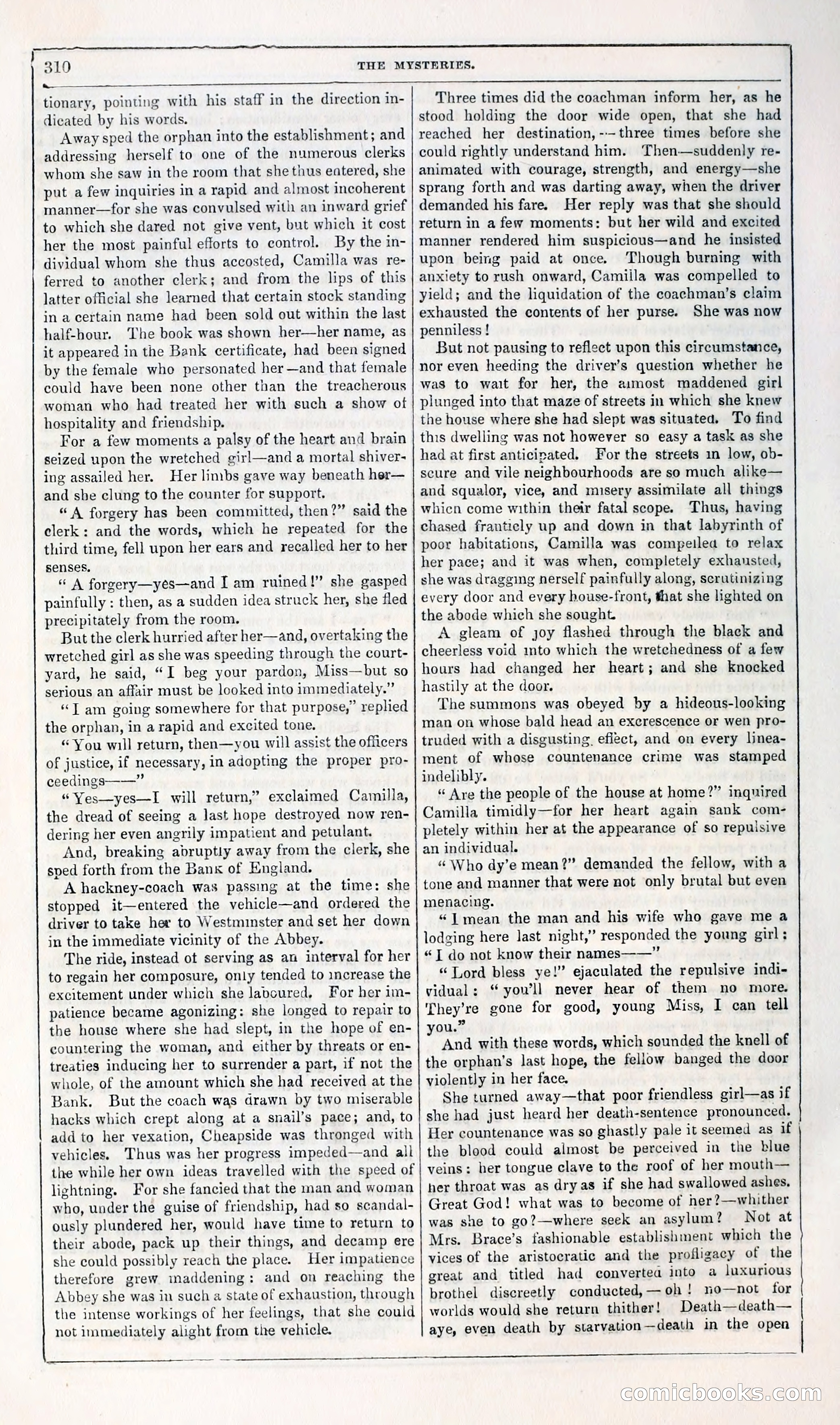
A restored page from Penny Dreadfuls, 1849. Page through the whole issue in the reader above.
📄 Transcribed text from this page (OCR, searchable)
Machine-transcribed from the original scan — historical spelling and the odd misread are preserved.
310 fa tionary, pointing with his staff in the direction in- dicated by his words. Away sped the orphan into the establishment; and addressing herself to one of the numerous clerks whom she saw in the room that she thus eatered, she put a few inquiries in a rapid and almost incoherent manner—for she was convulsed with an inward grief to which she dared not give vent, but which it cost her the most painful efforts to control. By the in- dividual whom she thus accosted, Camilla was re- ferred to another clerk; and from the lips of this latter official she learned that certain stock standing in a certain name had been sold out within the last half-hour. The book was shown her—her name, as it appeared in the Bank certificate, had been signed by the female who personated her —and that female could have been none other than the treacherous woman who had treated her with such a show of hospitality and friendship. For a few moments a palsy of the heart and brain seized upon the wretched girl—and a mortal shiver- ing assailed her. Her linibs gave way beneath her— and sbe clung to the counter for support. “ A forgery has been committed, then?” said the elerk : and the words, which he repeated for the third time, fell upon her ears and recalled her to her senses. “ A forgery—yes—and I am ruined!” she gasped painfully ; then, as a sudden idea struck her, she fled precipitately from the room. But the clerk hurried after her—and, overtaking the wretched girl as she was speeding through the court- yard, he said, “I beg your pardon, Miss—but so serious an affair must be looked into immediately.” “J am going somewhere for that purpose,” replied the orphan, in a rapid and excited tone. “You will return, then—you will assist the officers of justice, if necessary, in adopting the proper pro- ceedings——” “Yes—yes—I will return,” exclaimed Camilla, the dread of seeing a last hope destroyed now ren- dering her even angrily impatient and petulant. And, breaking abruptly away from the clerk, she sped forth from the Bank of England. A hackney-coach was passing at the time: she stopped it—entered the vehicle—and ordered the driver to take her to Westminster and set her down in the immediate vicinity of the Abbey. The ride, instead ot serving as an interval for her to regain her composure, only tended to increase the excitement under which she laboured, For her 1m- patience became agonizing: she longed to repair to the house where she had slept, in the hope of en- countering the woman, and either by threats or en- treaties inducing her to surrender a part, if not the whole, of the amount which she had received at the Bank. But the coach was drawn by two miserable hacks which crept along at a snail’s pace; and, to add to her vexation, Cheapside was thronged with vehicles. Thus was her progress impeded—and all the while her own ideas travelled with the speed of lightning. For she fancied that the man and woman who, under the guise of friendship, had so scandal- ously plundered her, would have time to return to their abode, pack up their things, and decamp ere she could possibly reach the place. Her impatience therefore grew maddening: and on reaching the Abbey she was in such a state of exhaustion, through the intense workings of her feelings, that she could not immediately alight from tite vehicle. THE ————— een MYSTERIES. Three times did the coachman inform her, as he stood holding the door wide open, that she had reached her destination, ---three times before she could rightly understand him. Then—suddenly re- animated with courage, strength, and energy—she sprang forth and was darting away, when the driver demanded his fare. Her reply was that she should return in a few moments: but her wild and excited manner rendered him suspicious—and he insisted upon being paid at once. Though burning with anxiety to rush onward, Camiila was compelled to yield; and the liquidation of the coachman’s claim exhausted the contents of her purse. She was now penniless ! But not pausing to reflect upon this circumstance, nor even heeding the driver’s question whether he was to wait for her, the aimost maddened girl plunged into that maze of streets in which she knew the house where she had slept was situated. To find this dwelling was not however so easy a task as she had at first anticinated. For the streets in low, ob- scure and vile neighbourhoods are so much alike— and squalor, vice, and misery assimilate all things whicn come within their fatal scope. Thus, having chased franticly up and down in that labyrinth of poor habitations, Camilla was compeilea to relax her pace; and it was when, completely exhausted, she was dragging nerself painfully along, scrutinizing every door and every house-front, that she lighted on the abode which she sought. A gleam of joy flashed through the black and cheerless void mto which the wretchedness of a few hours had changed her heart; and she Knocked hastily at the door. The summons was obeyed by a hideous-looking man on whose bald head an excrescence or wen pro- truded with a disgusting. eflect, and on every linea- ment of whose countenance crime was stamped indelibly. “ Are the people of the house at home?” inquired Camilla timidly—for her heart again sank com- pletely within her at the appearance of so repulsive an individual. “ Who dy’e mean?” demanded the fellow, with a tone and manner that were not only brutal but even menacing. “ | mean the man and his wife who gave me a lodging here last night,” responded the young girl; “J do not know their names——” “Lord bless ye!” ejaculated the repulsive indi- vidual: “ you'll never hear of them no more. They’re gone for good, young Miss, I can tell you.” And with these words, which sounded the knell of the orphan’s last hope, the fellow banged the door violently in her face. She turned away—that poor friendless girl—as if she had just heard her death-sentence pronounced. Her countenance was so ghastly pale it seemed as if | the blood could almost be perceived in the blue veins: her tongue clave to the roof of her mouth— her throat was as dry as if she had swallowed ashes. Great God! what was to become of her?—whither was she to go?—where seek an asylum? Not at Mrs. Brace’s fashionable establishment which the vices of the aristocratic and the profligacy of the great and titled had convertea into a luxurious brothel discreetly conducted,—oh! no—not for worlds would she return thither! Death—death— aye, even death by starvation —death in the open SSS (CO) DOO CSE (C(O)