
Penny Dreadfuls, 1849 · page 353 of 394
The Mysteries of the Court of London — page 353: what you’re looking at
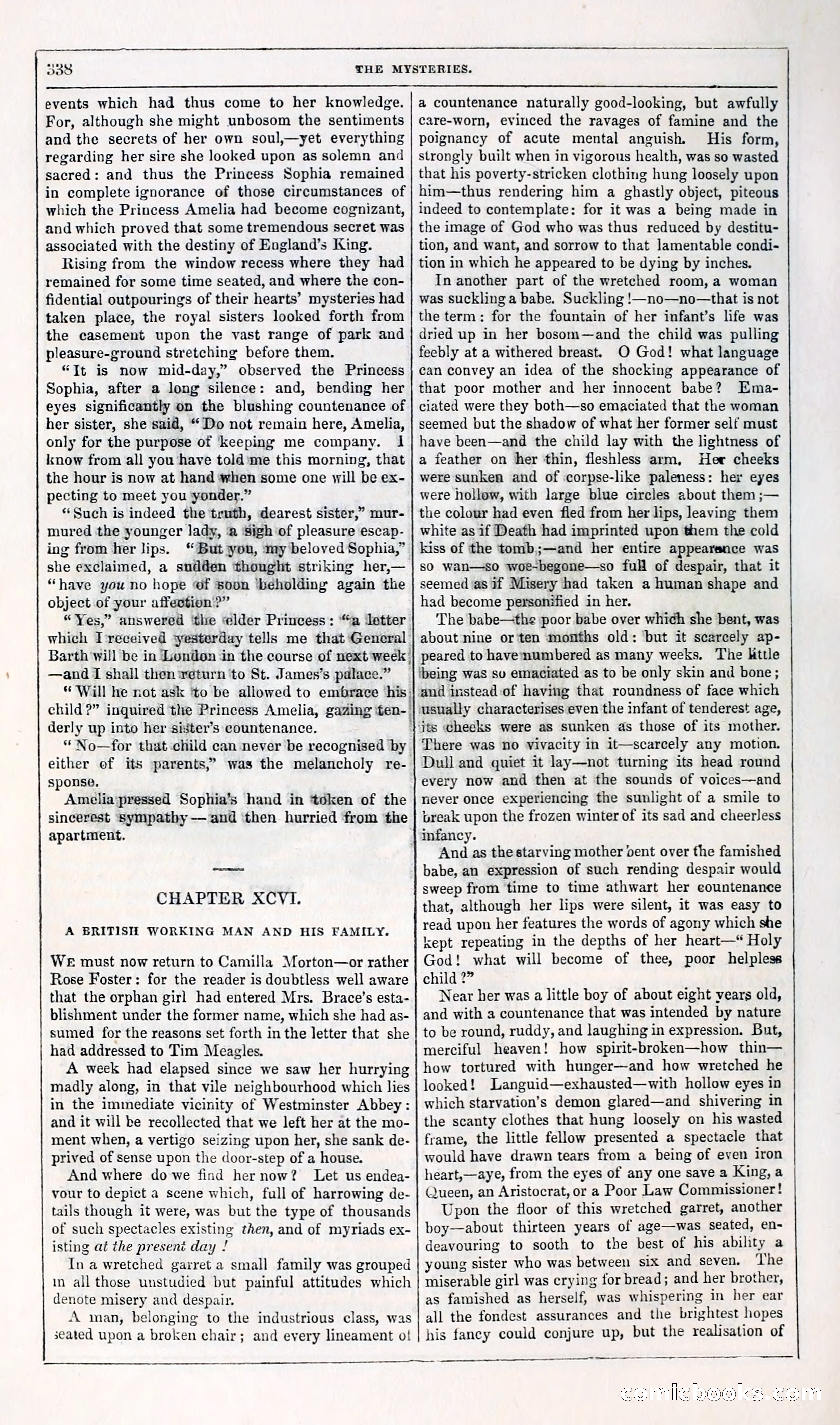
A restored page from Penny Dreadfuls, 1849. Page through the whole issue in the reader above.
📄 Transcribed text from this page (OCR, searchable)
Machine-transcribed from the original scan — historical spelling and the odd misread are preserved.
3358 THE MYSTERIES. events which had thus come to her knowledge. For, although she might unbosom the sentiments and the secrets of her own soul,—yet everything regarding her sire she looked upon as solemn and sacred: and thus the Princess Sophia remained in complete ignorance of those circumstances of which the Princess Amelia had become cognizant, and which proved that some tremendous secret was associated with the destiny of England’s King. Rising from the window recess where they had remained for some time seated, and where the con- fidential outpourings of their hearts’ mysteries had taken place, the royal sisters looked forth from the casement upon the vast range of park and pleasure-ground stretching before them. “It is now mid-day,” observed the Princess Sophia, after a long silence: and, bending her eyes significantly on the blushing countenance of her sister, she said, **Do not remain here, Amelia, only for the purpose of ‘keeping me company. 1 know from all you have told ‘me this morning, that the hour is now at hand when some one will be ex- pecting to meet you yonder.” ‘Such is indeed the truth, dearest sister,” mur- mured the younger lady, a Sigh of pleasure escap- ing from her lips. “ But you, my beloved Sophia,” she exclaimed, a sud@en thought striking her,— “have you no hope @f s00n ‘beholding again the object of your affection?” “Yes,” answered ‘the elder Princess: “a Jetter which I received yesterday tells me that General Barth'will be in Lundon in the course of next week: —and I shall then return ‘to St. James’s palace.” “Will he not ask ‘to be allowed to embrace his: child ?” inguired the Princess Amelia, gazing ten-_ derly up into her sister’s countenance. “ No—for that child can never be recognised by either of its parents,” was the melancholy re- sponse, Ameliapressed Sophia’s hand in token of the sincerest sympathy — and then hurried from the apartment. CHAPTER XCVI. A BRITISH WORKING MAN AND HIS FAMILY. WE must now return to Camilla Morton—or rather Rose Foster: for the reader is doubtless well aware that the orphan girl had entered Mrs. Brace’s esta- blishment under the former name, which she had as- sumed for the reasons set forth in the letter that she had addressed to Tim Meagles. A week had elapsed since we saw her hurrying madly along, in that vile neighbourhood which lies in the immediate vicinity of Westminster Abbey: and it will be recollected that we left her at the mo- ment when, a vertigo seizing upon her, she sank de- prived of sense upon the door-step of a house. And where do we find hernow? Let us endea- vour to depict a scene which, full of harrowing de- tails though it were, was but the type of thousands of such spectacles existing then, and of myriads ex- isting at the present day ! In a wretched garret a small family was grouped in all those unstudied but painful attitudes which denote misery and despair. A man, belonging to the industrious class, was seated upon a broken chair; and every lineament ot! feebly at a withered breast. can convey an idea of the shocking appearance of that poor mother and her innocent babe? ciated were they both—so emaciated that the woman seemed but the shadow of what her former self must a feather on her thin, fleshless arm, were sunken and of corpse-like paleness: her eyes were hollow, with large blue circles about them ;— the colour had even fled from her lips, leaving them a countenance naturally good-looking, but awfully care-worn, evinced the ravages of famine and the poignancy of acute mental anguish. His form, strongly built when in vigorous health, was so wasted that his poverty-stricken clothing hung loosely upon him—thus rendering him a ghastly object, piteous indeed to contemplate: for it was a being made in the image of God who was thus reduced by destitu- tion, and want, and sorrow to that lamentable condi- tion in which he appeared to be dying by inches. In another part of the wretched room, a woman was suckling a babe. Suckling !—no—no—that is not the term: for the fountain of her infant’s life was dried up in her bosom—and the child was pulling O God! what language Ema- have been—and the child lay with the lightness of Her cheeks white as if Death had imprinted upon them the cold kiss of the tomb;—and her entire appearance was sO wan—so woe-begone—so full of despair, that it seemed as 3f Misery had taken a human shape and had become personified in her. The babe—the poor babe over which she bent, was about nine or ten months old: but it scarcely ap- peared to havemumbered as many weeks. The Kittle ‘being was su emaciated as to be only skin and bone; and instead of having that roundness of face which usually characterises even the infant of tenderest age, its cheeks were as sunken as those of its mother. There was no vivacity in it—scarcely any motion. Dull and quiet it lay—not turning its head round every now and then at the sounds of voices—and never once experiencing the sunlight of a smile to break upon the frozen winter of its sad and cheerless Infancy. And as the starving mother bent over fhe famished babe, an expression of such rending despair would sweep from time to time athwart her eountenance that, although her lips were silent, it was easy to read upon her features the words of agony which she kept repeating in the depths of her heart—* Holy God! what will become of thee, poor helpless child 2” Near her was a little boy of about eight vears old, and with a countenance that was intended by nature to be round, ruddy, and laughing in expression. But, merciful heaven! how spirit-broken—how thin— how tortured with hunger—and how wretched he looked! Languid—exhausted—with hollow eyes in which starvation’s demon glared—and shivering in the scanty clothes that hung loosely on his wasted frame, the little fellow presented a spectacle that would have drawn tears from a being of even iron heart,—aye, from the eyes of any one save a King, a Queen, an Aristocrat, or a Poor Law Commissioner! Upon the floor of this wretched garret, another boy—about thirteen years of age—was seated, en- deavouring to sooth to the best of his ability a young sister who was between six and seven. The miserable girl was crying for bread; and her brother, as famished as herself, was whispering in her ear all the fondest assurances and the brightest hopes his fancy could conjure up, but the realisation of acest A LE (C(O) nn) 6)(0)(©) CSE @ (C(O)