
Penny Dreadfuls, 1849 · page 37 of 394
The Mysteries of the Court of London — page 37: what you’re looking at
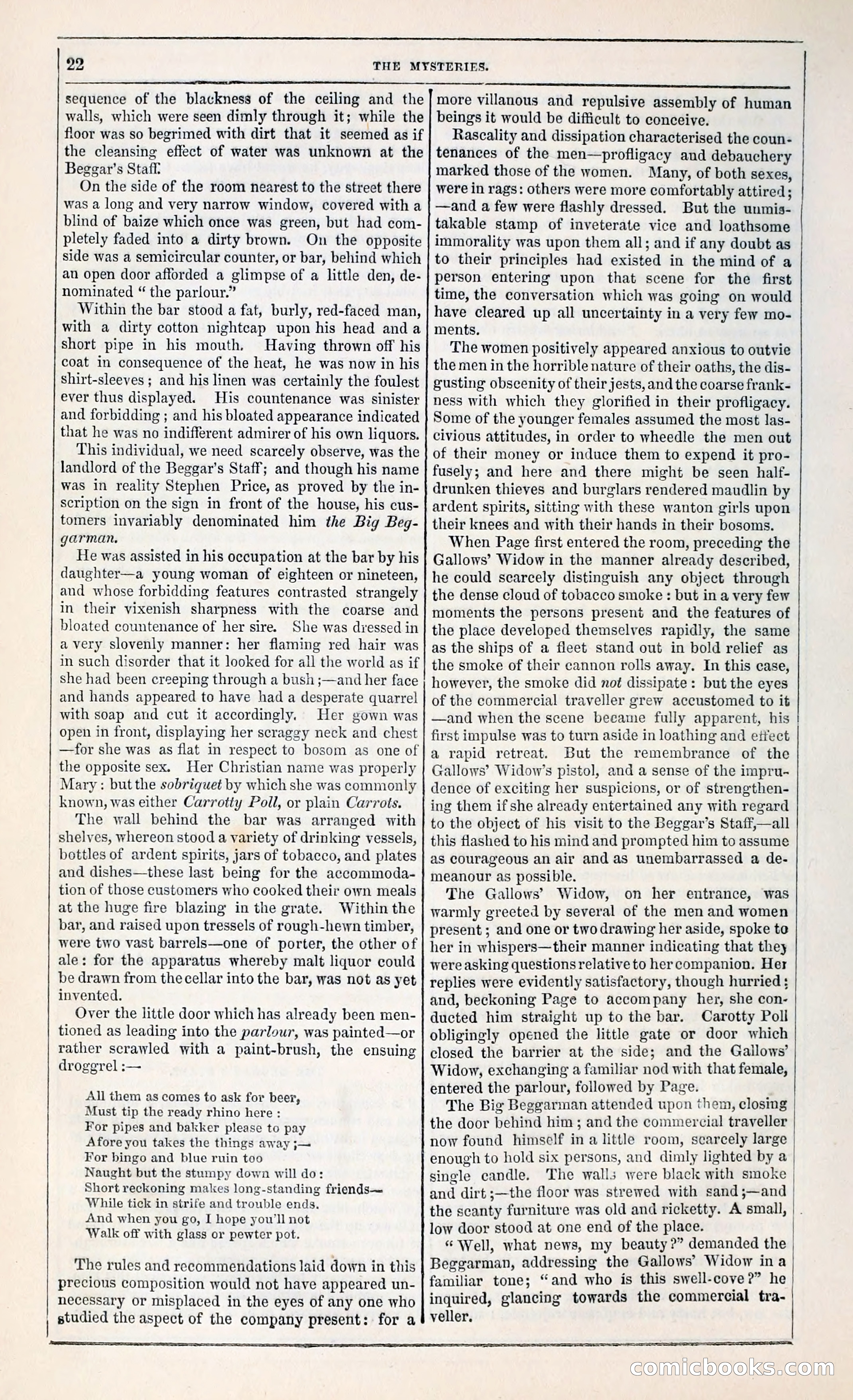
A restored page from Penny Dreadfuls, 1849. Page through the whole issue in the reader above.
📄 Transcribed text from this page (OCR, searchable)
Machine-transcribed from the original scan — historical spelling and the odd misread are preserved.
nme LL LLL LLL LL CC TT CT et tet 22 sequence of the blackness of the ceiling and the walls, which were seen dimly through it; while the floor was so begrimed with dirt that it seemed as if the cleansing effect of water was unknown at the Beggar's Staff. On the side of the room nearest to the street there was a long and very narrow window, covered with a blind of baize which once was green, but had com- pletely faded into a dirty brown. On the opposite side was a semicircular counter, or bar, behind which an open door afforded a glimpse of a little den, de- nominated “ the parlour.” Within the bar stood a fat, burly, red-faced man, with a dirty cotton nightcap upon his head anda short pipe in his mouth. Having thrown off his coat in consequence of the heat, he was now in his shirt-sleeves ; and his linen was certainly the foulest ever thus displayed. His countenance was sinister and forbidding ; and his bloated appearance indicated that he was no indifferent admirer of his own liquors. This individual, we need scarcely observe, was the landlord of the Beggar’s Staff; and though his name was in reality Stephen Price, as proved by the in- scription on the sign in front of the house, his cus- tomers invariably denominated him the Big Beg- garman. He was assisted in his occupation at the bar by his daughter—a young woman of eighteen or nineteen, aud whose forbidding features contrasted strangely in their vixenish sharpness with the coarse and bloated countenance of her sire. She was dressed in a very slovenly manner: her flaming red hair was in such disorder that it looked for all the world as if she had been creeping through a bush ;—and her face and hands appeared to have had a desperate quarrel with soap and cut it accordingly. Her gown was open in front, displaying her scragey neck and chest —for she was as flat in respect to bosom as one of the opposite sex. Her Christian name was properly Mary: but the sobriquet by which she was commonly known, was either Carrotty Poll, or plain Carrots. The wall behind the bar was arranged with shelves, whereon stood a variety of drinking vessels, bottles of ardent spirits, jars of tobacco, and plates and dishes—these last being for the accommoda- tion of those customers who cooked their own meals at the huge fire blazing in the grate. Within the bar, and raised upon tressels of rough-hewn timber, were two vast barrels—one of porter, the other of ale: for the apparatus whereby malt liquor could be drawn from the cellar into the bar, was not as yet invented. Over the little door which has already been men- tioned as leading into the parlour, was painted—or rather scrawled with a paint-brush, the ensuing droggrel :— All them as comes to ask for beer, Must tip the ready rhino here: For pipes and bakker please to pay Afore you takes the things away ;— For bingo and blue ruin too Naught but the stumpy down will do: Short reckoning makes long-standing friends~ While tick in strife and trouble ends. And when you go, I hope you'll not Walk off with glass or pewter pot. The rules and recommendations laid down in this precious composition would not have appeared un- necessary or misplaced in the eyes of any one who | studied the aspect of the company present: for a THE MYSTERIES. eae Lae Meee more villanous and repulsive assembly of human beings it would be difficult to conceive. Rascality and dissipation characterised the coun- tenances of the men—profligacy and debauchery marked those of the women. Many, of both sexes, were in rags: others were more comfortably attired; —and a few were flashly dressed. But the uumis- takable stamp of inveterate vice and loathsome immorality was upon them all; and if any doubt as to their principles had existed in the mind of a person entering upon that scene for the first time, the conversation which was going on would have cleared up all uncertainty in a very few mo- ments. The women positively appeared anxious to outvie the men in the horrible nature of their oaths, the dis- gusting obscenity of their jests, and the coarse frank- ness with which they glorified in their profligacy. Some of the younger females assumed the most las- Civious attitudes, in order to wheedle the men out of their money or induce them to expend it pro- fusely; and here and there might be seen half- drunken thieves and burglars rendered maudlin by ardent spirits, sitting with these wanton girls upon their knees and with their hands in their bosoms. When Page first entered the room, preceding the Gallows’ Widow in the manner already described, he could searcely distinguish any object through the dense cloud of tobacco smoke : but in a very few moments the persons present and the features of the place developed themselves rapidly, the same as the ships of a fleet stand out in bold relief as the smoke of their cannon rolls away. In this ease, however, the smoke did noé dissipate: but the eyes of the commercial traveller grew accustomed to it —and when the scene became fully apparent, his first impulse was to turn aside in loathing and etfect a rapid retreat. But the remembrance of the Gallows’ Widow’s pistol, and a sense of the impru- dence of exciting her suspicions, or of strengthen- ing them if she already entertained any with regard to the object of his visit to the Beggar’s Staff,—all this flashed to his mind and prompted him to assume as courageous an air and as unembarrassed a de- meanour as possible. The Gallows’ Widow, on her entrance, was warmly greeted by several of the men and women present; and one or two drawing her aside, spoke te her in whispers—their manner indicating that they were asking questions relative to hercompanion. Her replies were evidently satisfactory, though hurried ; and, beckoning Page to accompany her, she con- ducted him straight up to the bar. Carotty Poll obligingly opened the little gate or door which closed the barrier at the side; and the Gallows’ Widow, exchanging a familiar nod with that female, entered the parlour, followed by Page. The Big Beggarman attended upon them, closmg the door behind him; and the commercial traveller now found himself in a little room, searcely large enough to hold six persons, and dimly lighted by a single candle. The walls were black with smoke and dirt ;—the floor was strewed with sand ;—and the scanty furniture was old and ricketty. A small, low door stood at one end of the place. “ Well, what news, my beauty?” demanded the Beggarman, addressing the Gallows’ Widow ina familiar tone; “and who is this swell-cove?” he inquired, glancing towards the commercial tra- veller. COLMA ElOoOOKS. COR