
Penny Dreadfuls, 1849 · page 61 of 394
The Mysteries of the Court of London — page 61: what you’re looking at
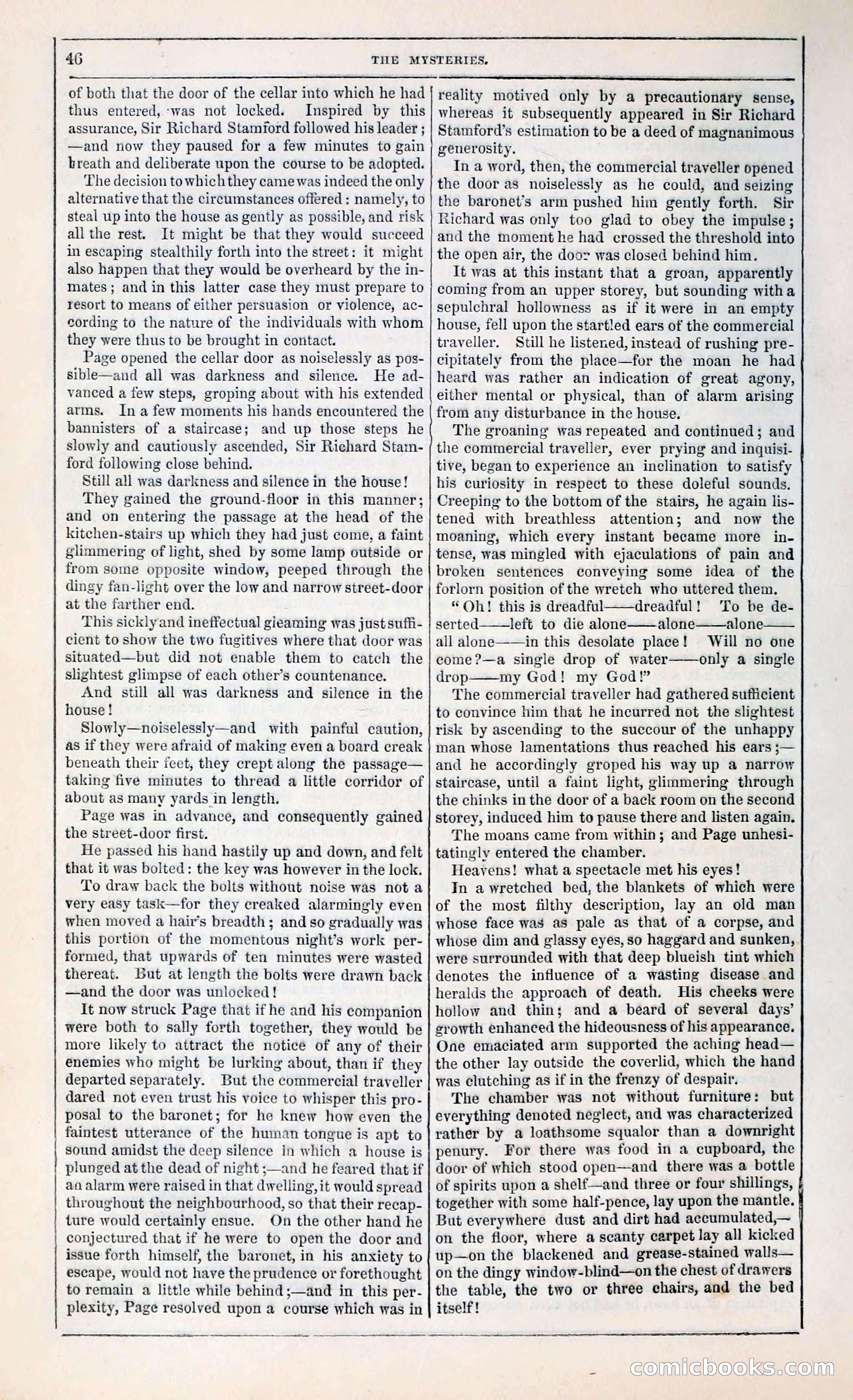
A restored page from Penny Dreadfuls, 1849. Page through the whole issue in the reader above.
📄 Transcribed text from this page (OCR, searchable)
Machine-transcribed from the original scan — historical spelling and the odd misread are preserved.
i eS I 46 of both that the door of the cellar into which he had thus entered, ‘was not locked. Inspired by this assurance, Sir Richard Stamford followed his leader ; —and now they paused for a few minutes to gain breath and deliberate upon the course to be adopted. The decision to which they came was indeed the only alternative that the circumstances offered : namely, to steal up into the house as gently as possible, and risk all the rest. It might be that they would succeed in escaping stealthily forth into the street: it might also happen that they would be overheard by the in- mates ; and in this latter case they must prepare to resort to means of either persuasion or violence, ac- cording to the nature of the individuals with whom they were thus to be brought in contact. Page opened the cellar door as noiselessly as pos- sible—and all was darkness and silence. He ad- vanced a few steps, groping about with his extended arms. In afew moments his hands encountered the bannisters of a staircase; and up those steps he slowly and cautiously ascended, Sir Richard Stam- ford following close behind. Still all was darkness and silence in the house! They gained the ground-floor in this manner; and on entering the passage at the head of the kitchen-stairs up which they had just come, a faint glimmering of light, shed by some lamp outside or from some opposite window, peeped through the dingy fan-light over the low and narrow street-door at the farther end. This sickly and ineffectual gieaming was just suffi- cient to show the two fugitives where that door was situated—but did not enable them to catch the slightest glimpse of each other’s countenance. And still all was darkness and silence in the house! Slowly—noiselessly—and with painful caution, as if they were afraid of making even a board creak beneath their feet, they crept along the passage— taking five minutes to thread a little corridor of about as many yards in length. Page was in advance, and consequently gained the street-door first. He passed his hand hastily up and down, and felt that it was bolted: the key was however in the lock. To draw back the bolts without noise was not a very easy task—for they ecreaked alarmingly even when moved a hair’s breadth; and so gradually was this portion of the momentous night’s work per- formed, that upwards of ten minutes were wasted thereat. But at length the bolts were drawn back —and the door was unlocked! It now struck Page that if he and his companion were both to sally forth together, they would be more likely to attract the notice of any of their enemies who might be lurking about, than if they departed separately. But the commercial traveller dared not even trust his voice to whisper this pro- posal to the baronet; for he knew how even the faintest utterance of the human tongue is apt to sound amidst the deep silence in which a house is plunged atthe dead of night ;—and he feared that if an alarm were raised in that dwelling, it would spread throughout the neighbourhood, so that their recap- ture would certainly ensue. On the other hand he conjectured that if he were to open the door and issue forth himself, the baronet, in his anxiety to escape, would not have the prudence or forethought to remain a little while behind ;—and in this per- plexity, Page resolved upon a course which was in ee ee SS THE MYSTERIES. reality motived only by a precautionary sense, whereas it subsequently appeared in Sir Richard Stamford’s estimation to be a deed of magnanimous generosity. In a word, then, the commercial traveller opened the door as noiselessly as he could, and seizing the baronet’s arm pushed him gently forth. Sir Richard was only too glad to obey the impulse; and the moment he had crossed the threshold into the open air, the door was closed behind him. It was at this instant that a groan, apparently coming from an upper storey, but sounding witha sepulchral hollowness as if it were in an empty house, fell upon the startied ears of the commercial traveller. Still he listened, instead of rushing pre- cipitately from the place—for the moan he had heard was rather an indication of great agony, either mental or physical, than of alarm arising from any disturbance in the house. The groaning was repeated and continued; and the commercial traveller, ever prying and inquisi- tive, began to experience an inclination to satisfy his curiosity in respect to these doleful sounds. Creeping to the bottom of the stairs, he again lis- tened with breathless attention; and now the moaning, which every instant became more in- tense, was mingled with ejaculations of pain and broken sentences conveying some idea of the forlorn position of the wretch who uttered them. “Oh! this is dreadful——dreadful! To be de- serted——_left to die alone——alone——alone—— all alone——in this desolate place! Will no one come ?—a single drop of water——only a single drop——my God! my God!” The commercial traveller had gathered sufficient to convince him that he incurred not the slightest risk by ascending to the succour of the unhappy man whose lamentations thus reached his ears ;— and he accordingly groped his way up a narrow staircase, until a faint light, glimmering through the chinks in the door of a back room on the second storey, induced him to pause there and listen again. The moans came from within; and Page unhesi- tatingly entered the chamber. Heavens! what a spectacle met his eyes! In a wretched bed, the blankets of which were of the most filthy description, lay an old man whose face was as pale as that of a corpse, and whose dim and glassy eyes, so haggard and sunken, were surrounded with that deep blueish tint which denotes the influence of a wasting disease and heralds the approach of death. His cheeks were hollow and thins and a beard of several days’ srowth enhanced the hideousness of his appearance. One emaciated arm supported the aching head— the other lay outside the coverlid, which the hand was clutching as if in the frenzy of despair. The chamber was not without furniture: but everything denoted neglect, and was characterized rather by a loathsome squalor than a downright penury. For there was food in a cupboard, the door of which stood open—and there was a bottle of spirits upon a shelf—and three or four shillings, together with some half-pence, lay upon the mantle. But everywhere dust and dirt had accumulated,— on the floor, where a scanty carpet lay all kicked up—on the blackened and grease-stained walls— on the dingy window-blind—on the chest of drawers the table, the two or three chairs, and the bed itself! —_—— ~~} - = COLMA (ElNOO|KS, CON