
Penny Dreadfuls, 1849 · page 68 of 394
The Mysteries of the Court of London — page 68: what you’re looking at
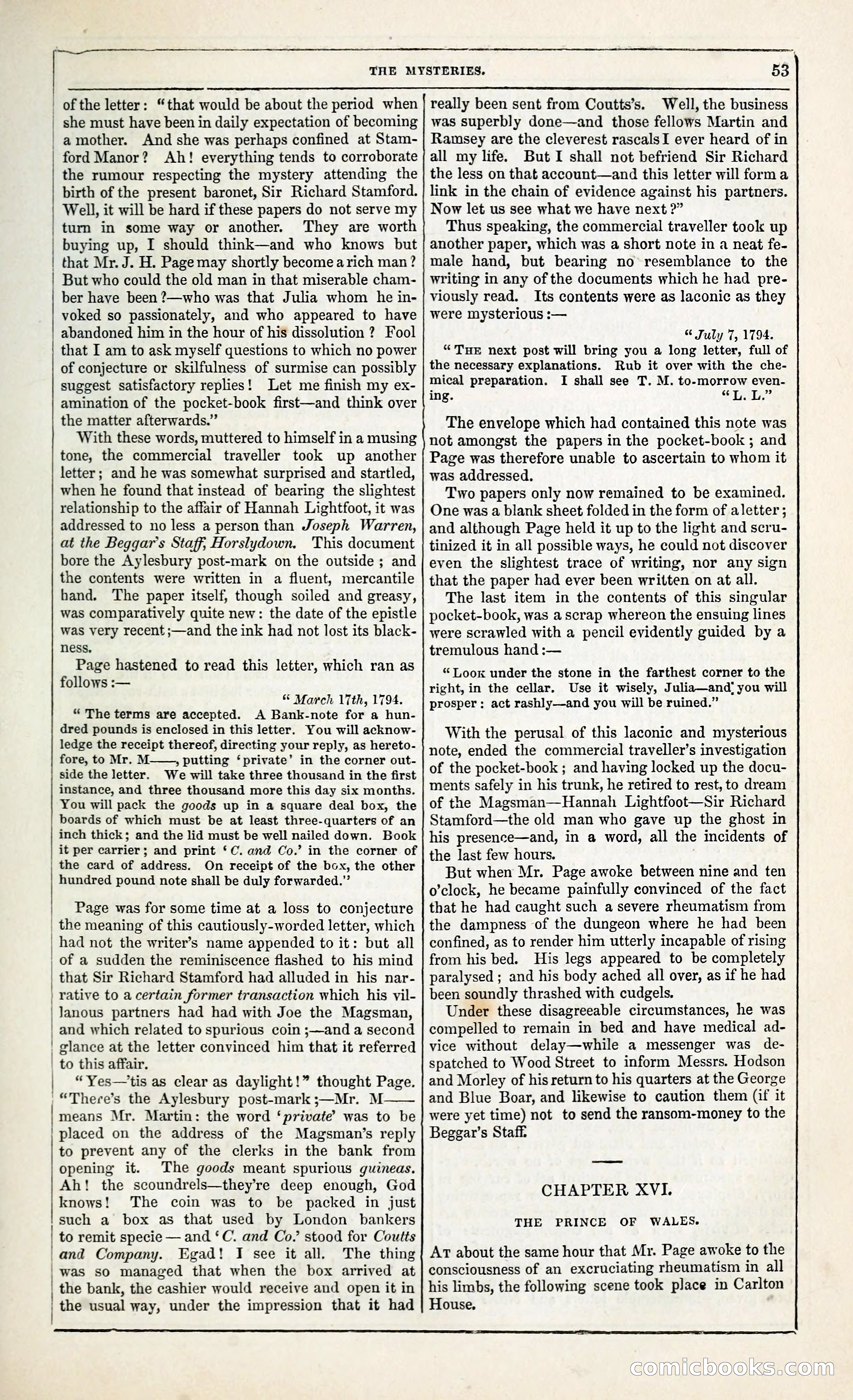
A restored page from Penny Dreadfuls, 1849. Page through the whole issue in the reader above.
📄 Transcribed text from this page (OCR, searchable)
Machine-transcribed from the original scan — historical spelling and the odd misread are preserved.
THE MYSTERIES. | of the letter: “that would be about the period when _ she must have been in daily expectation of becoming _amother. And she was perhaps confined at Stam- ford Manor? Ah! everything tends to corroborate the rumour respecting the mystery attending the birth of the present baronet, Sir Richard Stamford. Well, it will be hard if these papers do not serve my _turn in some way or another. They are worth buying up, I should think—and who knows but that Mr. J. H. Page may shortly become arich man? But who could the old man in that miserable cham- ber have been ?—who was that Julia whom he in- voked so passionately, and who appeared to have abandoned him in the hour of his dissolution ? Fool that I am to ask myself questions to which no power of conjecture or skilfulness of surmise can possibly suggest satisfactory replies! Let me finish my ex- amination of the pocket-book first—and think over the matter afterwards.” With these words, muttered to himself in a musing tone, the commercial traveller took up another letter; and he was somewhat surprised and startled, when he found that instead of bearing the slightest relationship to the affair of Hannah Lightfoot, it was addressed to no less a person than Joseph Warren, at the Beggar's Staff, Horslydown. This document bore the Aylesbury post-mark on the outside; and the contents were written in a fluent, mercantile hand. The paper itself, though soiled and greasy, was comparatively quite new: the date of the epistle was very recent ;—and the ink had not lost its black- ness. Page hastened to read this letter, which ran as follows :— i ® March 17th, 1794. “ The terms are accepted. A Bank-note for a hun- dred pounds is enclosed in this letter. You will acknow- ledge the receipt thereof, directing your reply, as hereto- fore, to Mr. M , putting ‘private’ in the corner out- side the letter. We will take three thousand in the first instance, and three thousand more this day six months. You will pack the goods up in a square deal box, the boards of which must be at least three-quarters of an inch thick; and the lid must be well nailed down. Book it per carrier; and print ‘C. and Co.’ in the corner of the card of address. On receipt of the box, the other hundred pound note shall be duly forwarded.” Page was for some time at a loss to conjecture | the meaning of this cautiously-worded letter, which had not the writer’s name appended to it: but all | of a sudden the reminiscence flashed to his mind that Sir Richard Stamford had alluded in his nar- | rative to a certain former transaction which his vil- _Janous partners had had with Joe the Magsman, | and which related to spurious coin ;~—and a second _ glance at the letter convinced him that it referred to this affair. “Yes—tis as clear as daylight!” thought Page. “Thece’s the Aylesbury post-mark;—Mr. M means Mr. Martin: the word ‘private’ was to be _placed on the address of the Magsman’s reply to prevent any of the clerks in the bank from opening it. The goods meant spurious guineas. Ah! the scoundrels—theyre deep enough, God knows! The coin was to be packed in just such a box as that used by London bankers to remit specie — and ‘C. and Co,’ stood for Coutts and Company. FEgad! I see it all. The thing /was so managed that when the box arrived at | the bank, the cashier would receive and open it in | the usual way, under the impression that it had 53 really been sent from Coutts’s. Well, the business was superbly done—and those fellows Martin and Ramsey are the cleverest rascalsI ever heard of in all my life. But I shall not befriend Sir Richard the less on that account—and this letter will form a link in the chain of evidence against his partners. Now let us see what we have next ?” Thus speaking, the commercial traveller took up another paper, which was a short note in a neat fe- male hand, but bearing no resemblance to the writing in any of the documents which he had pre- viously read. Its contents were as laconic as they were mysterious :— “& July 7, 1794. “THE next post will bring you a long letter, full of the necessary explanations. Rub it over with the che- mical preparation. I shall see T. M. to-morrow even- ing. ad bed Ve The envelope which had contained this note was not amongst the papers in the pocket-book ; and Page was therefore unable to ascertain to whom it was addressed. Two papers only now remained to be examined. One was a blank sheet folded in the form of aletter; and although Page held it up to the light and scru- tinized it in all possible ways, he could not discover even the slightest trace of writing, nor any sign that the paper had ever been written on at all. The last item in the contents of this singular pocket-book, was a scrap whereon the ensuing lines were scrawled with a pencil evidently guided by a tremulous hand :— “Loox under the stone in the farthest corner to the right, in the cellar. Use it wisely, Julia—and_ you will prosper: act rashly—and you will be ruined.” With the perusal of this laconic and mysterious note, ended the commercial traveller’s investigation of the pocket-book ; and having locked up the docu- ments safely in his trunk, he retired to rest, to dream of the Magsman—Hannah Lightfoot—Sir Richard Stamford—the old man who gave up the ghost in his presence—and, in a word, all the incidents of the last few hours. But when Mr. Page awoke between nine and ten o’clock, he became painfully convinced of the fact that he had caught such a severe rheumatism from the dampness of the dungeon where he had been confined, as to render him utterly incapable of rising from his bed. His legs appeared to be completely paralysed ; and his body ached all over, as if he had been soundly thrashed with cudgels. Under these disagreeable circumstances, he was compelled to remain in bed and have medical ad- vice without delay—while a messenger was de- spatched to Wood Street to inform Messrs. Hodson and Morley of his return to his quarters at the George and Blue Boar, and likewise to caution them (if it were yet time) not to send the ransom-money to the Beggar’s Staff. CHAPTER XVI. THE PRINCE OF WALES. AT about the same hour that Mr. Page awoke to the consciousness of an excruciating rheumatism in all his limbs, the following scene took place in Carlton House, com Elooolks.conn