
Penny Dreadfuls, 1849 · page 87 of 394
The Mysteries of the Court of London — page 87: what you’re looking at
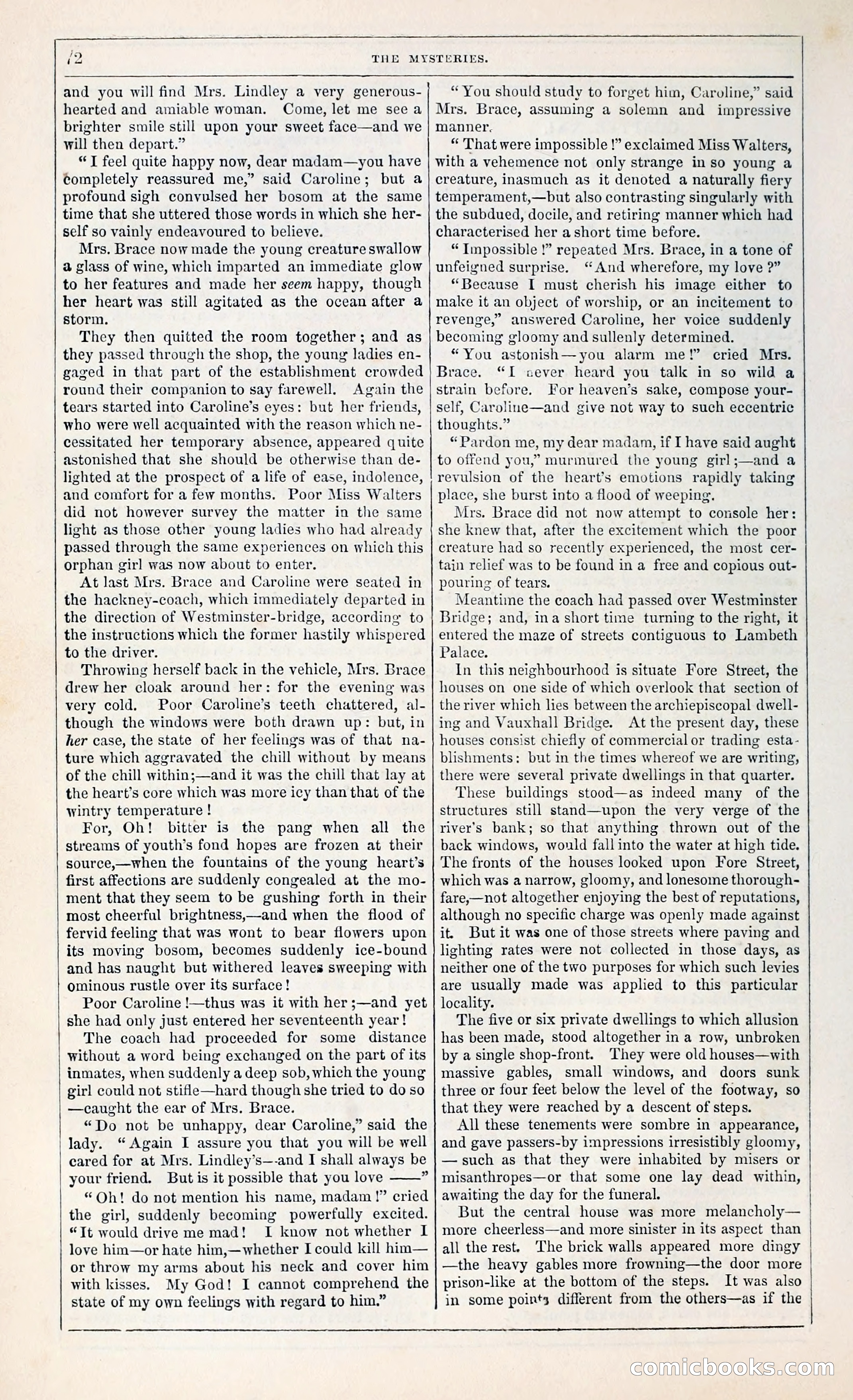
A restored page from Penny Dreadfuls, 1849. Page through the whole issue in the reader above.
📄 Transcribed text from this page (OCR, searchable)
Machine-transcribed from the original scan — historical spelling and the odd misread are preserved.
(2 THE MYSTERIES. and you will find Mrs. Lindley a very generous- hearted and amiable woman. Come, let me see a brighter smile still upon your sweet face—and we will then depart.” “TJ feel quite happy now, dear madam—you have completely reassured me,” said Caroline; but a profound sigh convulsed her bosom at the same time that she uttered those words in which she her- self so vainly endeavoured to believe. Mrs. Brace now made the young creature swallow a glass of wine, which imparted an immediate glow to her features and made her seem happy, though her heart was still agitated as the ocean after a storm. They then quitted the room together; and as they passed through the shop, the young ladies en- gaged in that part of the establishment crowded round their companion to say farewell. Again the tears started into Caroline’s eyes: but her friends, who were well acquainted with the reason which ne- cessitated her temporary absence, appeared quite astonished that she should be otherwise than de- lighted at the prospect of a life of ease, indolence, and comfort for a few months. Poor Miss Walters did not however survey the matter in the same light as those other young ladies who had already passed through the same experiences on which this orphan girl was now about to enter. At last Mrs. Brace and Caroline were seated in the hackney-coach, which immediately departed in the direction of Westminster-bridge, according to the instructions which the former hastily whispered to the driver. Throwing herself back in the vehicle, Mrs. Brace drew her cloak around her: for the evening was very cold. Poor Caroline’s teeth chattered, al- though the windows were both drawn up: but, in her case, the state of her feelings was of that na- ture which aggravated the chill without by means of the chill within;—and it was the chill that lay at the heart’s core which was more icy than that of the wintry temperature ! For, Oh! bitter is the pang when all the streams of youth’s fond hopes are frozen at their source,—when the fountains of the young heart’s first affections are suddenly congealed at the mo- ment that they seem to be gushing forth in their most cheerful brightness,—and when the flood of fervid feeling that was wont to bear flowers upon its moving bosom, becomes suddenly ice-bound and has naught but withered leaves sweeping with ominous rustle over its surface! Poor Caroline !—thus was it with her ;—and yet she had only just entered her seventeenth year! The coach had proceeded for some distance without a word being exchanged on the part of its inmates, when suddenly a deep sob, which the young girl could not stifle—hard though she tried to do so —caught the ear of Mrs. Brace. “Do not be unhappy, dear Caroline,” said the lady. “Again I assure you that you will be well cared for at Mrs. Lindley’s—-and I shall always be your friend. But is it possible that you love ——” “Oh! do not mention his name, madam !” cried the girl, suddenly becoming powerfully excited. “Tt would drive me mad! I know not whether I love him—or hate him,—whether I could kill him— or throw my arms about his neck and cover him with kisses. My God! I cannot comprehend the state of my own feelings with regard to him.” “You should study to forget him, Caroline,” said Mrs. Brace, assuming a solemn and impressive manner. “That were impossible !” exclaimed Miss Walters, with a vehemence not only strange in so young a creature, inasmuch as it denoted a naturally fiery temperament,—but also contrasting singularly with the subdued, docile, and retiring manner which had characterised her a short time before. “ Impossible !” repeated Mrs. Brace, in a tone of unfeigned surprise. “And wherefore, my love ?” * Because I must cherish his image either to make it an object of worship, or an incitement to revenge,” answered Caroline, her voice suddenly becoming gloomy and sullenly determined. “You astonish—you alarm me!” cried Mrs. Brace. “I cever heard you talk in so wild a strain before. For heaven’s sake, compose your- self, Caroline—and give not way to such eccentric thoughts.” “Pardon me, my dear madam, if I have said aught to offend you,” murmured the young girl;—and a revulsion of the heart’s emotions rapidly taking place, she burst into a flood of weeping. Mrs. Brace did not now attempt to console her: she knew that, after the excitement which the poor creature had so recently experienced, the most cer- tain relief was to be found in a free and copious out- pouring of tears. Meantime the coach had passed over Westminster Bridge; and, ina short time turning to the right, it entered the maze of streets contiguous to Lambeth Palace. In this neighbourhood is situate Fore Street, the houses on one side of which overlook that section of the river which lies between the archiepiscopal dwell- ing and Vauxhall Bridge. At the present day, these houses consist chiefly of commercial or trading esta- blishments: but in the times whereof we are writing, there were several private dwellings in that quarter. These buildings stood—as indeed many of the structures still stand—upon the very verge of the river's bank; so that anything thrown out of the back windows, would fall into the water at high tide. The fronts of the houses looked upon Fore Street, which was a narrow, gloomy, and lonesome thorough- fare,—not altogether enjoying the best of reputations, although no specific charge was openly made against it. But it was one of those streets where paving and lighting rates were not collected in those days, as neither one of the two purposes for which such levies are usually made was applied to this particular locality. The five or six private dwellings to which allusion has been made, stood altogether in a row, unbroken by a single shop-front. They were old houses—with massive gables, small windows, and doors sunk three or four feet below the level of the footway, so that they were reached by a descent of steps. All these tenements were sombre in appearance, and gave passers-by impressions irresistibly gloomy, — such as that they were inhabited by muisers or misanthropes—or that some one lay dead within, awaiting the day for the funeral. But the central house was more melancholy— more cheerless—and more sinister in its aspect than all the rest. The brick walls appeared more dingy —the heavy gables more frowning—the door more prison-like at the bottom of the steps. It was also in some points different from the others—as if the COMA (EloOOKS. COR