
Penny Dreadfuls, 1860 · page 177 of 391
The Mysteries of the Court of London — page 177: what you’re looking at
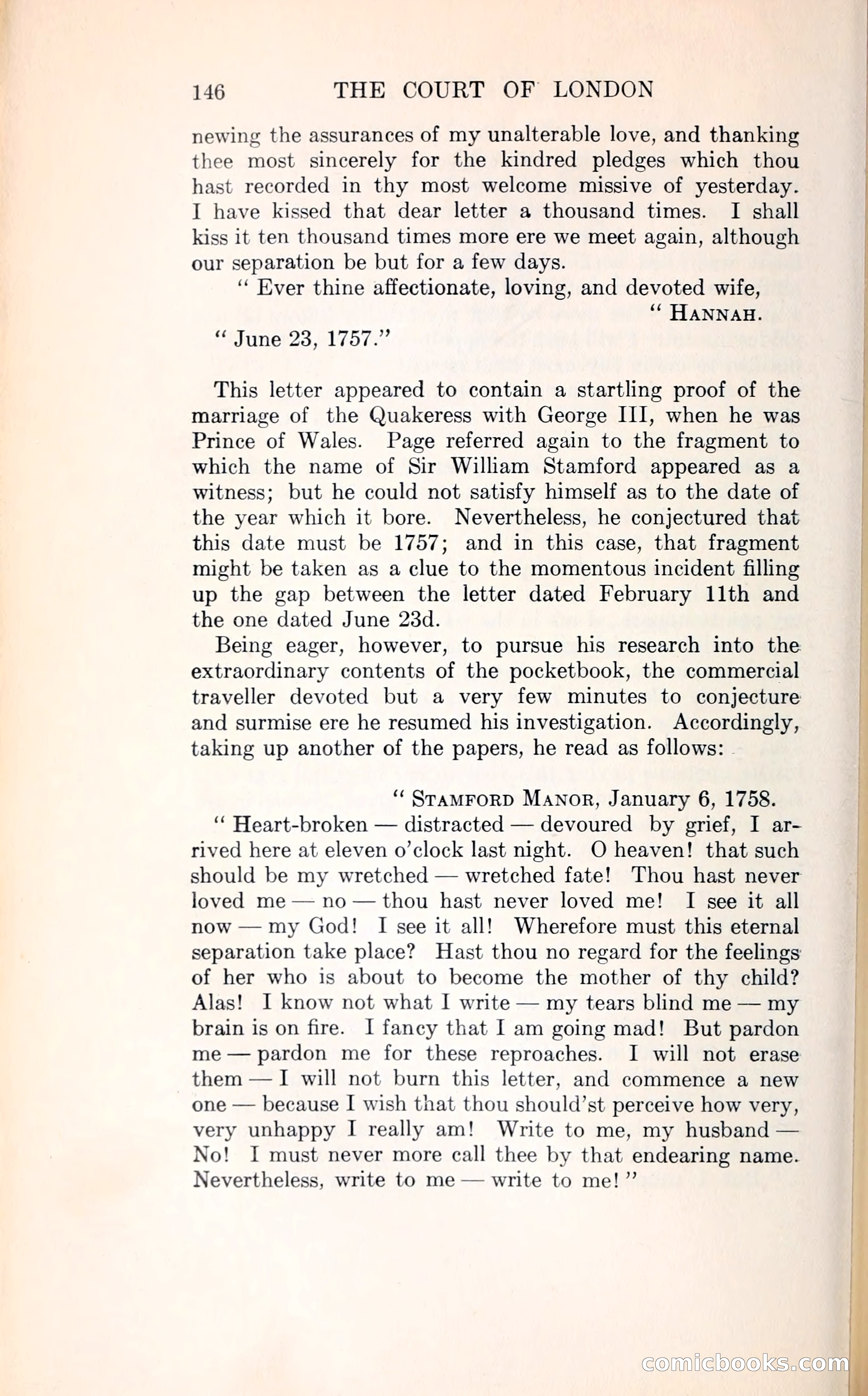
A restored page from Penny Dreadfuls, 1860. Page through the whole issue in the reader above.
📄 Transcribed text from this page (OCR, searchable)
Machine-transcribed from the original scan — historical spelling and the odd misread are preserved.
146 THE COURT OF LONDON newing the assurances of my unalterable love, and thanking thee most sincerely for the kindred pledges which thou hast recorded in thy most welcome missive of yesterday. I have kissed that dear letter a thousand times. I shall kiss it ten thousand times more ere we meet again, although our separation be but for a few days. ‘“ Ever thine affectionate, loving, and devoted wife, ‘““ HANNAH. ‘sJune’25,1757.-° This letter appeared to contain a startling proof of the marriage of the Quakeress with George III, when he was Prince of Wales. Page referred again to the fragment to which the name of Sir Wiliam Stamford appeared as a witness; but he could not satisfy himself as to the date of the year which it bore. Nevertheless, he conjectured that this date must be 1757; and in this case, that fragment might be taken as a clue to the momentous incident filling up the gap between the letter dated February 11th and the one dated June 28d. Being eager, however, to pursue his research into the extraordinary contents of the pocketbook, the commercial traveller devoted but a very few minutes to conjecture and surmise ere he resumed his investigation. Accordingly, taking up another of the papers, he read as follows: - ‘““ STAMFORD Manor, January 6, 1758. ‘““ Heart-broken — distracted — devoured by grief, I ar- rived here at eleven o’clock last night. O heaven! that such should be my wretched — wretched fate! Thou hast never loved me — no — thou hast never loved me! I see it all now — my God! I see it all! Wherefore must this eternal separation take place? Hast thou no regard for the feelings of her who is about to become the mother of thy child? Alas! I know not what I write — my tears blind me — my brain is on fire. I fancy that I am going mad! But pardon me — pardon me for these reproaches. I will not erase them — I will not burn this letter, and commence a new one — because I wish that thou should’st perceive how very, very unhappy I really am! Write to me, my husband — No! I must never more call thee by that endearing name. Nevertheless, write to me — write to me! ”’ CONnniec OOOkKS.C@)