
Penny Dreadfuls, 1860 · page 112 of 394
The Mysteries of the Court of London — page 112: what you’re looking at
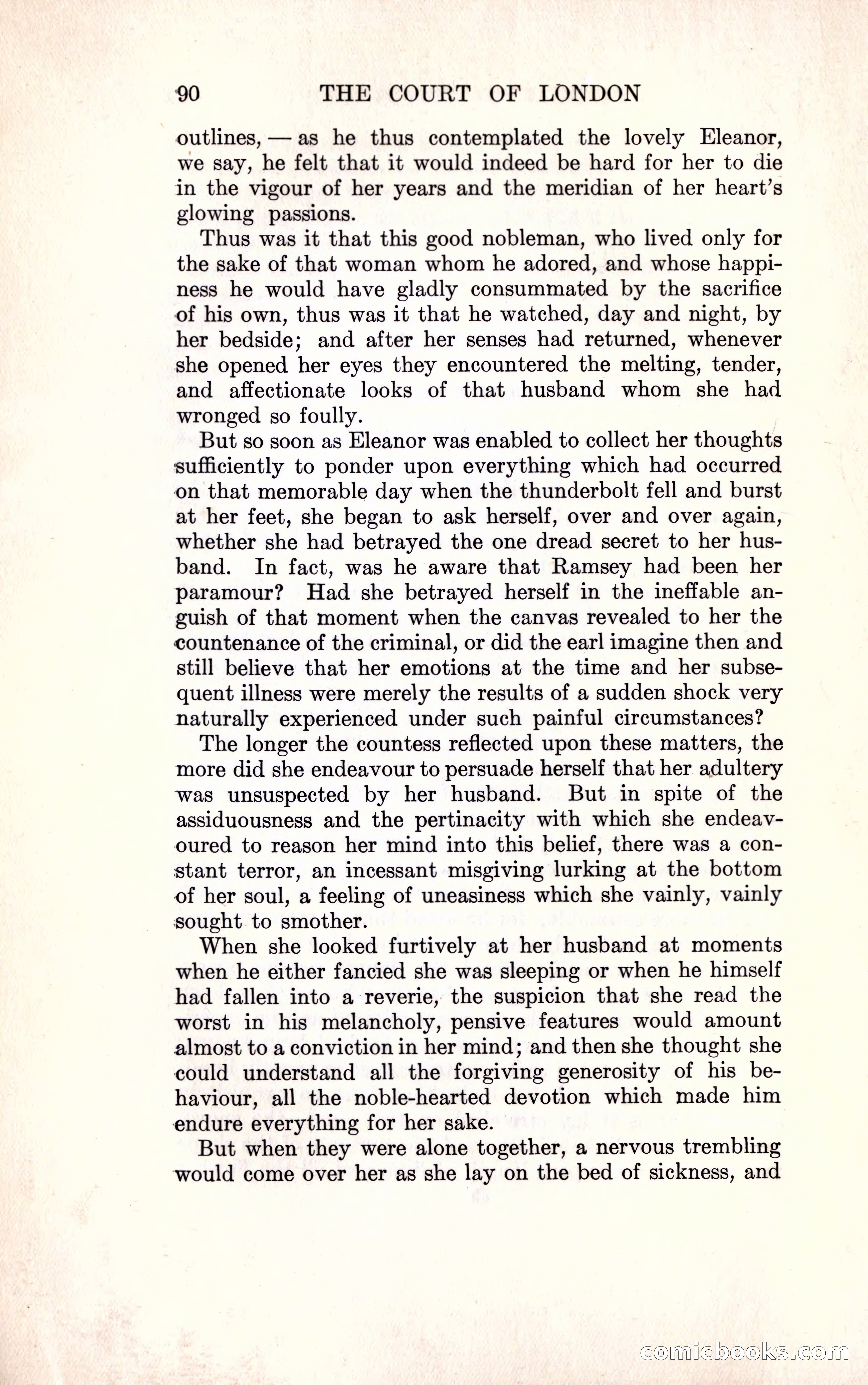
A restored page from Penny Dreadfuls, 1860. Page through the whole issue in the reader above.
📄 Transcribed text from this page (OCR, searchable)
Machine-transcribed from the original scan — historical spelling and the odd misread are preserved.
‘90 THE COURT OF LONDON outlines, — as he thus contemplated the lovely Eleanor, we say, he felt that it would indeed be hard for her to die in the vigour of her years and the meridian of her heart’s glowing passions. Thus was it that this good nobleman, who lived only for the sake of that woman whom he adored, and whose happi- ness he would have gladly consummated by the sacrifice of his own, thus was it that he watched, day and night, by her bedside; and after her senses had returned, whenever she opened her eyes they encountered the melting, tender, and affectionate looks of that husband whom she had wronged so foully. But so soon as Eleanor was enabled to collect her thoughts sufficiently to ponder upon everything which had occurred on that memorable day when the thunderbolt fell and burst at her feet, she began to ask herself, over and over again, whether she had betrayed the one dread secret to her hus- band. In fact, was he aware that Ramsey had been her paramour? Had she betrayed herself in the ineffable an- guish of that moment when the canvas revealed to her the countenance of the criminal, or did the earl imagine then and still believe that her emotions at the time and her subse- quent illness were merely the results of a sudden shock very naturally experienced under such painful circumstances? The longer the countess reflected upon these matters, the more did she endeavour to persuade herself that her adultery was unsuspected by her husband. But in spite of the assiduousness and the pertinacity with which she endeav- oured to reason her mind into this belief, there was a con- stant terror, an incessant misgiving lurking at the bottom of her soul, a feeling of uneasiness which she vainly, vainly sought to smother. When she looked furtively at her husband at moments when he either fancied she was sleeping or when he himself had fallen into a reverie, the suspicion that she read the worst in his melancholy, pensive features would amount almost to a conviction in her mind; and then she thought she could understand all the forgiving generosity of his be- haviour, all the noble-hearted devotion which made him endure everything for her sake. - But when they were alone together, a nervous trembling would come over her as she lay on the bed of sickness, and COmiclboookSs.: