
Penny Dreadfuls, 1860 · page 264 of 394
The Mysteries of the Court of London — page 264: what you’re looking at
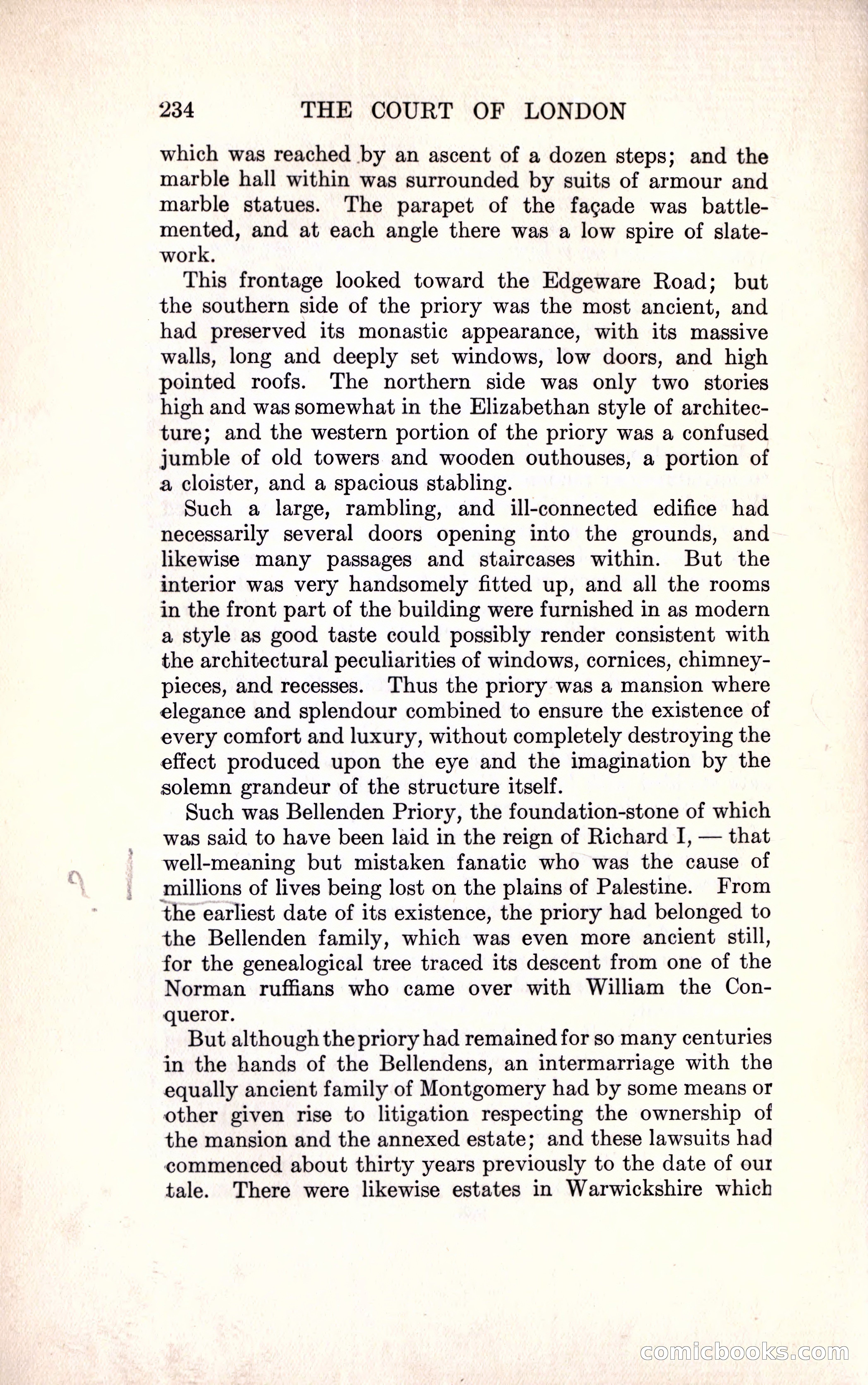
A restored page from Penny Dreadfuls, 1860. Page through the whole issue in the reader above.
📄 Transcribed text from this page (OCR, searchable)
Machine-transcribed from the original scan — historical spelling and the odd misread are preserved.
234 THE COURT OF LONDON which was reached by an ascent of a dozen steps; and the marble hall within was surrounded by suits of armour and marble statues. The parapet of the facade was battle- mented, and at each angle there was a low spire of slate- work. This frontage looked toward the Edgeware Road; but the southern side of the priory was the most ancient, and had preserved its monastic appearance, with its massive walls, long and deeply set windows, low doors, and high pointed roofs. The northern side was only two stories high and was somewhat in the Elizabethan style of architec- ture; and the western portion of the priory was a confused jumble of old towers and wooden outhouses, a portion of a cloister, and a spacious stabling. Such a large, rambling, and ill-connected edifice had necessarily several doors opening into the grounds, and likewise many passages and staircases within. But the interior was very handsomely fitted up, and all the rooms in the front part of the building were furnished in as modern a style as good taste could possibly render consistent with the architectural peculiarities of windows, cornices, chimney- pieces, and recesses. Thus the priory was a mansion where elegance and splendour combined to ensure the existence of every comfort and luxury, without completely destroying the effect produced upon the eye and the imagination by the solemn grandeur of the structure itself. Such was Bellenden Priory, the foundation-stone of which was said to have been laid in the reign of Richard I, — that well-meaning but mistaken fanatic who was the cause of millions of lives being lost on the plains of Palestine. From the earliest date of its existence, the priory had belonged to the Bellenden family, which was even more ancient still, for the genealogical tree traced its descent from one of the Norman ruffians who came over with William the Con- queror. But although the priory had remained for so many centuries in the hands of the Bellendens, an intermarriage with the equally ancient family of Montgomery had by some means or other given rise to litigation respecting the ownership of the mansion and the annexed estate; and these lawsuits had commenced about thirty years previously to the date of our tale. There were likewise estates in Warwickshire which COnmicbooolks (C(O)