
Penny Dreadfuls, 1849 · page 130 of 394
The Mysteries of the Court of London — page 130: what you’re looking at
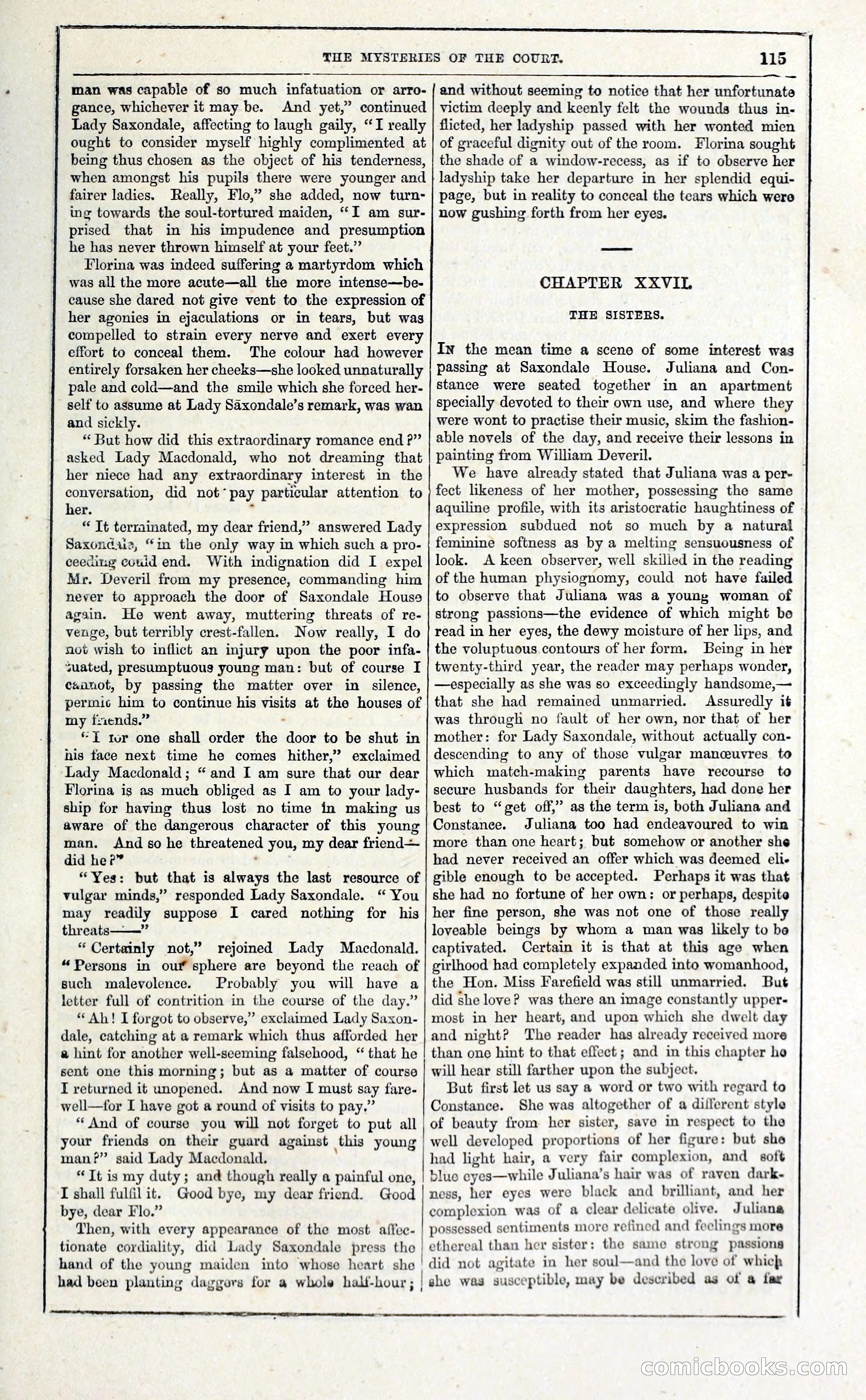
A restored page from Penny Dreadfuls, 1849. Page through the whole issue in the reader above.
📄 Transcribed text from this page (OCR, searchable)
Machine-transcribed from the original scan — historical spelling and the odd misread are preserved.
SN See THE MYSTERIES OF THE COURT. man was capable of so much infatuation or arro- - gance, whichever it may be. And yet,” continued Lady Saxondale, affecting to laugh gaily, “TI really ought to consider myself highly complimented at being thus chosen as the object of his tenderness, when amongst his pupils there were younger and fairer ladies. Really, Flo,” she added, now turn- ing towards the soul-tortured maiden, “I am sur- prised that in his impudence and presumption he has never thrown himself at your feet.” Florina was indeed suffering a martyrdom which was all the more acute—all the more intense—be- cause she dared not give vent to the expression of her agonies in ejaculations or in tears, but was compelled to strain every nerve and exert every effort to conceal them. The colour had however entirely forsaken her cheeks—she looked unnaturally pale and cold—and the smile which she forced her- self to assume at Lady Saxondale’s remark, was wan and sickly. ‘But how did this extraordinary romance end ?” asked Lady Macdonald, who not dreaming that her niece had any extraordinary interest in the conversation, did not*pay particular attention to her. : “ Tt terminated, my dear friend,” answered Lady Saxondaiz, “in the only way in which such a pro- ceeding couid end. With indignation did I expel Mr. Deveril from my presence, commanding him never to approach the door of Saxondale House again. He went away, muttering threats of re- veuge, but terribly crest-fallen. Now really, I do not wish to inflict an injury upon the poor infa- Suated, presumptuous young man: but of course I cuanot, by passing the matter over in silence, permit him to continue his visits at the houses of my fiends.” . 3 *{ tor one shall order the door to be shut in his face next time he comes hither,” exclaimed Lady Macdonald; “ and I am sure that our dear Florina is as much obliged as I am to your lady- ship for having thus lost no time in making us aware of the dangerous character of this young man. And so he threatened you, my dear friend— did he?” , “Yes: but that is always the last resource of vulgar minds,” responded Lady Saxondale. “ You may readily suppose I cared nothing for his threats——” “ Certainly not,” rejoined Lady Macdonald. “Persons in our sphere are beyond the reach of such malevolence. Probably you will have a letter full of contrition in the course of the day.” “Ah! I forgot to observe,” exclaimed Lady Saxon- dale, catching at a remark which thus afforded her a hint for another well-seeming falsehood, “ that he sent one this morning; but as a matter of course I returned it unopened. And now I must say fare- well—for I have got a round of visits to pay,” “And of course you will not forget to put all your friends on their guard against this young man?” said Lady Macdonald. “Tt is my duty; and though really a painful one, I shall fulfil it. Good bye, my dear friend. Good bye, dear Flo.” Then, with every appearance of the most affee- tionate cordiality, did Lady Saxondale press the hand of the young maiden into whose heart she had been planting daggors for a whole half-hour; LLL LE LOLOL IL OO TCT tt 115 and without seeming to notice that her unfortunate victim deeply and keenly felt the wounds thus in- flicted, her ladyship passed with her wonted mien of graceful dignity out of the room. Florina sought the shade of a window-recess, as if to observe her ladyship take her departure in her splendid equi- page, but in reality to conceal the tears which were now gushing forth from her eyes. CHAPTER XXVIL THE SISTERS. In the mean time a scene of some interest was passing at Saxondale House. Juliana and Con- stance were seated together in an apartment specially devoted to their own use, and where they were wont to practise their music, skim the fashion- able novels of the day, and receive their lessons in painting from William Deveril. We have already stated that Juliana was a per- | fect likeness of her mother, possessing the same aquiline profile, with its aristocratic haughtiness of expression subdued not so much by a natural feminine softness as by a melting sensuousness of look. A keen observer, well skilled in the reading of the human physiognomy, could not have failed to observe that Juliana was a young woman of strong passions—the evidence of which might be read in her eyes, the dewy moisture of her lips, and the voluptuous.contours of her form. Being in her twenty-third year, the reader may perhaps wonder, —especially as she was so exceedingly handsome,— that she had remained unmarried. Assuredly it was through no fault of her own, nor that of her mother: for Lady Saxondale, without actually con- descending to any of those vulgar manceuvres to which match-making parents have recourse to secure husbands for their daughters, had done her best to “get off,’ as the term is, both Juliana and Constanee. Juliana too had endeavoured to win more than one heart; but somehow or another she had never received an offer which was deemed elie gible enough to be accepted. Perhaps it was that she had no fortune of her own: or perhaps, despite her fine person, she was not one of those really loveable beings by whom a man was likely to be captivated. Certain it is that at this age when girlhood had completely expanded into womanhood, the Hon. Miss Farefield was still unmarried. But did she love? was there an image constantly upper- most in her heart, and upon which she dwelt day and night? The reader has already received more than one hint to that effect; and in this chapter ho will hear still farther upon the subject. But first let us say a word or two with regard to Constance. She was altogether of a different style of beauty from her sister, save in respect to the well developed proportions of her figure: but she had light hair, a very fair complexion, and soft blue eyes—while Juliana’s hair was of raven dark- ness, her eyes were black and brilliant, and her complexion was of a clear delicate olive. Juliana possessed sentiments more refined and feclings more | ethereal than her sister: the same strong passions did not agitate in her soul—and the love of which | she was susceptible, may be described as of a fax ' ' i COMIC OOO© S (CO)