
Penny Dreadfuls, 1849 · page 146 of 394
The Mysteries of the Court of London — page 146: what you’re looking at
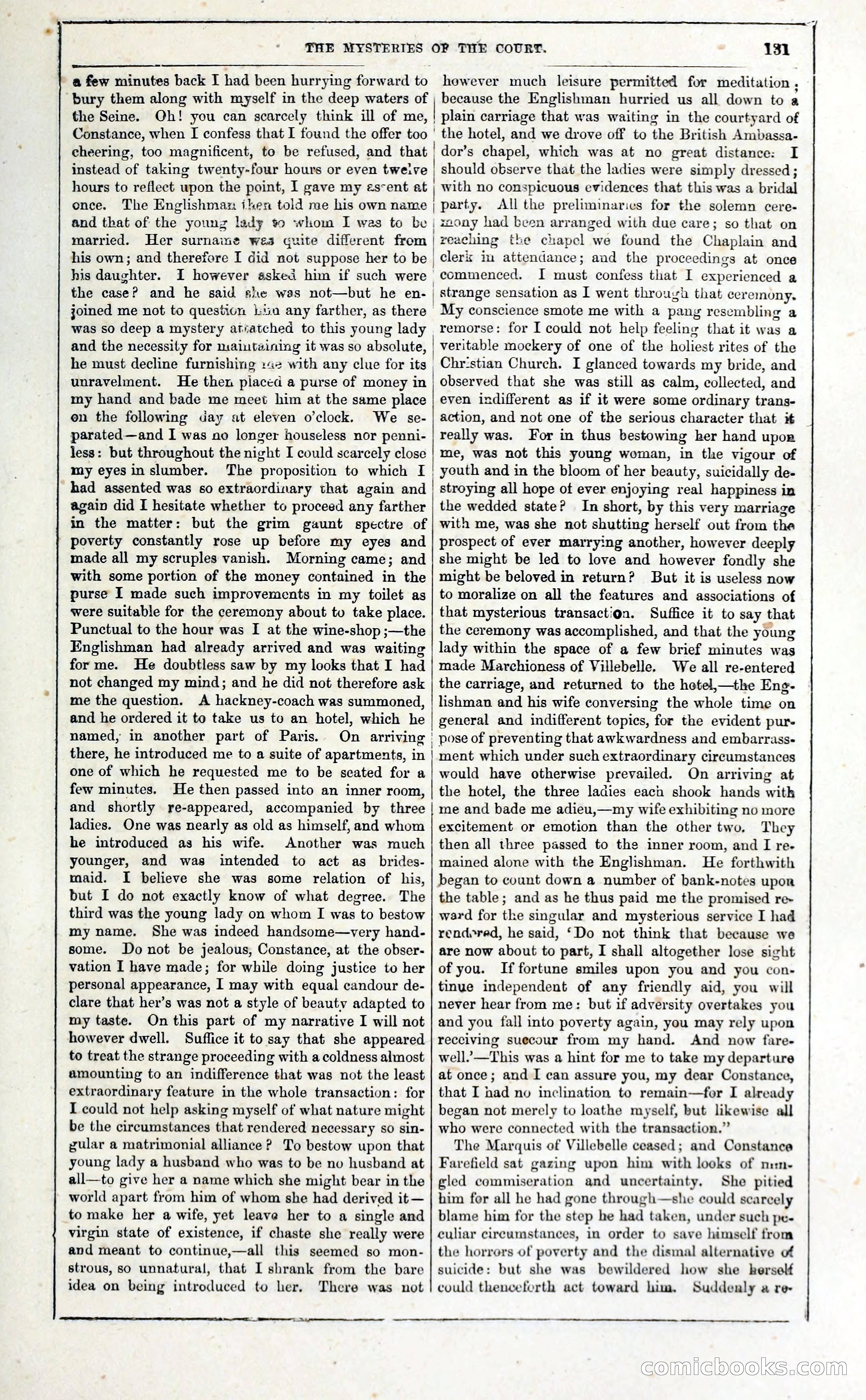
A restored page from Penny Dreadfuls, 1849. Page through the whole issue in the reader above.
📄 Transcribed text from this page (OCR, searchable)
Machine-transcribed from the original scan — historical spelling and the odd misread are preserved.
THE MYSTERIES OF THE COURT. 131 a few minutes back I had been hurrying forward to however much leisure permitted for meditation , bury them along with myself in the deep waters of ; because the Englishman hurried us all down to a the Seine. Qh! you can scarcely think ill of me, | plain carriage that was waiting in the courtyard of Constance, when I confess that I found the offer too ' the hotel, and we drove off to the British Ambassa- cheering, too magnificent, to be refused, and that | dor’s chapel, which was at no great distance: I instead of taking twenty-four hours or even tweive | should observe that the ladies were simply dressed; hours to reflect wpon the point, I gave my es-ent at | with no conspicuous evidences that this was a bridal once. The Englishman iken told me his own name | Barty: er the mdaat ome the solemn cere- and that of the young lady $0 whom I was to be | xcony had been arranged with due care; so that on married. Her eat a quite different from | Reni the chapel ros found the Chaplain and his own; and therefore I did not suppose her to be | clerk im attendance; and the proceedings at once his daughter. I however asked him if such were commenced. I must confess that I experienced a the case? and he said she wes not—but he en- | strange sensation as I went through that ceremony, joined me not to question Ls any farther, as there My conscience smote me with a pang resembling a was so deep a mystery atiatched to this young lady remorse: for I could not help feeling that it was a and the necessity for maintaining it was so absolute, | veritable mockery of one of the holiest rites of the he must decline furnishing :42 with any clue for its unravelment. He then placed a purse of money in my hand and bade me meet him at the same place on the following «day at eleven o’clock. We se- parated—and I was no longer houseless nor penni- less: but throughout the night I could scarcely close my eyes in slumber. had assented was so extraordinary that again and again did I hesitate whether to proceed any farther in the matter: but the grim gaunt spectre of poverty constantly rose up before my eyes and made all my scruples vanish. Morning came; and with some portion of the money contained in the purse I made such improvements in my toilet as were suitable for the ceremony about to take place. Punctual to the hour was I at the wine-shop ;—the Englishman had already arrived and was waiting for me. He doubtless saw by my looks that I had not changed my mind; and he did not therefore ask me the question. A hackney-coach was summoned, and he ordered it to take us to an hotel, which he named, in another part of Paris. there, he introduced me to a suite of apartments, in one of which he requested me to be seated for a few minutes. He then passed into an inner room, and shortly re-appeared, accompanied by three ladies. One was nearly as old as himself, and whom he introduced as his wife. Another was much younger, and was intended to act as_ brides- maid. I believe she was some relation of his, but I do not exactly know of what degree. The third was the young lady on whom I was to bestow my name. She was indeed handsome—very hand- some. Do not be jealous, Constance, at the obser- vation I have made; for while doing justice to her personal appearance, I may with equal candour de- clare that her’s was not a style of beauty adapted to my taste. On this part of my narrative I will not however dwell. Suffice it to say that she appeared to treat the strange proceeding with a coldness almost amounting to an indifference that was not the least extraordinary feature in the whole transaction: for I could not help asking myself of what nature might be the circumstances that rendered necessary so sin- gular a matrimonial alliance? To bestow upon that young lady a husband who was to be no husband at all—to give her a name which she might bear in the world apart from him of whom she had derived it— to make her a wife, yet leave her to a single and virgin state of existence, if chaste she really were and meant to continue,—all this seemed so mon- strous, so unnatural, that I shrank from the bare idea on being introduced to her. There was not _——— The proposition to which [ | On arriving | Chr-stian Church. I glanced towards my bride, and observed that she was still as calm, collected, and even indifferent as if it were some ordinary trans- action, and not one of the serious character that # really was. For in thus bestowing her hand upor me, was not this young woman, in the vigour of youth and in the bloom of her beauty, suicidally de- stroying all hope of ever enjoying real happiness in the wedded state? In short, by this very marriage with me, was she not shutting herself out from the prospect of ever marrying another, however deeply she might be led to love and however fondly she might be beloved in return? But it is useless now to moralize on all the features and associations of that mysterious transaction. Suffice it to say that the ceremony was accomplished, and that the young lady within the space of a few brief minutes was made Marchioness of Villebelle. We all re-entered the carriage, and returned to the hetel—the Eng- lishman and his wife conversing the whole time on general and indifferent topics, for the evident pur- pose of preventing that awkwardness and embarrass- ment which under such extraordinary circumstances would have otherwise prevailed. On arriving at the hotel, the three ladies each shook hands with me and bade me adieu,—my wife exhibiting no more excitement or emotion than the other two, They then all three passed to the inner room, and I re- mained alone with the Englishman. He forthwith began to count down a number of bank-notes upon the table; and as he thus paid me the promised re- ward for the singular and mysterious service I had rendered, he said, ‘Do not think that because we are now about to part, I shall altogether lose sicht of you. If fortune smiles upon you and you con- tinue independent of any friendly aid, you will never hear from me: but if adversity overtakes you and you fall into poverty again, you may rely upon receiving suecour from my hand. And now fare- well.’—This was a hint for me to take my departure at once; and I can assure you, my dear Constance, that I nad no inclination to remain—for I already began not merely to loathe myself, but likewise all who were connected with the transaction.” The Marquis of Villebelle ceased; and Constance Farefield sat gazing upon him with looks of m:n- gled commiseration and uncertainty, She pitied him for all he had gone through—she could scarcely blame him for the step he had taken, under such pe- culiar circumstances, in order to save himself from the horrors of poverty and the dismal alternative of suicide: but she was bewildered how she herself could thenceforth act toward lim, Suddenly a re- EOMmMIclboooks (CO)