
Penny Dreadfuls, 1849 · page 151 of 394
The Mysteries of the Court of London — page 151: what you’re looking at
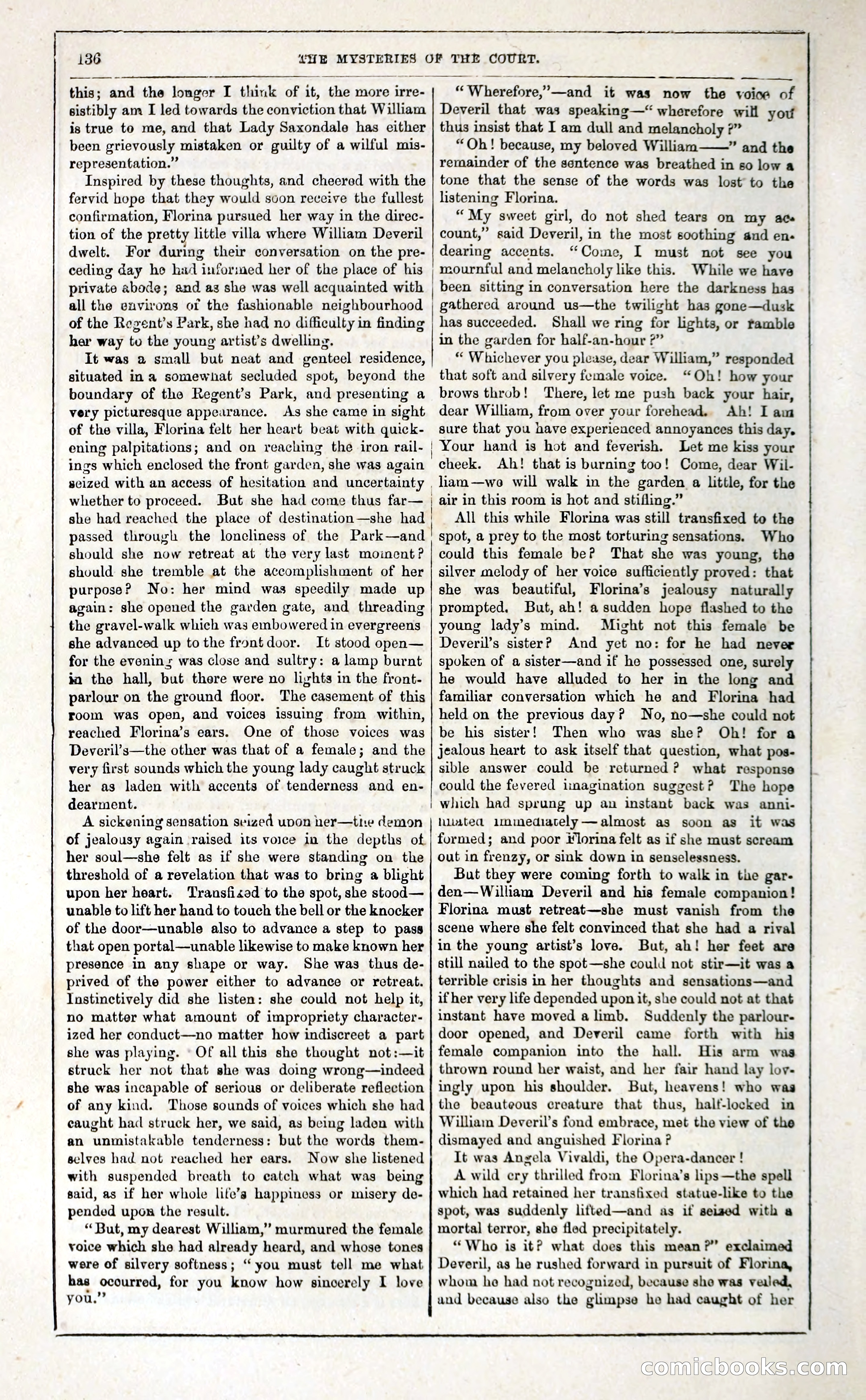
A restored page from Penny Dreadfuls, 1849. Page through the whole issue in the reader above.
📄 Transcribed text from this page (OCR, searchable)
Machine-transcribed from the original scan — historical spelling and the odd misread are preserved.
136 es this; and the longer I think of it, the more irre- sistibly am I led towards the conviction that William is true to me, and that Lady Saxondale has either been grievously mistaken or guilty of a wilful mis- representation.” Inspired by these thoughts, and cheered with the fervid hope that they would soon receive the fullest confirmation, Florina pursued her way in the direc- tion of the pretty little villa where William Deveril dwelt. For during their conversation on the pre- ceding day he had informed her of the place of his private abode; and ag she was well acquainted with all the exvirons of the fashionable neighbourhood of the Rezent’s Park, she had no difficulty in finding her way to the young artist’s dwelling. It was a small but neat and genteel residence, situated ina somewhat secluded spot, beyond the boundary of the Regent’s Park, and presenting a very picturesque appearance. As she came in sight of the villa, Florina felt her heart beat with quick- ening palpitations; and on reaching the iron rail- ings which enclosed the front garden, she was again seized with an access of hesitation and uncertainty whether to proceed. But she had come thus far— she had reached the place of destination—she had passed through the loncliness of the Park—and should she now retreat at the very last moinent? should she tremble at the accomplishment of her purpose? No: her mind was speedily made up again: she opened the garden gate, and threading the gravel-walk which was embowered in evergreens she advanced up tothe frontdoor. It stood open— for the evenins was close and sultry: a lamp burnt in the hall, but there were no lizhts in the front- parlour on the ground floor. The casement of this room was open, and voices issuing from within, reached Filorina’s ears. One of those voices was Deveril’s—the other was that of a female; and the very first sounds which the young lady caught struck her as laden with accents of tenderness and en- dearment. A sickening sensation seized upon her—tie demon of jealousy again raised its voice in the depths ot her soul—she felt as if she were standing on the threshold of a revelation that was to bring a blight upon her heart. Transfized to the spot, she stood— unable to lift her hand to touch the bell or the knocker of the door—unable also to advance a step to pass that open portal—unable likewise to make known her presence in any shape or way. She was thus de- prived of the power either to advance or retreat. Instinctively did she listen: she could not help it, no matter what amount of impropriety character- ized her conduct—no matter how indiscreet a part she was playing. © Of all this she thought not:—it struck her not that she was doing wrong—indeed she was incapable of serious or deliberate reflection of any kind. Those sounds of voices which she had eaught had struck her, we said, as being ladon with an unmistakable tenderness: but the words them- selves had not reached her ears. Now she listened with suspended breath to eatch what was being said, as if her whole life’s happiness or misery de- pended upon the result. “But, my dearest William,” murmured the female voice which she had already heard, and whose tones were of silvery softness; “you must tell me what has ocourred, for you know how sincerely I love you,” \ lmimediately —almost as soon as it was UE MYSTERIES OF THE COURT. ——_—— _ — —_ “ Wherefore,’—and it was now the yoise of Deveril that was speaking—“ wherefore will yorf thus insist that I am dull and melancholy ?” “Oh! because, my beloved William——” and the remainder of the sentence was breathed in so low a tone that the sense of the words was lost to the listening Florina. “My sweet girl, do not shed tears on my acs count,” said Deveril, in the most soothing and en- dearing accents. “Come, I must not see you mournful and melancholy like this. While we have been sitting in conversation here the darkness has gathered around us—the twilight has gone—dusk has succeeded. Shall we ring for lights, or tamble in the garden for half-an-hour ?” “ Whichever you please, dear William,” responded that soft and silvery female voice. “Oh! how your brows throb! There, let me push back your hair, dear William, from over your forehead. Ah! Iam sure that you have experieaced annoyances this day. | Your hand is hot and feverish. Let me kiss your cheek. Ah! that is burning too! Come, dear Wil- _liam—wo will walk in the garden a little, for the air in this room is hot and stifling.” All this while Florina was still transfixed to the spot, a prey to the most torturing sensations. Who could this female be? That she was young, the silver melody of her voice sufficiently proved: that she was beautiful, Florina’s jealousy naturally prompted. But, ah! a sudden hope flashed to the young lady’s mind. Might not this female be Deveril’s sister? And yet no: for he had never spoken of a sister—and if he possessed one, surely he would have alluded to her in the long and familiar conversation which he and Florina had held on the previous day? No, no—she could not be his sister! Then who was she? Oh! for a jealous heart to ask itself that question, what pos- sible answer could be returned? what response could the fevered imagination suggest? The hope which had sprung up an instant back was anni- formed; and poor Wlorina felt as if she must scream out in frenzy, or sink down in senselessness. But they were coming forth to walk in the gar- den—William Deveril and his female companion! Florina must retreat—she must vanish from the scene where she felt convinced that she had a rival in the young artist’s love. But, ah! her feet are still nailed to the spot—she could not stir—it was a terrible crisis in her thoughts and sensations—and if her very life depended upon it, she could not at that instant have moved a limb. Suddenly the parlour. door opened, and Deveril came forth with his female companion into the hall. His arm was thrown round her waist, and her fair hand lay loy- ingly upon his shoulder. But, heavens! who was the beauteous creature that thus, half-locked in William Deveril’s fond embrace, met the view of the dismayed and anguished Florina? It was Angela Vivaldi, the Opera-dancer ! A wild ery thrilled from Florina’s lips—the spell which had retained her transfixed statue-like to the spot, was suddenly lifted—and as if seiaed with a mortal terror, she fled precipitately. “Who is it? what does this mean?” exclaimed Deveril, as he rushed forward in pursuit of Florina, whom he had not recognized, because she was vealed, und because also the glimpse he had caught of her EO) 0)(0)(6) <=) (E©)