
Penny Dreadfuls, 1849 · page 17 of 394
The Mysteries of the Court of London — page 17: what you’re looking at
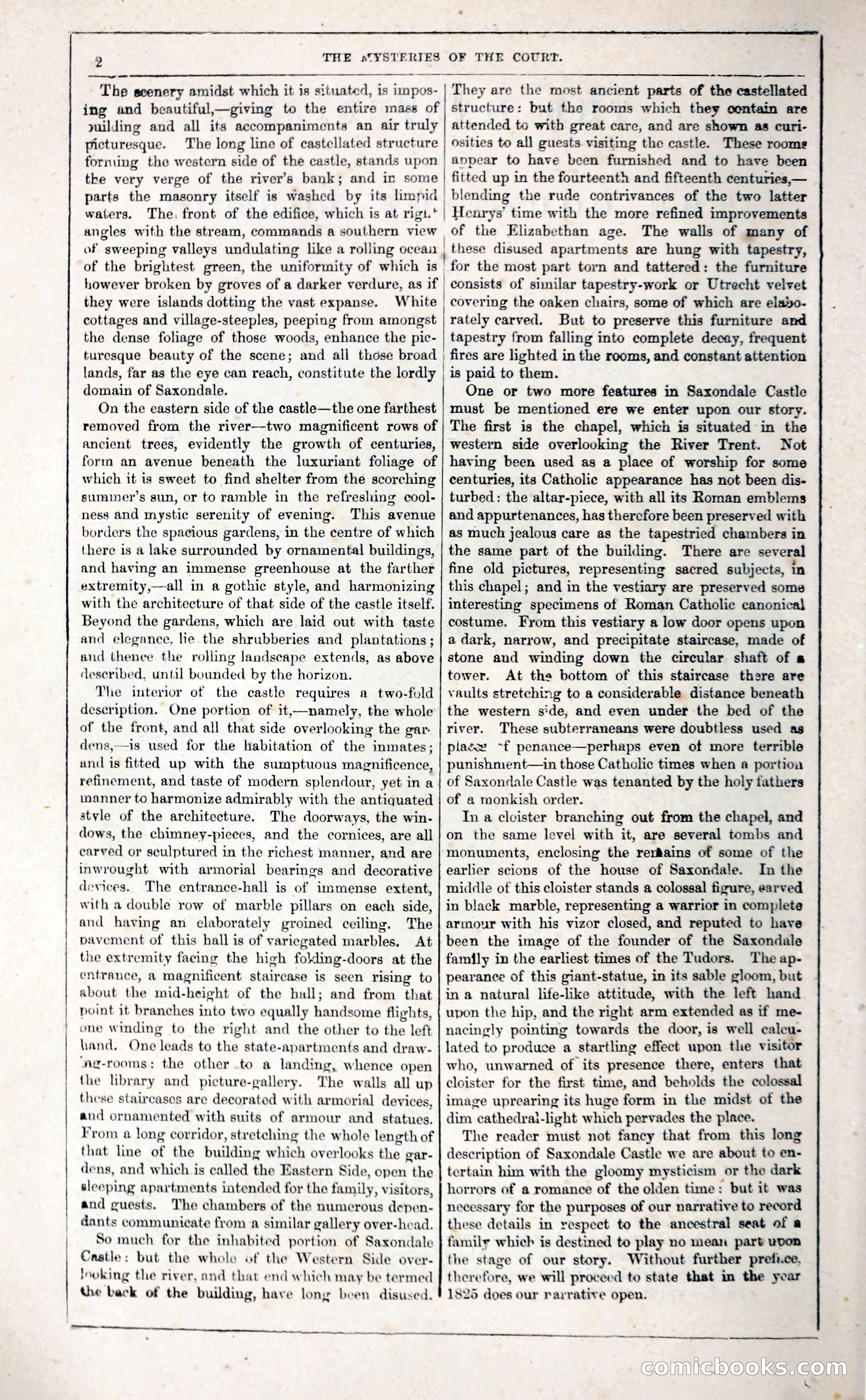
A restored page from Penny Dreadfuls, 1849. Page through the whole issue in the reader above.
📄 Transcribed text from this page (OCR, searchable)
Machine-transcribed from the original scan — historical spelling and the odd misread are preserved.
9 THE s*YSTERIES OF THE COURT. ie dimen Thp scenery amidst which it is situated, is impos- ing and beautiful,—giving to the entire mass of yuilding and all its accompaniments an air truly Picturesque. The long line of castellated structure forning the western side of the castle, stands upon | the very verge of the river’s bank; and in some parts the masonry itself is washed by its limpid | waters. angles with the stream, commands a southern view | of sweeping valleys undulating like a rolling ocean , of the brightest green, the uniformity of which is however broken by groves of a darker verdure, as if | they were islands dotting the vast expanse. White | cottages and village-steeples, peeping from amongst the dense foliage of those woods, enhance the pic- turesque beauty of the scene; and all those broad lands, far as the eye can reach, constitute the lordly domain of Saxondale. On the eastern side of the castle—the one farthest removed from the river—two magnificent rows of ancient trees, evidently the growth of centuries, form an avenue beneath the luxuriant foliage of which it is sweet to find shelter from the scorching suminer’s sun, or to ramble in the refreshing cool- ness and mystic serenity of evening. This avenue borders the spacious gardens, in the centre of which there is a lake surrounded by ornamental buildings, and having an immense greenhouse at the farther extremity,—all in a gothic style, and harmonizing with the architecture of that side of the castle itself. Beyond the gardens, which are laid out with taste and elegance, lie. the shrubberies and plantations ; and thenee the rolling Jandseape extends, as above deseribed, until bounded by the horizon. The interior of the castle requires a two-fold description. One portion of it,—namely, the whole of the front, and all that side overlooking the gar: dens,—is used for the habitation of the inmates; und is fitted up with the sumptuous magnificence, refinement, and taste of modern splendour, yet in a manner to harmonize admirably with the antiquated style of the architecture. The doorways, the win- dows, the chimney-pieces, and the cornices, are all carved or sculptured in the richest manner, and are inwrought with armorial bearings and decorative devices. The entrance-hall is of immense extent, with a double row of marble pillars on each side, and having an elaborately groined ceiling. The pavement of this hall is of variegated marbles. At the extremity facing the high fo! xhng- doors at the entrance, a magnificent staircase is seen rising to about the mid-height of the ball; and from that point it branches into two equally handsome flights, one winding to the right and the other to the left hand, One! leads to the state-apartments and draw- ‘ng-rooms: the other to a landing, whence open the library and picture-gallery. The walls all up these staircases are decorated with armorial devices, and ornamented with suits of armour and statues. rom a long corridor, stretching the whole length of that line of the building which overlooks the gar- dens, and which is called the Eastern Side, open the sleeping apartments intended for the family, visitors, and guests. The chambers of the numerous depen- dants communicate from a similar gallery over-head. So much for the inhabited portion of Saxondale Castle: but the whole of the Western Side over- looking the river, and that end which may be termed the back of the building, have long been disused. ee Ee They are the most ancient parts of the castellated structure: but the rooms which they contain are attended to with great care, and are shown as curi- osities to all guests visiting the castle. These rooms anpear to have been furnished and to have been | fitted up in the fourteenth and fifteenth centuries,— blending the rude contrivances of the two latter The, front of the edifice, which is at rigt.t | Henrys’ time with the more refined improvements of the Elizabethan age. The walls of many of these disused apartments are hung with tapestry, for the most part torn and tattered: the furniture consists of similar tapestry-work or Utrecht velvet covering the oaken chairs, some of which are elao- rately carved. But to preserve this furniture and tapestry from falling into complete decay, frequent | fires are lighted in the rooms, and constant attention | is paid to them. One or two more features in Saxondale Castle must be mentioned ere we enter upon our story. The first is the chapel, which is situated in the western side overlooking the River Trent. Not having been used as a place of worship for some centuries, its Catholic appearance has not been dis- turbed: the altar-piece, with all its Roman emblems and appurtenances, has therefore been preserved with as much jealous care as the tapestried chambers in the same part of the building. There are several fine old pictures, representing sacred subjects, in this chapel; and in the vestiary are preserved some interesting specimens of Roman Catholic canonical costume. From this vestiary a low door opens upon a dark, narrow, and precipitate staircase, made of stone and winding down the circular shaft of » tower. At the bottom of this staircase there are vaults stretching to a considerable distance beneath the western side, and even under the bed of the river. These subterraneans were doubtless used as place ~f penance—perhaps even of more terrible punishment—in those Catholic times when a portion of Saxondale Castle was tenanted by the holy fathers of a monkish order. In a clcister branching out from the chapel, and on the same level with it, are several tombs and monuments, enclosing the rerdains of some of the earlier seions of the house of Saxondale. In the middle of this cloister stands a colossal figure, earved in black marble, representing a warrior in complete armour with his vizor closed, and reputed to have been the image of the founder of the Saxondale family in the earliest times of the Tudors. The ap- pearance of this giant-statue, in its sable gloom, but in a natural life-like attitude, with the left hand upon the hip, and the right arm extended as if me- nacingly pointing towards the door, is well calcu- lated to produce a startling effect upon the visitor who, unwarned of its presence there, enters that cloister for the first time, and beholds the colossal image uprearing its huge form in the midst of the dim cathedrai-light which pervades the place. The reader must not fancy that from this long description of Saxondale Castle we are about to en- tertain him with the gloomy mysticism or the dark horrors of a romance of the olden time: but it was necessary for the purposes of our narrative to record these details in respect to the ancestral seat of a family which is destined to play no mean part upon the stage of our story. Without further preft.ce. therefore, we will proceed to state that in the year 1825 does our rarrative open. GOMILGDOOKS (E(0)