
Penny Dreadfuls, 1849 · page 180 of 394
The Mysteries of the Court of London — page 180: what you’re looking at
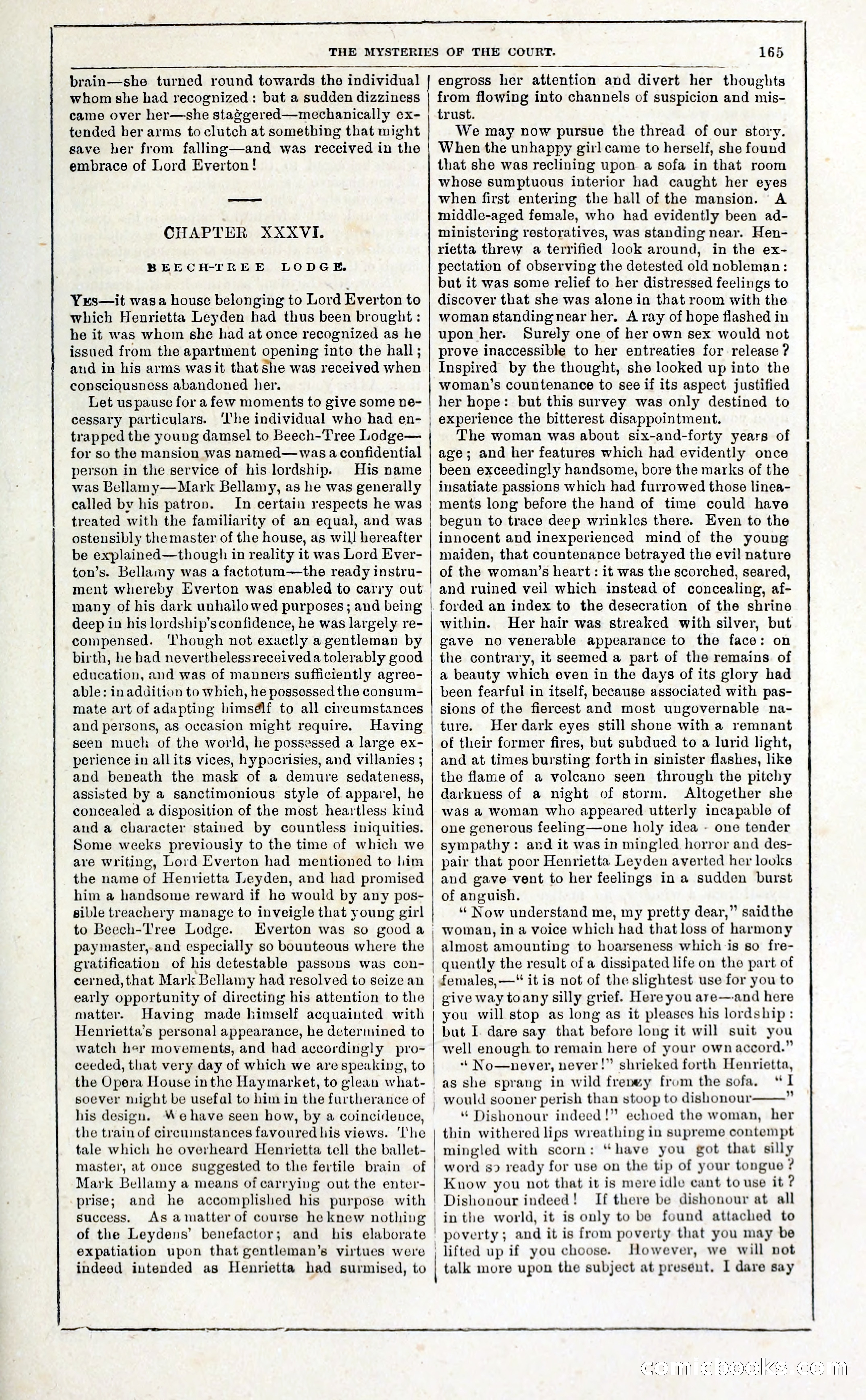
A restored page from Penny Dreadfuls, 1849. Page through the whole issue in the reader above.
📄 Transcribed text from this page (OCR, searchable)
Machine-transcribed from the original scan — historical spelling and the odd misread are preserved.
a we ee THE MYSTERIES OF THE COURT. brain—she turned round towards the individual whom she had recognized: but a sudden dizziness came over her—she staggered—mechanically ex- tended her arms to clutch at something that might save her from falling—and was received in the embrace of Lord Everton! eo CHAPTER XXXVI. BEECH-TREE LODGE Yrs— it wasa house belonging to Lord Everton to which Henrietta Leyden had thus been brought : he it was whom she had at once recognized as he issued from the apartment opening into the hall; aud in his arms wasit that she was received when consciousness abandoned her. Let us pause for a few moments to give some ne- cessary particulars. The individual who had en- trapped the young damsel to Beech-Tree Lodge— for so the mansion was named—was a confidential person in the service of his lordship. His name was Bellamy—Mark Bellamy, as he was generally called bv his patron. In certain respects he was treated with the familiarity of an equal, and was ostensibly the master of the house, as will hereafter be explained—though in reality it was Lord Ever- ton’s. Bellamy was a factotum—the ready instru- ment whereby Everton was enabled to carry out many of his dark unhallowed purposes ; and being deep in his lordship’sconfidence, he was largely re- compensed. ‘Though not exactly a gentleman by birth, he had neverthelessreceiveda tolerably good education, and was of manners sufficiently agree- able: in addition to which, he possessed the consum- mate art of adapting himsélf to all circumstances and persons, as occasion might require. Having seen much of the world, he possessed a large ex- perience in allits vices, hypocrisies, and villanies ; and beneath the mask of a demure sedateness, assisted by a sanctimonious style of apparel, he concealed a disposition of the most heartless kind and a character stained by countless iniquities. Some weeks previously to the time of which we are writing, Lord Everton had mentioned to him the name of Henrietta Leyden, and had promised him a handsowe reward if he would by any pos- sible treachery manage to inveigle that young girl to Beech-Tree Lodge. payimaster, and especially so bounteous where the gratification of his detestable passons was con- cerned, that Mark Bellamy had resolved to seize an early opportunity of directing his attention to the matter. Having made himself acquainted with Henrietta’s personal appearance, be determined to watch her movements, and had accordingly pro- ceeded, that very day of which we are speaking, to the Opera House inthe Haymarket, to glean what- soever might be usefal to him in the furtherance of his design. Mehave seen how, by a coincideuce, the train of circuinstances favoured his views. ‘lhe tale which he overheard Henrietta tell the ballet- master, at once suggested to the fertile brain of Mark Bellamy a means of carryivg out the enter- prise; and he accomplished his purpose with success. of the Leydens’ benefactor; and his elaborate expatiation upon that gentleman’s virtues were indeed intended as Henrietta had surmised, to | As amatter of course he knew nothing | Everton was so good a | 165 engross her attention and divert her thoughts from flowing into channels of suspicion and mis- trust. We may now pursue the thread of our story. When the unhappy girl came to herself, she found that she was reclining upon a sofa in that room whose sumptuous interior had caught her eyes when first entering the hall of the mansion. A middle-aged female, who had evidently been ad- ministering restoratives, was standing near. Hen- rietta threw a terrified look around, in the ex- pectation of observing the detested old nobleman: but it was some relief to her distressed feelings to discover that she was alone in that room with the woman standing near her. A ray of hope flashed in upon her. Surely one of her own sex would not prove inaccessible to her entreaties for release ? Inspired by the thought, she looked up into the woman’s countenance to see if its aspect justified her hope: but this survey was only destined to experience the bitterest disappvintment. The woman was about six-and-forty years of age; and her features which had evidently once been exceedingly handsome, bore the marks of the insatiate passions which had furrowed those linea- ments long before the hand of time could have begun to trace deep wrinkles there. Even to the innocent and inexperienced mind of the young maiden, that countenance betrayed the evil nature of the woman’s heart: it was the scorched, seared, and ruined veil which instead of concealing, af- forded an index to the desecration of the shrine within. Her hair was streaked with silver, but gave no venerable appearance to the face: on the contrary, it seemed a part of the remains of a beauty which even in the days of its glory had been fearful in itself, because associated with pas- sions of the fiercest and most ungovernable na- ture. Her dark eyes still shone with a remnant of their former fires, but subdued to a lurid light, and at times bursting forthin sinister flashes, like the flame of a volcano seen through the pitchy darkness of a night of storm. Altogether she was a woman who appeared utterly incapable of one generous feeling—one holy idea - one tender sympathy: and it was in mingled horror and des- pair that poor Henrietta Leyden averted her looks and gave vent to her feelings in a sudden burst of anguish. ‘‘ Now understand me, my pretty dear,” saidthe woman, in a voice which had that loss of harmony almost amounting to hoarseness which is so fre- quently the result of a dissipated life on the part of | females, —“ it is not of the slightest use for you to give way toany silly grief. Here you are—and here you will stop as long as it pleases his lordship: but I dare say that before long it will suit you well enough to remain here of your ownaccord.” * No—never, never!” shrieked forth Henrietta, as she sprang in wild frenwy from the sofa. “I would sooner perish than stoop to dishonour 7 ‘ Dishonour indeed!” echoed the woman, her thin withered lips wreathing in supreme contempt ' mingled with scorn: “have you got that silly word s9 ready for use on the tip of your tongue ? Know you not that it is mere idle cant to use it ? Dishouour indeed! If there be dishonour at all in the world, it is only to be found attached to poverty; and it is from poverty that you may be lifted up if you choose. However, we will not talk more upon the subject at present. 1 dare say a (C(O) (C DOOKS (CO)