
Penny Dreadfuls, 1849 · page 187 of 394
The Mysteries of the Court of London — page 187: what you’re looking at
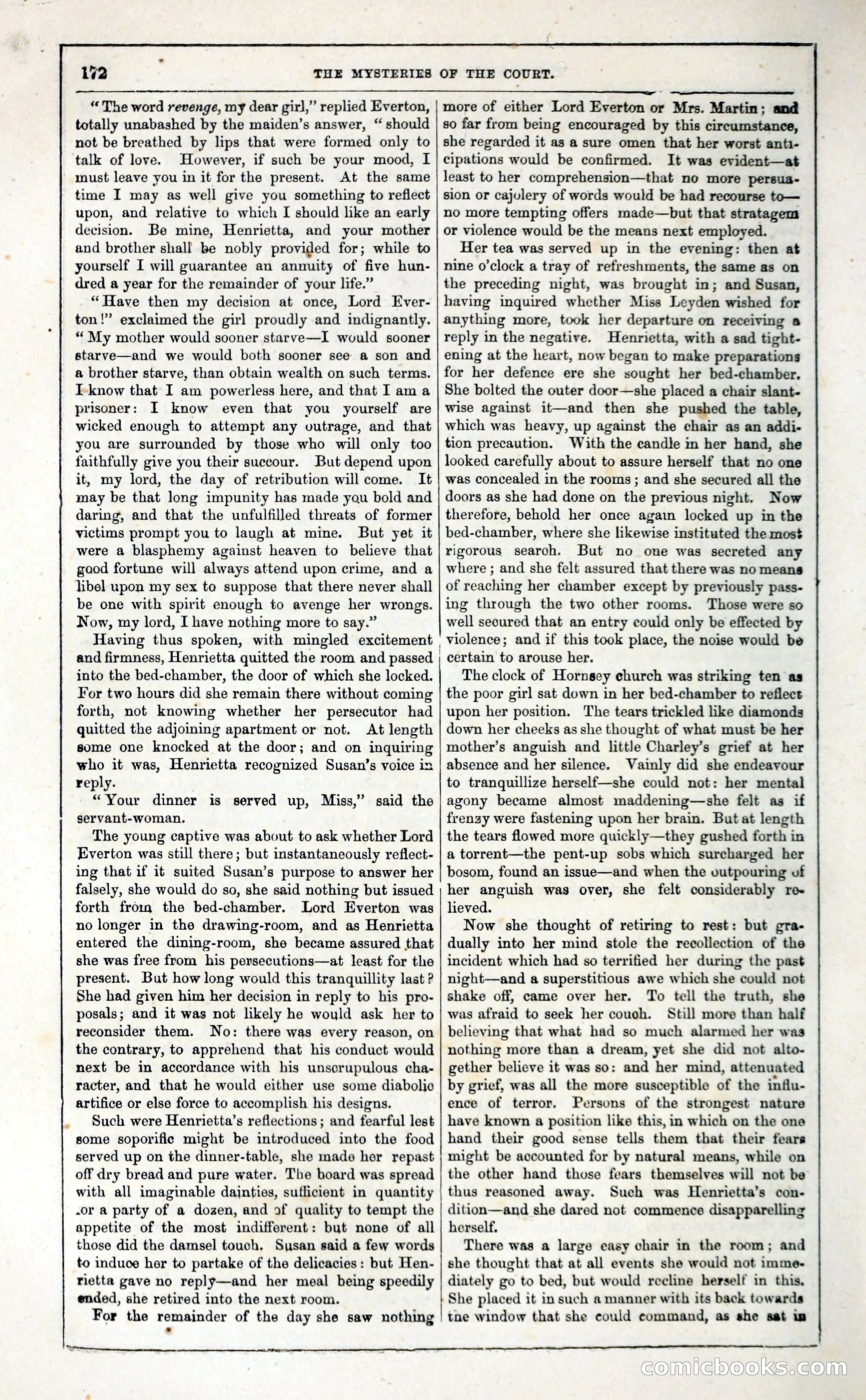
A restored page from Penny Dreadfuls, 1849. Page through the whole issue in the reader above.
📄 Transcribed text from this page (OCR, searchable)
Machine-transcribed from the original scan — historical spelling and the odd misread are preserved.
Bn Li2 The word revenge, my dear gir],” replied Everton, totally unabashed by the maiden’s answer, “ should not be breathed by lips that were formed only to talk of love. However, if such be your mood, I must leave you in it for the present. At the same time I may as well give you something to reflect upon, and relative to which I should like an early decision. Be mine, Henrietta, and your mother and brother shall be nobly provided for; while to yourself I will guarantee an annuity of five hun- dred a year for the remainder of your life.” “Have then my decision at once, Lord Ever- ton!” exclaimed the girl proudly and indignantly. “ My mother would sooner starve—I would sooner starve—and we would both sooner see a son and a brother starve, than obtain wealth on such terms. I-know that I am powerless here, and that I am a prisoner: I know even that you yourself are wicked enough to attempt any outrage, and that you are surrounded by those who will only too faithfully give you their suecour. But depend upon it, my lord, the day of retribution will come. It may be that long impunity has made you bold and daring, and that the unfulfilled threats of former victims prompt you to laugh at mine. But yet it were a blasphemy against heaven to believe that gaod fortune will always attend upon crime, and a libel upon my sex to suppose that there never shall be one with spirit enough to avenge her wrongs. Now, my lord, I have nothing more to say.” Having thus spoken, with mingled excitement and firmness, Henrietta quitted the room and passed into the bed-chamber, the door of which she locked. For two hours did she remain there without coming forth, not knowing whether her persecutor had quitted the adjoining apartment or not. At length some one knocked at the door; and on inquiring who it was, Henrietta recognized Susan’s voice in reply. “Your dinner is served up, Miss,” said the servant-woman. The young captive was about to ask whether Lord Everton was still there; but instantaneously reflect- ing that if it suited Susan’s purpose to answer her falsely, she would do so, she said nothing but issued forth from, the bed-chamber. Lord Everton was no longer in the drawing-room, and as Henrietta entered the dining-room, she became assured that she was free from his persecutions—at least for the present. But how long would this tranquillity last ? She had given him her decision in reply to his pro- posals; and it was not likely he would ask her to reconsider them. No: there was every reason, on the contrary, to apprehend that his conduct would next be in accordance with his unscrupulous cha- racter, and that he would either use some diabolic artifice or else force to accomplish his designs. Such were Henrietta’s reflections; and fearful lest some soporific might be introduced into the food served up on the dinner-table, she made her repast off dry bread and pure water. The board was spread with all imaginable dainties, sufficient in quantity .or a party of a dozen, and of quality to tempt the appetite of the most indifferent: but none of all those did the damsel touch, Susan said a few words to induce her to partake of the delicacies: but Hen- rietta gave no reply—and her meal being speedily ended, she retired into the next room. For the remainder of the day she saw nothing THE MYSTERIES OF THE COURT. more of either Lord Everton or Mrs. Martin; and so far from being encouraged by this circumstance, she regarded it as a sure omen that her worst anti- cipations would be confirmed. It was evident—at least to her comprehension—that no more persua- sion or cajulery of words would be had recourse to— no more tempting offers made—but that stratagem or violence would be the means next employed. Her tea was served up in the evening: then at nine o’clock a tray of refreshments, the same as on the preceding night, was brought in; and Susan, having inquired whether Miss Leyden wished for anything more, took her departure on receiving a reply in the negative. Henrietta, with a sad tight- ening at the heart, now began to make preparations for her defence ere she sought her bed-chamber. She bolted the outer door—she placed a chair slant- wise against it—and then she pushed the table, which was heavy, up against the chair as an addi- tion precaution. With the candle m her hand, she looked carefully about to assure herself that no one was concealed in the rooms; and she secured all the doors as she had done on the previous night. Now therefore, behold her once again locked up in the bed-chamber, where she likewise instituted the most rigorous search. But no one was secreted any where ; and she felt assured that there was no means of reaching her chamber except by previously pass- ing through the two other rooms. Those were so well secured that an entry could only be effected by violence; and if this took place, the noise would be certain to arouse her. The clock of Hornsey church was striking ten as the poor girl sat down in her bed-chamber to reflect upon her position. The tears trickled like diamonds down her cheeks as she thought of what must be her mother’s anguish and little Charley’s grief at her absence and her silence. Vainly did she endeavour to tranquillize herself—she could not: her mental agony became almost maddening—she felt as if frenzy were fastening upon her brain. But at length the tears flowed more quickly—they gushed forth in a torrent—the pent-up sobs which sureharged her bosom, found an issue—and when the outpouring of her anguish was over, she felt considerably re- lieved. Now she thought of retiring to rest: but gra- dually into her mind stole the recollection of the incident which had so terrified her during the past night—and a superstitious awe which she could not shake off, came over her. To tell the truth, she was afraid to seek her couch. Still more than half believing that what had so much alarmed her was nothing more than a dream, yet she did not alto- gether believe it was so: and her mind, attenuated by grief, was all the more susceptible of the influ- ence of terror. Persons of the strongest nature have known a position like this, in which on the one hand their good sense tells them that their fears might be accounted for by natural means, while on the other hand thuse fears themselves will not be thus reasoned away. Such was Henrietta’s con- dition—and she dared not commence disapparelling herself. There was a large easy chair in the room; and she thought that at all events she would not imme- diately go to bed, but would recline herself in this, She placed it in such a manner with its back towards toe window that she could command, as she sat ip GOmiicdoo (C cS (€©)