
Penny Dreadfuls, 1849 · page 189 of 394
The Mysteries of the Court of London — page 189: what you’re looking at
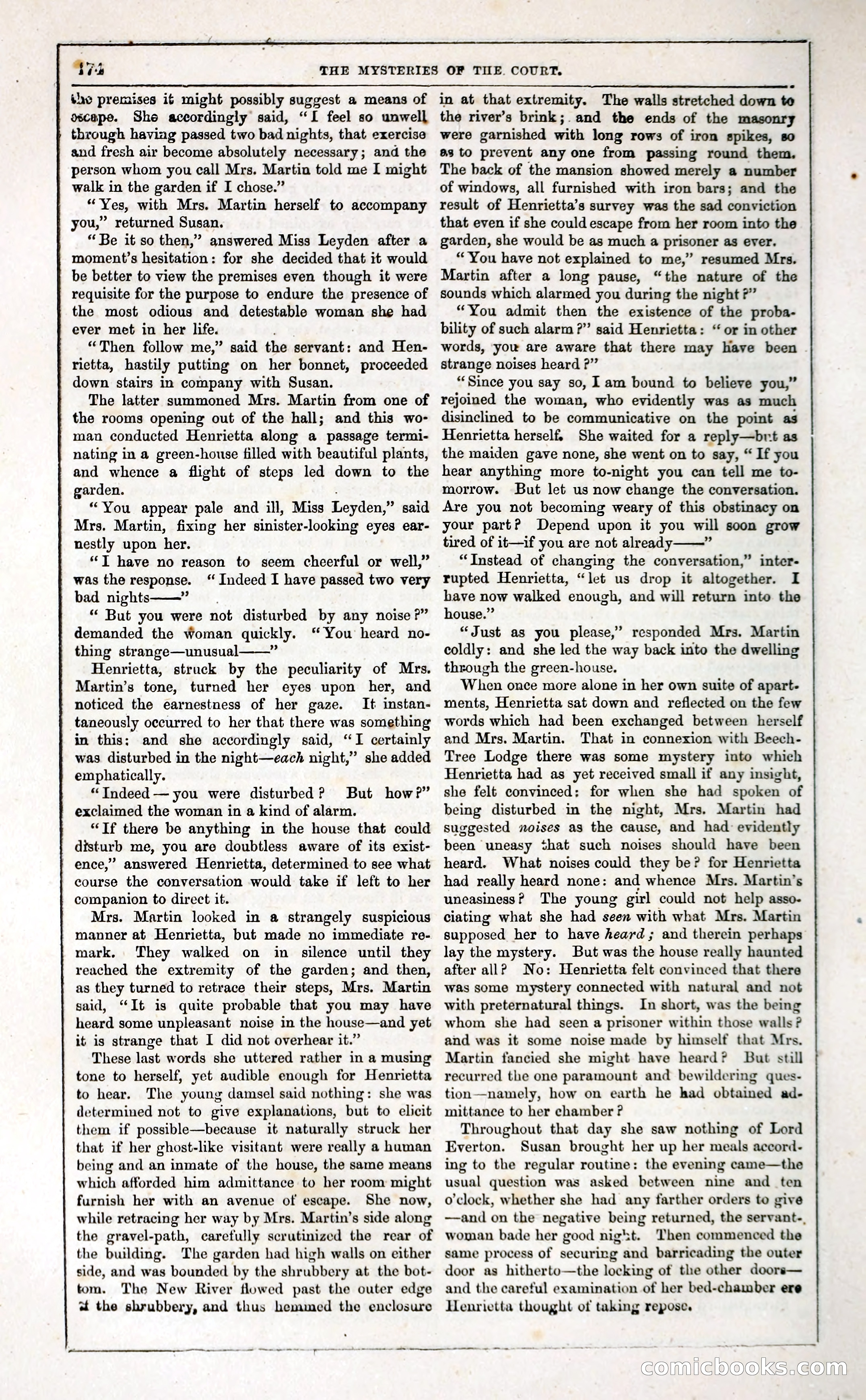
A restored page from Penny Dreadfuls, 1849. Page through the whole issue in the reader above.
📄 Transcribed text from this page (OCR, searchable)
Machine-transcribed from the original scan — historical spelling and the odd misread are preserved.
374 THE MYSTERIES OF TILE. COURT. the premises it might possibly suggest a means of oscape. She accordingly said, “I feel so unwell through having passed two bad nights, that exercise and fresh air become absolutely necessary; and the person whom you call Mrs. Martin told me I might walk in the garden if I chose.” “Yes, with Mrs. Martin herself to accompany you,” returned Susan. “ Be it so then,’ answered Miss Leyden after a moment’s hesitation: for she decided that it would be better to view the premises even though it were requisite for the purpose to endure the presence of the most odious and detestable woman she had ever met in her life. | “Then follow me,” said the servant: and Hen- rictta, hastily putting on her bonnet, proceeded down stairs in company with Susan. The latter summoned Mrs. Martin from one of the rooms opening out of the hall; and this wo- man conducted Henrietta along a passage termi- nating in a green-house filled with beautiful plants, and whence a flight of steps led down to the garden. “You appear pale and ill, Miss Leyden,” said Mrs. Martin, fixing her sinister-looking eyes ear- nestly upon her. ‘IT have no reason to seem cheerful or well,” was the response. “ Indeed I have passed two very bad nights——” “ But you were not disturbed by any noise?” demanded the Woman quickly. “You heard no- thing strange—unusual Henrietta, struck by the peculiarity of Mrs. Martin’s tone, turned her eyes upon her, and noticed the earnestness of her gaze. It instan- taneously occurred to her that there was something in this; and she accordingly said, ‘‘I certainly was disturbed in the night—each night,” she added emphatically. “Indeed — you were disturbed? But how?” exclaimed the woman in a kind of alarm. “Tf there be anything in the house that could disturb me, you are doubtless aware of its exist- ence,” answered Henrietta, determined to see what course the conversation would take if left to her companion to direct it. Mrs. Martin looked in a strangely suspicious manner at Henrietta, but made no immediate re- mark. They walked on in silence until they reached the extremity of the garden; and then, as they turned to retrace their steps, Mrs. Martin said, “It is quite probable that you may have heard some unpleasant noise in the house—and yet it is strange that I did not overhear it.” These last words she uttered rather in a musing tone to herself, yet audible enough for Henrietta to hear. The young damsel said nothing: she was determined not to give explanations, but to elicit them if possible—because it naturally struck her that if her ghost-like visitant were really a human being and an inmate of the house, the same means which afforded him admittance to her room might furnish her with an avenue of escape. She now, while retracing her way by Mrs. Martin’s side along the gravel-path, carefully scrutinized the rear of the building. The garden had high walls on either side, and was bounded by the shrubbery at the bot- tom. The New River flowed past the outer edge sf the shrubbery, and thus hemmed the enclosure ee eg eee ee Oe ee 5 ans in at that extremity. The walls stretched down to the river’s brink;. and the ends of the masonry were garnished with long rows of iron spikes, so a3 to prevent any one from passing round them, The back of the mansion showed merely a number of windows, all furnished with iron bars; and the result of Henrietta’s survey was the sad conviction that even if she could escape from her room into the garden, she would be as much a prisoner as ever. “You have not explained to me,” resumed Mrs. Martin after a long pause, “the nature of the sounds which alarmed you during the night ?” “You admit then the existence of the proba- bility of such alarm ?” said Henrietta: “ or in other words, you are aware that there may Have been strange noises heard ?” “Since you say so, I am bound to believe you,” rejoined the woman, who evidently was as much disinclined to be communicative on the point as Henrietta herself. She waited for a reply—brt as the maiden gave none, she went on to say, “If you hear anything more to-night you can tell me to- morrow. But let us now change the conversation. Are you not becoming weary of this obstinacy on your part? Depend upon it you will soon grow tired of it—if you are not already “Instead of changing the conversation,” inter- rupted Henrietta, “let us drop it altogether. I have now walked enough, and will return inte the house.” “Just as you please,’ responded Mrs. Martin coldly: and she led the way back into the dwelling through the green-house. When once more alone in her own suite of apart- ments, Henrietta sat down and reflected on the few words which had been exchanged between herself and Mrs. Martin. That in connexion with Beech- Tree Lodge there was some mystery into which Henrietta had as yet received small if any insight, she felt convinced: for when she had spoken of being disturbed in the night, Mrs. Martin had suggested noises as the cause, and had evidently been uneasy ‘that such noises should have been heard. What noises could they be? for Henrietta had really heard none: and whence Mrs. Martin’s uneasiness? The young girl could not help asso- ciating what she had seen with what Mrs. Martin supposed her to have heard; and therein perhaps lay the mystery. But was the house really haunted after all? No: Henrietta felt convinced that there was some mystery connected with natural and not with preternatural things. In short, was the being whom she had seen a prisoner within those walls ? and was it some noise made by himself that Mrs. Martin fancied she might have heard? But still recurred the one paramount and bewildering ques- tion—namely, how on earth he had obtained ad- mittance to her chamber ? Throughout that day she saw nothing of Lord Everton. Susan brought her up her meals accord- ing to the regular routine: the evening came—the usual question was asked between nine and ten o'clock, whether she had any farther orders to give —and on the negative being returned, the servant-, woman bade her good night. Then commenced the same process of securirg and barricading the outer door as hitherto—the locking of the other doors— and the careful examination of her bed-chamber ere Henrietta thought of taking repose. _—— a ~~ - COMIC OOO <=) (E(0)