
Penny Dreadfuls, 1849 · page 213 of 394
The Mysteries of the Court of London — page 213: what you’re looking at
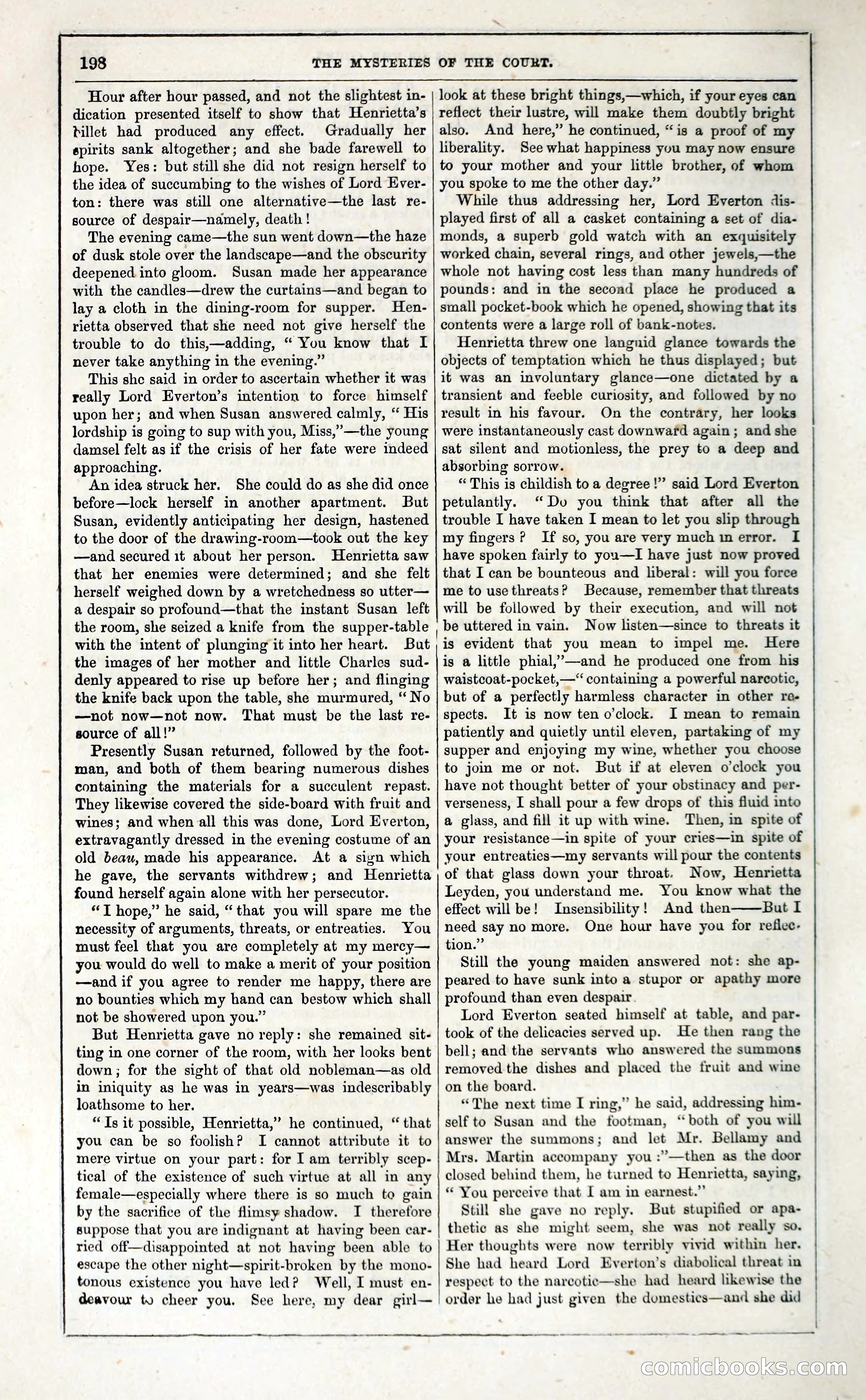
A restored page from Penny Dreadfuls, 1849. Page through the whole issue in the reader above.
📄 Transcribed text from this page (OCR, searchable)
Machine-transcribed from the original scan — historical spelling and the odd misread are preserved.
198 THE MYSTERIES OF THE COURT. Hour after hour passed, and not the slightest in- dication presented itself to show that Henrietta’s billet had produced any effect. Gradually her spirits sank altogether; and she bade farewell to hope. Yes: but still she did not resign herself to the idea of succumbing to the wishes of Lord Ever- ton: there was still one alternative—the last re- source of despair—namely, death ! The evening came—the sun went down—the haze of dusk stole over the landscape—and the obscurity deepened into gloom. Susan made her appearance with the candles—drew the curtains—and began to lay a cloth in the dining-room for supper. Hen- rietta observed that she need not give herself the trouble to do this,—adding, “ You know that I never take anything in the evening.” This she said in order to ascertain whether it was really Lord Everton’s intention to force himself upon her; and when Susan answered calmly, “ His lordship is going to sup with you, Miss,’—the young damsel felt as if the crisis of her fate were indeed approaching. An idea struck her. She could do as she did once before—lock herself in another apartment. But Susan, evidently anticipating her design, hastened to the door of the drawing-room—took out the key —and secured it about her person. Henrietta saw that her enemies were determined; and she felt herself weighed down by a wretchedness so utter— a despair so profound—that the instant Susan left the room, she seized a knife from the supper-table with the intent of plunging it into her heart. But the images of her mother and little Charles sud- denly appeared to rise up before her; and flinging the knife back upon the table, she murmured, ‘‘ No —not now—not now. That must be the last re- source of all!” Presently Susan returned, followed by the foot- man, and both of them bearing numerous dishes containing the materials for a succulent repast. They likewise covered the side-board with fruit and wines; and when all this was done, Lord Everton, extravagantly dressed in the evening costume of an old beau, made his appearance. At a sign which he gave, the servants withdrew; and Henrietta found herself again alone with her persecutor. “T hope,” he said, “that you will spare me the necessity of arguments, threats, or entreaties. You must feel that you are completely at my mercy— you would do well to make a merit of your position —and if you agree to render me happy, there are no bounties which my hand can bestow which shall not be showered upon you.” But Henrietta gave no reply: she remained sit- ting in one corner of the room, with her looks bent down ; for the sight of that old nobleman—as old in iniquity as he was in years—was indescribably loathsome to her. “Is it possible, Henrietta,” he continued, “ that you can be so foolish? I cannot attribute it to mere virtue on your part: for I am terribly scep- tical of the existence of such virtue at all in any female—especially where there is so much to gain by the sacrifice of the flimsy shadow. I therefore suppose that you are indignant at having been car- ried off—disappointed at not having been able to escape the other night—spirit-broken by the mono- tonous existence you have led? Well, I must en- deavour ty cheer you. See here, my dear girl— | ——. oe e+ ee ee allt look at these bright things,—which, if your eyes can reflect their lustre, will make them doubtly bright also. And here,” he continued, “is a proof of my liberality. See what happiness you may now ensure to your mother and your little brother, of whom you spoke to me the other day.” While thus addressing her, Lord Everton dis- played first of all a casket containing a set of dia- monds, a superb gold watch with an exquisitely worked chain, several rings, and other jewels,—the whole not having cost less than many hundreds of pounds: and in the second place he produced a small pocket-book which he opened, showing that its contents were a large roll of bank-notes. Henrietta threw one languid glance towards the objects of temptation which he thus displayed; but it was an involuntary glance—one dictated by a transient and feeble curiosity, and followed by no result in his favour. On the contrary, her looks were instantaneously cast downward again; and she sat silent and motionless, the prey to a deep and absorbing sorrow. “ This is childish to a degree!” said Lord Everton petulantly. “Do you think that after all the trouble I have taken I mean to let you slip through my fingers? If so, you are very muchimerror. I have spoken fairly to you—I have just now eat | that I can be bounteous and liberal: will you force me to usethreats? Because, remember that threats will be followed by their execution, and will not be uttered in vain. Now listen—since to threats it is evident that you mean to impel me. Here is a little phial,’—and he produced one from his waistcoat-pocket,—“ containing a powerful narcotic, but of a perfectly harmless character in other ra- spects. It is now ten o’clock. I mean to remain patiently and quietly until eleven, partaking of my supper and enjoying my wine, whether you choose to jom me or not. But if at eleven oclock you have not thought better of your obstinacy and per- verseness, I shall pour a few drops of this fluid into a glass, and fill it up with wine. Then, i in spite of your resistance—in spite of your cries—in spite of your entreatics—my servants will pour the contents of that glass down your throat. Now, Henrietta Leyden, you understand me. You know what the effect will be! Insensibility! And then But I need say no more. One hour have you for refiee- tion.” Still the young maiden answered not: she ap- peared to have sunk into a stupor or apathy more profound than even despair Lord Everton seated himself at table, and par- took of the delicacies served up. He then rang the bell; and the servants who answered the summons removed the dishes and placed the fruit and wine on the board. “The next time I ring,” he on™. addressing him- self to Susan and the footman, “both of you will answer the summons; and let Mr. Bellamy and Mrs. Martin accompany you :’—then as the door closed behind them, he turned to Henrietta, saying, * You perceive that I am in earnest.”’ Still she gave no reply. But stupified or a thetic as she might seem, she was not really so Her thoughts were now terribly vivid within her. She had heard Lord Everton’s diabolical threat in respect to the narecotice—she had heard likewise the order he had just given the doumestics—and she did woe oe -_——— ————— —_——_ | | CC ——— ECORNICLOO® (Cc Ss (E()