
Penny Dreadfuls, 1849 · page 219 of 394
The Mysteries of the Court of London — page 219: what you’re looking at
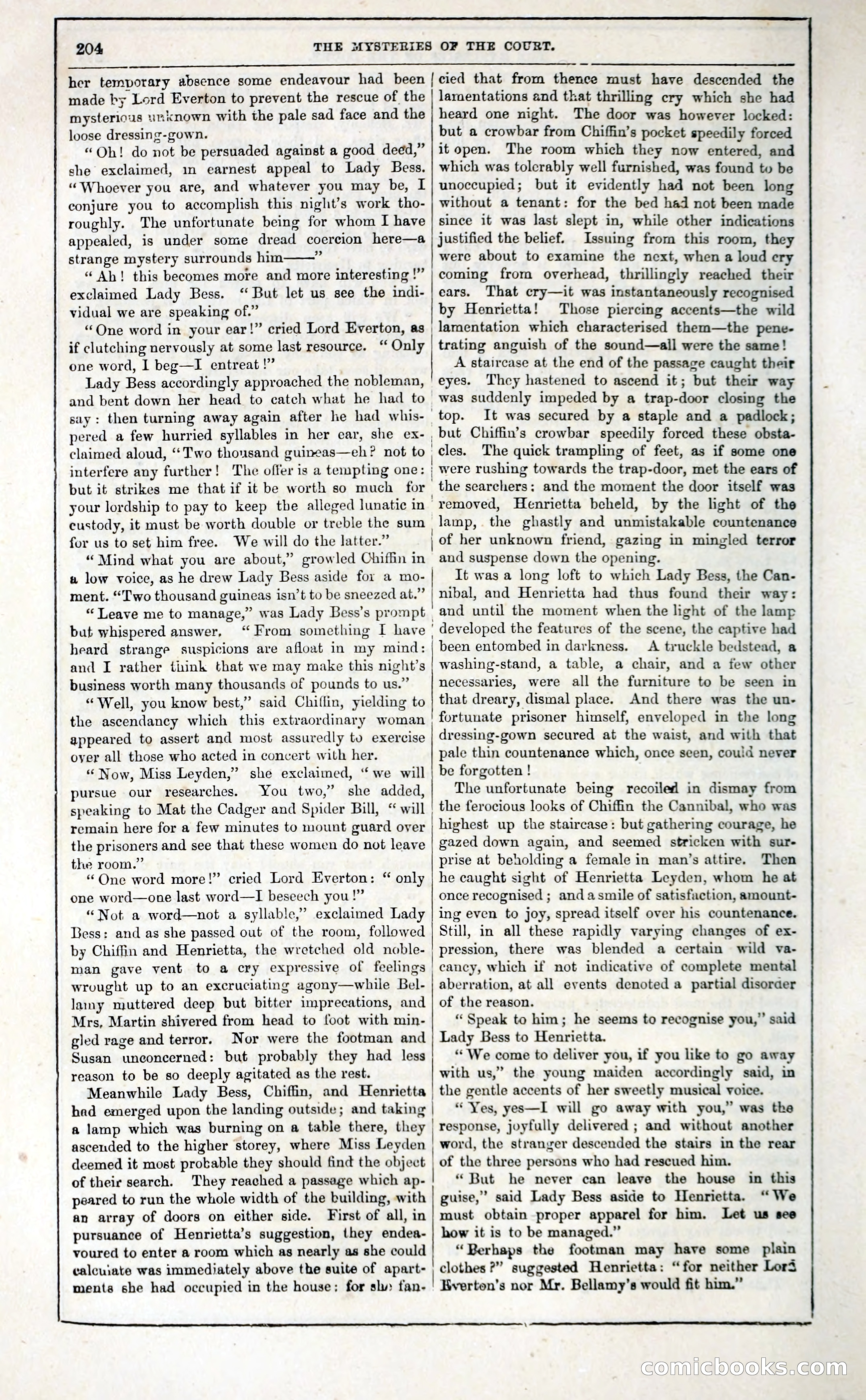
A restored page from Penny Dreadfuls, 1849. Page through the whole issue in the reader above.
📄 Transcribed text from this page (OCR, searchable)
Machine-transcribed from the original scan — historical spelling and the odd misread are preserved.
204 THE MYSTERIES OF THE COURT. her temporary absence some endeavour had been |cied that from thence must have descended the made by Lord Everton to prevent the rescue of the mysterious unknown with the pale sad face and the loose dressing-gown. “Oh! do not be persuaded against a good deed,” she exclaimed, mn earnest appeal to Lady Bess. “Whoever you are, and whatever you may be, I conjure you to accomplish this niglit’s work tho- roughly. The unfortunate being for whom I have appealed, is under some dread coercion here—a strange mystery surrounds him ty “ Ah! this becomes more and more interesting !” exclaimed Lady Bess. “ But let us see the indi- vidual we are speaking of.” “One word in your ear!” cried Lord Everton, as | if clutching nervously at some last resource. “ Only one word, I beg—I entreat !” Lady Bess accordingly approached the nobleman, and bent down her head to catch what he had to say: then turning away again after he had whis- pered a few hurried syllables in her car, she ex- claimed aloud, ‘“‘ Two thousand guineas—eh? not to interfere any further! The offer is a tempting one: | but it strikes me that if it be worth so much for your lordship to pay to keep the alleged lunatic in — custody, it must be worth double or treble the sum for us to set him free. We will do the latter.” “Mind what you are about,” growled OChiffin in — a low voice, as he drew Lady Bess aside for a mo- ment. “Two thousand guineas isn’t to be sneezed at.” “ Leave me to manage,” was Lady Bess’s prompt but whispered answer, ‘ From something I have heard strange suspicions are afloat in my mind: and I rather think that we may make this night’s business worth many thousands of pounds to us.” “Well, you know best,” said Chiflin, yielding to the ascendancy which this extraordinary woman appeared to assert and most assuredly to exercise oyer all those who acted in concert with her. “ Now, Miss Leyden,” she exclaimed, “we will pursue our researches. You two,” she added, speaking to Mat the Cadger and Spider Bill, “ will remain here for a few minutes to mount guard over the prisoners and see that these women do not leave the room.” “One word more!” cried Lord Everton: “ only one word—one last word—I beseech you!” “Not a word—not a syllable,’ exclaimed Lady Bess: and as she passed out of the room, followed by Chiffin and Henrietta, the wretched old noble- man gave vent to a cry expressive of feelings wrought up to an excruciating agony—while Bel- lamy muttered deep but bitter imprecations, and Mrs, Martin shivered from head to foot with min- gled rage and terror. Nor were the footman and Susan unconcerned: but probably they had less reason to be so deeply agitated as the rest. Meanwhile Lady Bess, Chiffin, and Henrietta had emerged upon the landing outside; and taking | a lamp which was burning on a table there, they | ascended to the higher storey, where Miss Leyden deemed it most prokable they should find the object of their search. They reached a passage which ap- peared to run the whole width of the building, with an array of doors on either side. First of all, in pursuance of Henrietta’s suggestion, they endea- voured to enter a room which as nearly as she could calcuiate was immediately above the suite of apart- ments she had occupied in the house; for sh» fan- i ' ; SSS nS EE eel lamentations and that thrilling cry which she had heard one night. The door was however locked: but a crowbar from Chiffin’s pocket speedily forced it open. The room which they now entered, and which was tolerably well furnished, was found to be unoccupied; but it evidently had not been long without a tenant: for the bed had not been made since it was last slept in, while other indications justified the belief. Issuing from this room, they were about to examine the next, when a loud ery coming from overhead, thrillingly reached their ears. That cry—it was instantaneously recognised by Henrietta! Those piercing accents—the wild lamentation which characterised them—the pene- trating anguish of the sound—all were the same! A staircase at the end of the passage caught their eyes. Thcy hastened to ascend it; but their way was suddenly impeded by a trap-door closing the top. It was secured by a staple and a padlock; but Chiffin’s crowbar speedily forced these obsta- cles. The quick trampling of feet, as if some one were rushing towards the trap-door, met the ears of the searchers: and the moment the door itself was removed, Henrietta beheld, by the light of the lamp, the ghastly and unmistakable countenance of her unknown friend, gazing in mingled terror and suspense down the opening. It was a long loft to which Lady Bess, the Can- nibal, and Henrietta had thus found their way: and until the moment when the light of the lamp developed the features of the scene, the captive had been entombed in darkness. A truckle bedstead, a washing-stand, a table, a chair, and a few other necessaries, were all the furniture to be seen in that dreary, dismal place. And there was the un- fortunate prisoner himself, enveloped in the long dressing-gown secured at the waist, and with that pale thin countenance which, once seen, could never be forgotten ! The unfortunate being recoiled in dismay from the ferocious looks of Chiffin the Cannibal, who was highest up the staircase: but gathering courage, he gazed down again, and seemed stricken with sur- prise at beholding a female in man’s attire. Then he caught sight of Henrietta Leyden, whom he at once recognised ; and asmile of satisfaction, amount- ing even to joy, spread itself over his countenance. Still, in all these rapidly varying changes of ex- pression, there was blended a certain wild va- cancy, which if not indicative of complete mental aberration, at all events denoted a partial disorder of the reason. “ Speak to him; he seems to recognise you,”’ said Lady Bess to Henrietta. “We come to deliver you, if you like to go away with us,” the young maiden accordingly said, in the gentle accents of her sweetly musical voice. *“ Yes, yes—I will go away with you,” was the response, joyfully delivered ; and without another word, the stranger descended the stairs in the rear of the three persons who had rescued him. * But he never can leave the house in this guise,” said Lady Bess aside to Henrietta. “We must obtain proper apparel for him. Let us see how it is to be managed.” “Perhaps the footman may have some plain clothes ?” suggested Henrietta: “for neither Lord Kverten’s nor Mr. Bellamy’s would fit him.” ECOMMICLOOOKS (€©)