
Penny Dreadfuls, 1849 · page 235 of 394
The Mysteries of the Court of London — page 235: what you’re looking at
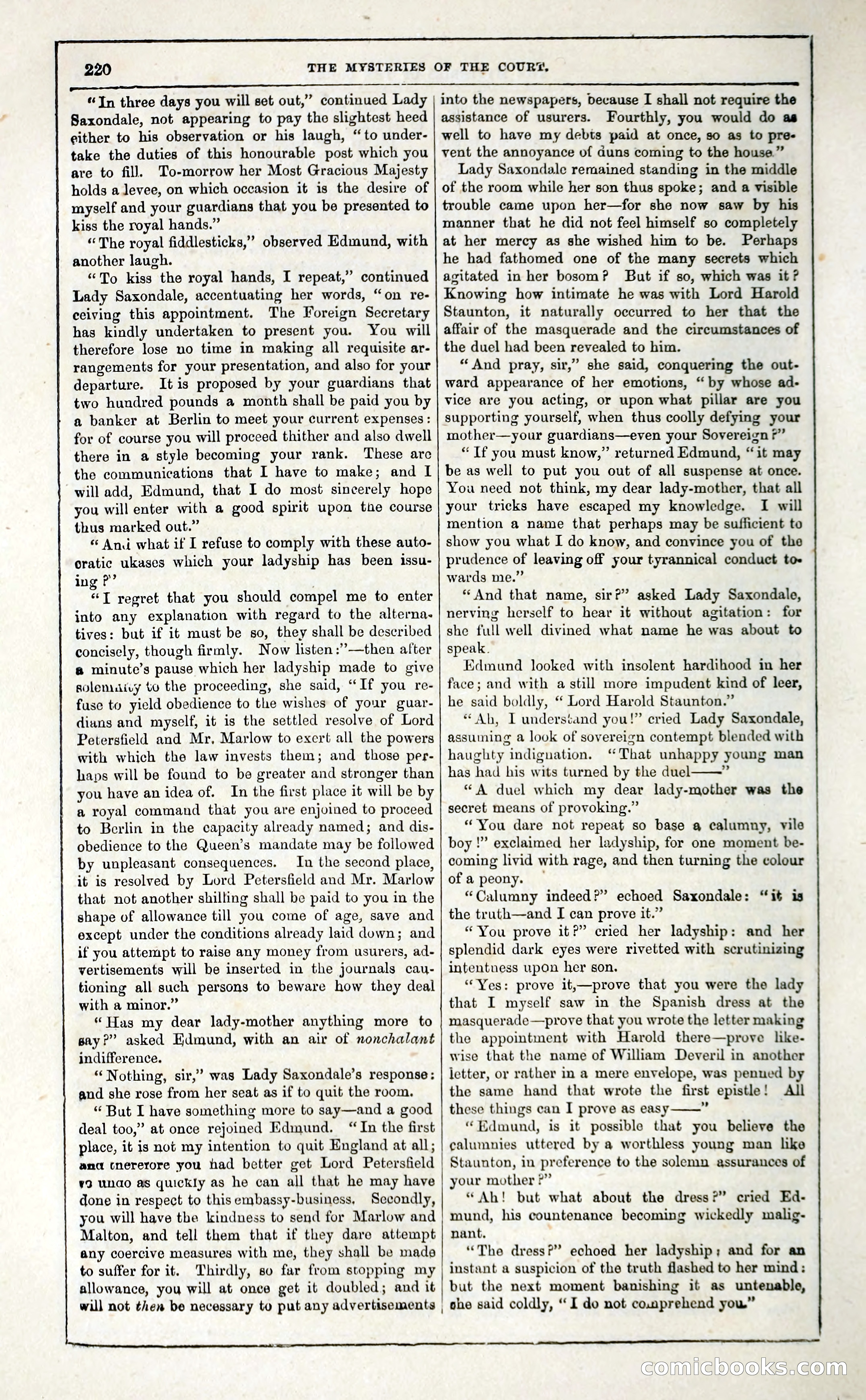
A restored page from Penny Dreadfuls, 1849. Page through the whole issue in the reader above.
📄 Transcribed text from this page (OCR, searchable)
Machine-transcribed from the original scan — historical spelling and the odd misread are preserved.
220 es “In three days you will set out,” continued Lady Saxondale, not appearing to pay the slightest heed either to his observation or his laugh, “to under- take the duties of this honourable post which you are to fill. To-morrow her Most Gracious Majesty holds a levee, on which occasion it is the desire of myself and your guardians that you be presented to kiss the royal hands.” “The royal fiddlesticks,” observed Edmund, with another laugh. “To kiss the royal hands, I repeat,” continued Lady Saxondale, accentuating her words, “on re- ceiving this appointment. The Foreign Secretary has kindly undertaken to present you. You will therefore lose no time in making all requisite ar- rangements for your presentation, and also for your departure. Itis proposed by your guardians that two hundred pounds a month shall be paid you by a banker at Berlin to meet your current expenses: for of course you will proceed thither and also dwell there in a style becoming your rank. These are the communications that I have to make; and I will add, Edmund, that I do most sincerely hope you will enter with a good spirit upon the course thus marked out.” “ And what if I refuse to comply with these auto- cratic ukases which your ladyship has been 1issu- ing P’ : “T regret that you should compel me to enter into any explanation with regard to the alterna- tives: but if it must be so, they shall be described concisely, though firmly. Now listen :”—then after @ minute’s pause which her ladyship made to give solemuivy to the proceeding, she said, “If you re- fuse to yield obedience to the wishes of your guar- diuns and myself, it is the settled resolve of Lord Petersfield and Mr, Marlow to excrt all the powers with which the law invests them; and those per- haps will be found to be greater and stronger than you have an idea of. In the first place it will be by a royal command that you are enjoined to proceed to Berlin in the capacity already named; and dis- obedience to the Queen’s mandate may be followed by unpleasant consequences. In the second place, it is resolved by Lord Petersfield and Mr. Marlow that not another shilling shall be paid to you in the shape of allowance till you come of age, save and except under the conditions already laid down; and if you attempt to raise any money from usurers, ad- vertisements will be inserted in the journals cau- tioning all such persons to beware how they deal with a minor.” “Has my dear lady-mother anything more to gay?” asked Edmund, with an air of nonchalant indifference. “Nothing, sir,’ was Lady Saxondale’s response: and she rose from her seat as if to quit the room. “ But I have something more to say—and a good deal too,” at once rejoined Edmund. “In the first place, it is not my intention to quit England at all; ana tnererore you had better get Lord Petersfield v3 unao as quickly as he can all that he may have done in respect to this embassy-business, Secondly, you will have the kindness to send for Marlow and Malton, and tell them that if they dare attempt any coercive measures with me, they shall be made to suffer for it. Thirdly, so far from stopping my allowance, you will at once get it doubled; and it will not then be necessary to put any advertisements | rr THE MYSTERIES OF THE COURT, into the newspapers, Decause I shall not require the assistance of usurers. Fourthly, you would do as well to have my debts paid at once, so as to pre- vent the annoyance of duns coming to the house.” Lady Saxondale remained standing in the middle of the room while her son thus spoke; and a visible trouble came upon her—for she now saw by his manner that he did not feel himself so completely at her mercy as she wished him to be. Perhaps he had fathomed one of the many secrets which agitated in her bosom? But if so, which was it? Knowing how intimate he was with Lord Harold Staunton, it naturally occurred to her that the affair of the masquerade and the circumstances of the duel had been revealed to him. “And pray, sir,” she said, conquering the out- ward appearance of her emotions, “‘ by whose ad- vice are you acting, or upon what pillar are you supporting yourself, when thus coolly defying your mother—your guardians—even your Sovereign ?” “Tf you must know,” returned Edmund, “it may be as well to put you out of all suspense at once. You need not think, my dear lady-mother, that all your tricks have escaped my knowledge. I will mention a name that perhaps may be sufficient to show you what I do know, and convince you of the prudence of leaving off your tyrannical conduct to- wards me.” “And that name, sir?” asked Lady Saxondale, nerving herself to hear it without agitation: for she full well divined what name he was about to speak. Edmund looked with insolent hardihood in her face; and with a still more impudent kind of leer, he said boldly, “ Lord Harold Staunton.” “Ah, I understand you!” cried Lady Saxondale, assuming a look of sovereign contempt blended with haughty indignation. “That unhappy young man has had his wits turned by the duel u “A duel which my dear lady-mother was the secret means of provoking.” “You dare not repeat so base a calumny, vile boy !” exclaimed her ladyship, for one moment be- coming livid with rage, and then turning the colour of a peony. — “Calumny indeed?” echoed Saxondale: “it is the truth—and I can prove it.” “You prove it?” cried her ladyship: and her splendid dark eyes were rivetted with scrutinizing intentness upon her gon. “Yes: prove it,—prove that you were the lady that I myself saw in the Spanish dress at the masquerade—prove that you wrote the letter making the appointment with Harold there—prove like- wise that the name of William Deveril in another letter, or rather in a mere envelope, was penned by the same hand that wrote the first epistle! All these things can I prove as easy ——” “Edmund, is it possible that you believe the calumnies uttered by a worthless young man like Staunton, in preference to the solemn assurances of your mother ?” “Ah! but what about the dress?” cried Ed- mund, his countenance becoming wickedly malig- nant. “The dress?” echoed her ladyship; and for an instant a suspicion of the truth flashed to her mind: but the next moment banishing if as untenable, ohe said coldly, “I do not coanprehend you.” ECOMMIcloooxs (E€@)