
Penny Dreadfuls, 1849 · page 241 of 394
The Mysteries of the Court of London — page 241: what you’re looking at
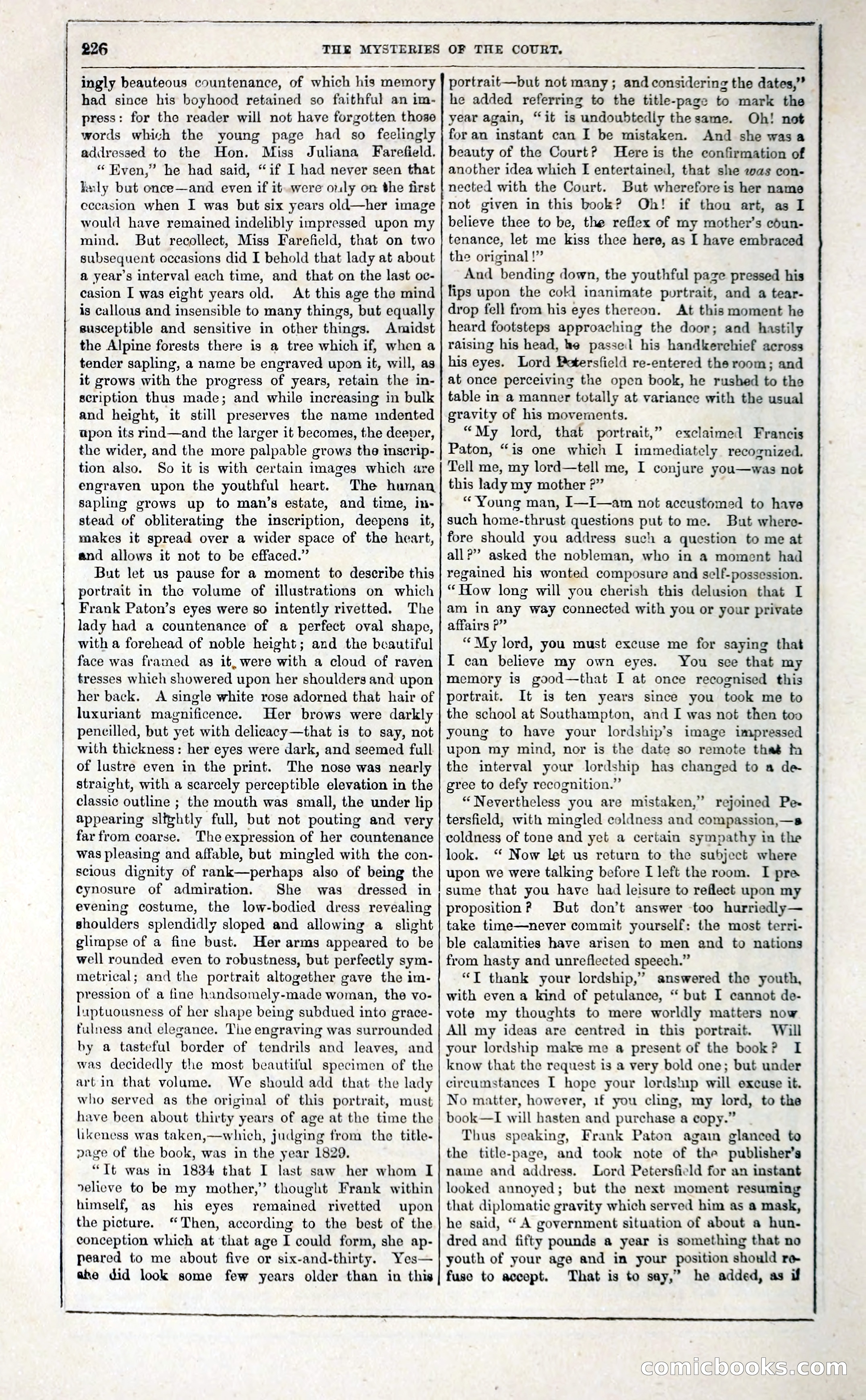
A restored page from Penny Dreadfuls, 1849. Page through the whole issue in the reader above.
📄 Transcribed text from this page (OCR, searchable)
Machine-transcribed from the original scan — historical spelling and the odd misread are preserved.
226 ingly beauteous countenance, of which his memory had since his boyhood retained so faithful an im- press: for the reader will not have forgotten those words which the young page had so feelingly addressed to the Hon. Miss Juliana Farefield. “ Kven,” he had said, “if I had never seen that kxly but once—and even if it..were ouly on the first eccasion when I was but six years old—her image would have remained indelibly impressed upon my mind. But recollect, Miss Farefield, that on two subsequent occasions did I behold that lady at about a year’s interval each time, and that on the last oc- casion I was eight years old. At this age the mind is callous and insensible to many things, but equally susceptible and sensitive in other things. Amidst the Alpine forests there is a tree which if, when a tender sapling, a name be engraved upon it, will, as it grows with the progress of years, retain the in- scription thus made; and while increasing in bulk and height, it still preserves the name indented upon its rind—and the larger it becomes, the deever, the wider, and the more palpable grows the inscrip- tion also. So it is with certain images which are engraven upon the youthful heart. The human sapling grows up to man’s estate, and time, im- stead of obliterating the inscription, deepens it, makes it spread over a wider space of the heart, and allows it not to be effaced.” But let us pause for a moment to describe this portrait in the volume of illustrations on which Frank Paton’s eyes were so intently rivetted. The lady had a countenance of a perfect oval shape, with a forehead of noble height; and the beautiful face was framed as it, were with a cloud of raven tresses which showered upon her shoulders and upon her back. A single white rose adorned that hair of luxuriant magnificence. Her brows were darkly pencilled, but yet with delicacy—that is to say, not with thickness: her eyes were dark, and seemed full of lustre even in the print. The nose was nearly straight, with a scarcely perceptible elevation in the classic outline ; the mouth was small, the under lip appearing slfphtly full, but not pouting and very far from coarse. The expression of her countenance was pleasing and affable, but mingled with the con- scious dignity of rank—perhaps also of being the cynosure of admiration. She was dressed in evening costume, the low-bodied dress revealing shoulders splendidly sloped and allowing a slight glimpse of a fine bust. Her arms appeared to be well rounded even to robustness, but perfectly sym- metrical; and the portrait altogether gave the im- pression of a fine handsomely-made woman, the vo- luptuousness of her shape being subdued into grace- fulness and elegance. The engraving was surrounded by a tasteful border of tendrils and leaves, and was decidedly the most beautiful specimen of the artin that volume. We should add that the lady who served as the original of this portrait, must have been about thirty years of age at the time the likeness was taken,—which, judging from the title- page of the book, was in the year 1829. “Tt was in 1834 that I last saw her whom I relieve to be my mother,’ thought Frank within himself, as his eyes remained rivetted upon the picture. “Then, according to the best of the conception which at that age I could form, she ap- peared to me about five or six-and-thirty. Yes— abe did look some few years older than in this eter ee THE MYSTERIES OF THE COURT, portrait—but not many; and considering the dates,” he added referring to the title-page to mark the year again, “it is undoubtedly thesame. Oh! not for an instant can I be mistaken. And she wasa beauty of the Court? Here is the confirmation of another idea which I entertained, that she was con- nected with the Court. But wherefore is her name not given in this book? Oh! if thou art, as I believe thee to be, the reflex of my mother’s coun- tenance, let me kiss thee here, as L have embraced the original !” And bending down, the youthful paze pressed his lips upon the cold inanimate portrait, and a tear- drop fell from his eyes thereon. At this moment he heard footsteps approaching the door; and hastily raising his head, 4e passel his handkerchief across his eyes. Lord Petersfield re-entered the room; and at once perceiving the open book, he rushed to the table in a manner totally at variance with the usual gravity of his movements. “My lord, that portrait,” exclaimed Francis Paton, “is one which I immediately recognized. Tell me, my lord—tell me, I conjure you—was not this lady my mother ?” “ Young man, I—I—am not accustomed to have such home-thrust questions put tome. But where- fore should you address such a question to me at all?” asked the nobleman, who in a moment had regained his wonted composure and self-possession. “ How long will you cherish this delusion that I am in any way connected with you or your private affairs P” “My lord, you must excuse me for saying that I can believe my own eyes. You sce that my memory is good—that I at once recognised this portrait. It is ten years since you took me to the school at Southampton, and I was not then too young to have your lordship’s image impressed upon my mind, nor is the date so remote thas ta the interval your lordship has changed to a de gree to defy recognition.” “Nevertheless you are mistaken,” rejoined Pe- tersfield, with mingled coldness and compassion,—s coldness of tone and yet a certain sympathy in the look. ‘ Now let us return to the subject where upon we were talking before I left the room. I pra sume that you have had leisure to reflect upon my proposition? But don’t answer too hurriedly— take time—never commit yourself: the most terri- ble calamities have arisen to men and to nations from hasty and unreflected speech.” “TY thank your lordship,” answered the youth, with even a kind of petulance, “ but I cannot de- vote my thoughts to mere worldly matters now All my ideas are centred in this portrait. Will your lordship make me a present of the book? I know that the request is a very bold one; but under circumstances I hope your lordship will excuse it. No matter, however, 1f you cling, my lord, to the book—I will hasten and purchase a copy.” Thus speaking, Frank Paton again glanced to the title-page, and took note of the publisher’s name and address. Lord Petersfield for an instant looked annoyed; but the next moment resuming that diplomatic gravity which served him as a mask, he said, “ A government situation of about a hun- dred and fifty pounds a year is something that no youth of your age and in your position should ro- fuse to accept. That is to say,” he added, as if ECOMMICOOOKS (E()