
Penny Dreadfuls, 1849 · page 245 of 394
The Mysteries of the Court of London — page 245: what you’re looking at
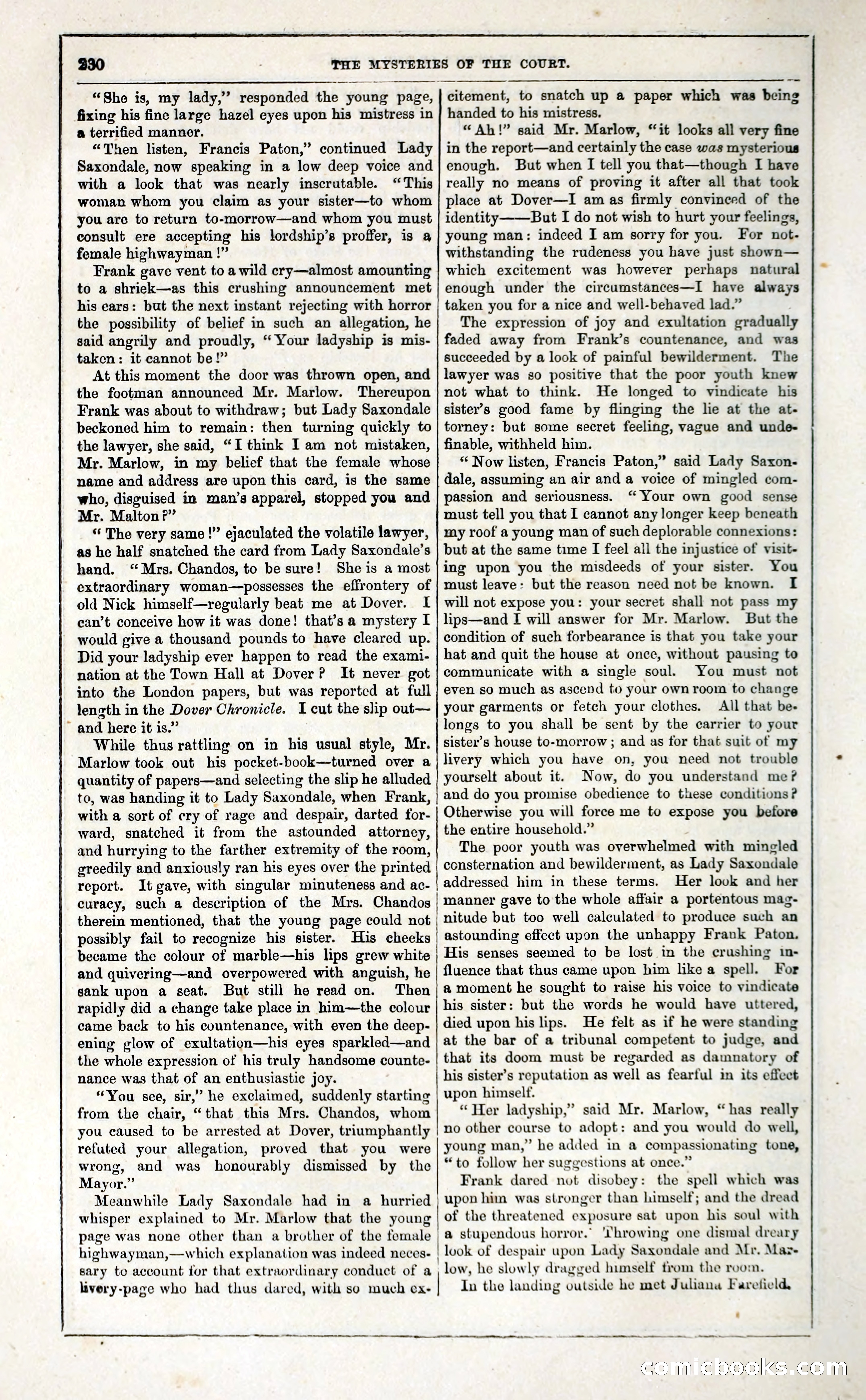
A restored page from Penny Dreadfuls, 1849. Page through the whole issue in the reader above.
📄 Transcribed text from this page (OCR, searchable)
Machine-transcribed from the original scan — historical spelling and the odd misread are preserved.
230 “She is, my lady,’ responded the young page, fixing his fine large hazel eyes upon his mistress in a terrified manner. “Then listen, Francis Paton,” continued Lady Saxondale, now speaking in a low deep voice and with a look that was nearly inscrutable. “This woman whom you claim as your sister—to whom you are to return to-morrow—and whom you must consult ere accepting his lordship’s proffer, is a female highwayman !” Frank gave vent to a wild cry—almost amounting to a shriek—as this crushing announcement met his ears: but the next instant rejecting with horror the possibility of belief in such an allegation, he said angrily and proudly, “ Your ladyship is mis- taken: it cannot be!” At this moment the door was thrown open, and the footman announced Mr. Marlow. Thereupon Frank was about to withdraw; but Lady Saxondale beckoned him to remain: then turning quickly to the lawyer, she said, “I think I am not mistaken, Mr. Marlow, in my belief that the female whose name and address are upon this card, is the same who, disguised in man’s apparel, stopped you and Mr. Malton?” ‘“ The very same!” ejaculated the volatile lawyer, as he half snatched the card from Lady Saxondale’s hand. “Mrs. Chandos, to be sure! She is a most extraordinary woman—possesses the effrontery of old Nick himself—regularly beat me at Dover. I can’t conceive how it was done! that’s a mystery I would give a thousand pounds to have cleared up. Did your ladyship ever happen to read the exami- nation at the Town Hall at Dover? It never got into the London papers, but was reported at full length in the Dover Chronicle. I cut the slip out— ~ and here it 1s.” While thus rattling on in his usual style, Mr. Marlow took out his pocket-book—turned over a quantity of papers—and selecting the slip he alluded to, was handing it to Lady Saxondale, when Frank, with a sort of cry of rage and despair, darted for- ward, snatched it from the astounded attorney, and hurrying to the farther extremity of the room, greedily and anxiously ran his eyes over the printed report. It gave, with singular minuteness and ac- curacy, such a description of the Mrs. Chandos therein mentioned, that the young page could not possibly fail to recognize his sister. His cheeks became the colour of marble—his lips grew white and quivering—and overpowered with anguish, he sank upon a seat. But still he read on. Then rapidly did a change take place in him—the colour came back to his countenance, with even the deep- ening glow of exultation—his eyes sparkled—and the whole expression of his truly handsome counte- nance was that of an enthusiastic joy. “You see, sir,” he exclaimed, suddenly starting from the chair, “that this Mrs. Chandos, whom you caused to be arrested at Dover, triumphantly refuted your allegation, proved that you were wrong, and was honourably dismissed by the Mayor.” Meanwhile Lady Saxondale had in a hurried whisper explained to Mr. Marlow that the young page was none other than a brother of the female highwayman,—which explanation was indeed neces- sary to account tor that extraordinary conduct of a lvery-page who had thus dared, with so much ex- me THE MYSTERIES OF THE COURT. — citement, to snatch up a paper which was being handed to his mistress. “Ah!” said Mr. Marlow, “it looks all very fine in the report—and certainly the case was mysterious enough. But when I tell you that—though I have really no means of proving it after all that took place at Dover—I am as firmly convinced of the identity--—But I do not wish to hurt your feelings, young man: indeed I am sorry for you. For not- withstanding the rudeness you have just shown— which excitement was however perhaps natural enough under the circumstances—I have always taken you for a nice and well-behaved lad.” The expression of joy and exultation gradually faded away from Frank’s countenance, and was succeeded by a look of painful bewilderment. The lawyer was so positive that the poor youth knew not what to think. He longed to vindicate his sister’s good fame by flinging the lie at the at- torney: but some secret feeling, vague and unde- finable, withheld him. “‘ Now listen, Francis Paton,” said Lady Saxon- dale, assuming an air and a voice of mingled com- passion and seriousness. “ Your own good sense must tell you that I cannot any longer keep beneath my roof a young man of such deplorable connexions: but at the same time I feel all the injustice of visit- ing upon you the misdeeds of your sister. You must leave: but the reason need not be known. I will not expose you: your secret shall not pass my lips—and I will answer for Mr. Marlow. But the condition of such forbearance is that you take your hat and quit the house at once, without pausing to communicate with a single soul. You must not even so much as ascend to your own room to change your garments or fetch your clothes. All that be- longs to you shall be sent by the carrier to your sister’s house to-morrow ; and as for that suit of my livery which you have on, you need not trouble yourselt about it. Now, do you understand me? and do you promise obedience to these conditions? Otherwise you will force me to expose you before the entire household.” The poor youth was overwhelmed with mingled consternation and bewilderment, as Lady Saxondale addressed him in these terms. Her look and her manner gave to the whole affair a portentous mag- nitude but too well calculated to produce such an astounding effect upon the unhappy Frank Paton. His senses seemed to be lost in the crushing in- fluence that thus came upon him like a spell. For a moment he sought to raise his voice to vindicate his sister: but the words he would have uttered, died upon his lips. He felt as if he were standing at the bar of a tribunal competent to judge, and that its doom must be regarded as damnatory of his sister’s reputation as well as fearful im its effect upon himself. “ Her ladyship,” said Mr. Marlow, “has really no other course to adopt: and you would do well, young man,” he added in a compassionating tone, “to follow her suggestions at once.” Frank dared not disobey: the spell which was upon him was stronger than himself; and the dread of the threatened exposure sat upon his soul with a stupendous horror.” ‘hrowing one dismal dreary look of despair upon Lady Saxondale and Mr. Maz- low, he slowly dragged himself trom the room. In the landing outside he met Juliana Faretield, ——_—— ee em we —-—. —,-~— —_—_——_— ECOMMICOOOKS (€©)