
Penny Dreadfuls, 1849 · page 275 of 394
The Mysteries of the Court of London — page 275: what you’re looking at
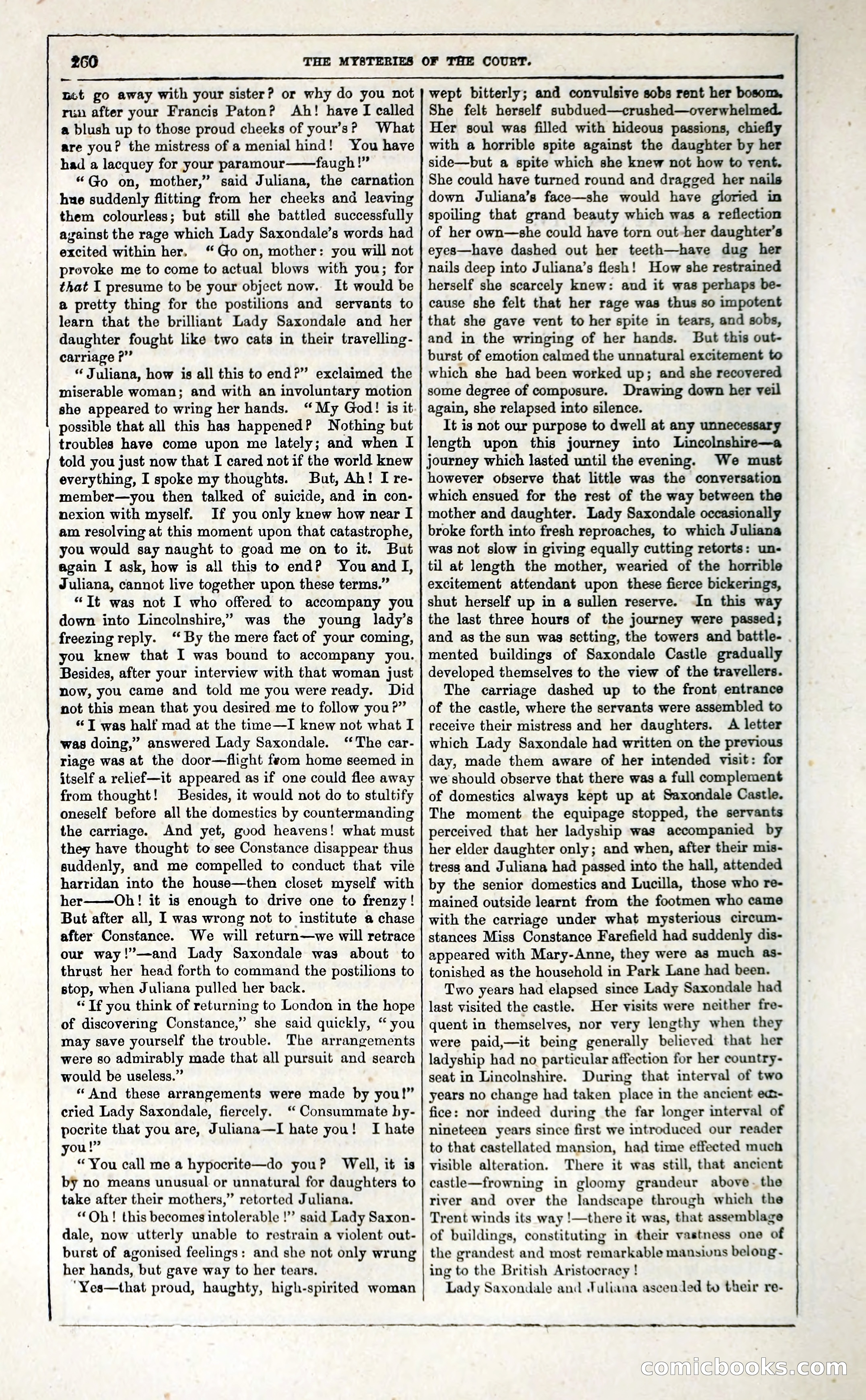
A restored page from Penny Dreadfuls, 1849. Page through the whole issue in the reader above.
📄 Transcribed text from this page (OCR, searchable)
Machine-transcribed from the original scan — historical spelling and the odd misread are preserved.
wet go away with your sister? or why do you not run after your Francis Paton? Ah! have I called a blush up to those proud cheeks of your’s? What are you? the mistress of a menial hind! You have had a lacquey for your paramour——faugh !” “Go on, mother,” said Juliana, the carnation hue suddenly flitting from her cheeks and leaving them colourless; but still she battled successfully ayainst the rage which Lady Saxondale’s words had excited within her, “Goon, mother: you will not provoke me to come to actual blows with you; for that I presume to be your object now. It would be a pretty thing for the postilions and servants to learn that the brilliant Lady Saxondale and her daughter fought like two cats in their travelling- carriage P”’ “ Juliana, how is all this to end?” exclaimed the miserable woman; and with an involuntary motion she appeared to wring her hands. “My God! is it possible that all this has happened? Nothing but troubles have come upon me lately; and when I told you just now that I cared not if the world knew everything, I spoke my thoughts. But, Ah! I re- member—you then talked of suicide, and in con- nexion with myself. If you only knew how near I am resolving at this moment upon that catastrophe, you would say naught to goad me on to it. But again I ask, how is all this to end? You and I, Juliana, cannot live together upon these terms.” “Tt was not I who offered to accompany you down into Lincolnshire,’ was the young lady’s freezing reply. “By the mere fact of your coming, you knew that I was bound to accompany you. Besides, after your interview with that woman just now, you came and told me you were ready. Did not this mean that you desired me to follow you?” ‘T was half mad at the time—I knew not what I was doing,” answered Lady Saxondale. ‘The car- riage was at the door—flight feom home seemed in itself a relief—it appeared as if one could flee away from thought! Besides, it would not do to stultify oneself before all the domestics by countermanding the carriage. And yet, guod heavens! what must they have thought to see Constance disappear thus suddenly, and me compelled to conduct that vile harridan into the house—then closet myself with her——Oh! it is enough to drive one to frenzy! But after all, I was wrong not to institute a chase after Constance. We will return—we will retrace our way!”—and Lady Saxondale was about to thrust her head forth to command the postilions to stop, when Juliana pulled her back. “Tf you think of returning to London in the hope of discovering Constance,” she said quickly, “you may save yourself the trouble. The arrangements were so admirably made that all pursuit and search would be useless.” * And these arrangements were made by you!” cried Lady Saxondale, fiercely. “ Consummate by- pocrite that you are, Juliana—I hate you! I hate ou!” “You call me a hypocrite—do you? Well, it is by no means unusual or unnatural for daughters to take after their mothers,” retorted Juliana. “Oh! this becomes intolerable |”? said Lady Saxon- dale, now utterly unable to restrain a violent out- burst of agonised feelings: and she not only wrung her hands, but gave way to her tears. ‘Yes—that proud, haughty, high-spirited woman —— ees ee ee — SS , THE MYSTERIES OF THE COURT. wept bitterly; and convulsive sobs rent her bosom. She felt herself subdued—crushed—overwhelmed. Her soul was filled with hideous passions, chiefly with a horrible spite against the daughter by her side—but a spite which she knew not how to vent. She could have turned round and dragged her nails down Juliana’s face—she would have giloried in spoiling that grand beauty which was a reflection of her own—she could have torn out-her daughter’s eyes—have dashed out her teeth—have dug her nails deep into Juliana’s flesh! How she restrained herself she scarcely knew: aud it was perhaps be- cause she felt that her rage was thus so impotent that she gave vent to her spite in tears, and sobs, and in the wringing of her hands. But this out- burst of emotion calmed the unnatural excitement to which she had been worked up; and she recovered some degree of composure. Drawing down her veil again, she relapsed into silence. It is not our purpose to dwell at any unnecessary length upon this journey into Lincolnshire—a journey which lasted until the evening. We must however observe that little was the conversation which ensued for the rest of the way between the mother and daughter. Lady Saxondale occasionally broke forth into fresh reproaches, to which Juliana was not slow in giving equally cutting retorts: un- til at length the mother, wearied of the horrible excitement attendant upon these fierce bickerings, shut herself up in a sullen reserve. In this way the last three hours of the journey were passed; and as the sun was setting, the towers and battle- mented buildings of Saxondale Castle gradually developed themselves to the view of the travellers. The carriage dashed up to the front entrance of the castle, where the servants were assembled to receive their mistress and her daughters. A letter which Lady Saxondale had written on the previous day, made them aware of her intended visit: for we should observe that there was a full complement of domestics always kept up at Saxondale Castle. The moment the equipage stopped, the servants perceived that her ladyship was accompanied by her elder daughter only; and when, after their mis- tress and Juliana had passed into the hall, attended by the senior domestics and Lucilla, those who re- mained outside learnt from the footmen who came with the carriage under what mysterious circum- stances Miss Constance Farefield had suddenly dis- appeared with Mary-Anne, they were as much as- tonished as the household in Park Lane had been. Two years had elapsed since Lady Saxondale had last visited the castle. Her visits were neither fre- quent in themselves, nor very lengthy when they were paid,—it being generally believed that her ladyship had no particular affection for her country- seat in Lincolnshire. During that interval of two years no change had taken place in the ancient em- fice: nor indeed during the far longer interval of nineteen years since first we introduced our reader to that castellated mansion, had time effected much visible alteration. There it was still, that ancient castle—frowning in gloomy grandeur above. the river and over the landscape through which the Trent winds its way !—there it was, that assemblage of buildings, constituting in their vastness one of the grandest and most remarkable mansiuns belong- ing to the British Aristocracy ! Lady Saxondale and Juliana ascended to their re- ——_ (C(O) 0)(0)(0) CS (E()