
Penny Dreadfuls, 1849 · page 277 of 394
The Mysteries of the Court of London — page 277: what you’re looking at
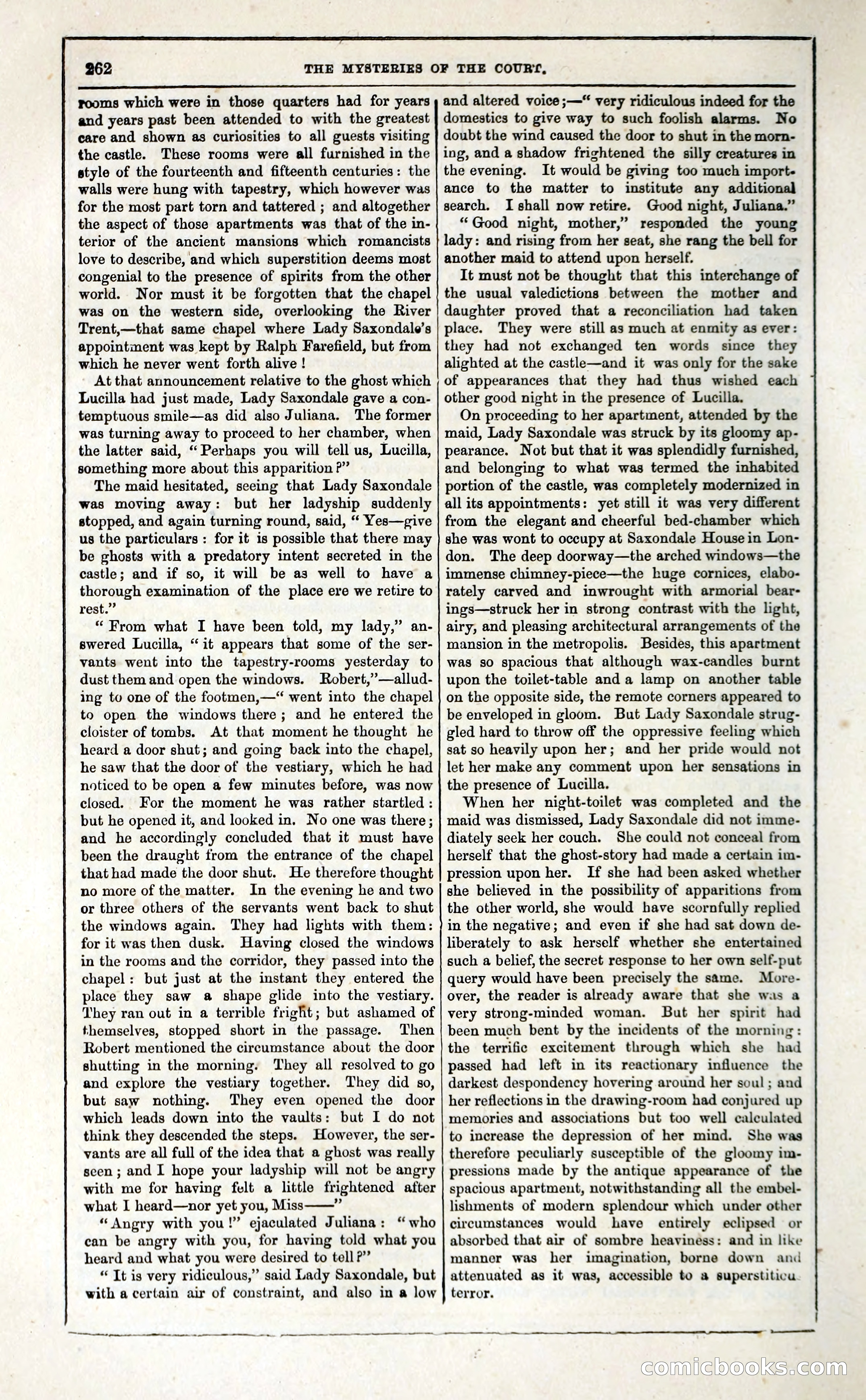
A restored page from Penny Dreadfuls, 1849. Page through the whole issue in the reader above.
📄 Transcribed text from this page (OCR, searchable)
Machine-transcribed from the original scan — historical spelling and the odd misread are preserved.
— 262 THE MYSTERIES OF THE COURT, rooms which were in those quarters had for years and years past been attended to with the greatest care and shown as curiosities to all guests visiting the castle. These rooms were all furnished in the atyle of the fourteenth and fifteenth centuries: the walls were hung with tapestry, which however was for the most part torn and tattered ; and altogether the aspect of those apartments was that of the in- terior of the ancient mansions which romancists love to describe, and which superstition deems most congenial to the presence of spirits from the other world. Nor must it be forgotten that the chapel was on the western side, overlooking the River Trent,—that same chapel where Lady Saxondale’s appointment was kept by Ralph Farefield, but from which he never went forth alive ! At that announcement relative to the ghost which Lucilla had just made, Lady Saxondale gave a con- temptuous smile—as did also Juliana. The former was turning away to proceed to her chamber, when the latter said, “Perhaps you will tell us, Lucilla, something more about this apparition P” The maid hesitated, seeing that Lady Saxondale was moving away: but her ladyship suddenly stopped, and again turning round, said, “ Yes—give us the particulars: for it is possible that there may be ghosts with a predatory intent secreted in the castle; and if so, it will be as well to have a thorough examination of the place ere we retire to rest.” “ From what I have been told, my lady,” an- swered Lucilla, “it appears that some of the ser- vants went into the tapestry-rooms yesterday to dust them and open the windows. Robert,’’—allud- ing to one of the footmen,—“ went into the chapel to open the windows there; and he entered the cloister of tombs. At that moment he thought he heard a door shut; and going back into the chapel, he saw that the door of the vestiary, which he had noticed to be open a few minutes before, was now closed. For the moment he was rather startled : but he opened it, and looked in. No one was there; and he accordingly concluded that it must have been the draught from the entrance of the chapel that had made the door shut. He therefore thought no more of the matter. In the evening he and two or three others of the servants went back to shut the windows again. They had lights with them: for it was then dusk. Having closed the windows in the rooms and the corridor, they passed into the chapel: but just at the instant they entered the place they saw a shape glide into the vestiary. They ran out in a terrible fright; but ashamed of themselves, stopped short in the passage. Then Robert mentioned the circumstance about the door shutting in the morning. They all resolved to go and explore the vestiary together. They did so, but saw nothing. They even opened the door which leads down into the vaults: but I do not think they descended the steps. However, the ser- vants are all full of the idea that a ghost was really seen ; and I hope your ladyship will not be angry with me for having felt a little frightened after what I heard—nor yet you, Miss——” “Angry with you!” ejaculated Juliana: “who can be angry with you, for having told what you heard and what you were desired to tell?” “ Tt is very ridiculous,” said Lady Saxondale, but with a certain air of constraint, and also in a low SO ct A LLL ——_ and altered voice ;—“ very ridiculous indeed for the domestics to give way to such foolish alarms. No doubt the wind caused the door to shut in the morn- ing, and a shadow frightened the silly creatures in the evening. It would be giving too much import. ance to the matter to institute any additional search. I shall now retire. Good night, Juliana.” “Good night, mother,” responded the young lady: and rising from her seat, she rang the bell for another maid to attend upon herself. It must not be thought that this interchange of the usual valedictions between the mother and daughter proved that a reconciliation had taken place. They were still as much at enmity as ever: they had not exchanged ten words since they alighted at the castle—and it was only for the sake of appearances that they had thus wished each other good night in the presence of Lucilla. On proceeding to her apartment, attended by the maid, Lady Saxondale was struck by its gloomy ap- pearance. Not but that it was splendidly furnished, and belonging to what was termed the inhabited portion of the castle, was completely modernized in all its appointments: yet still it was very different from the elegant and cheerful bed-chamber which she was wont to occupy at Saxondale House in Lon- don. The deep doorway—the arched windows—the immense chimney-piece—the huge cornices, elabo- rately carved and inwrought with armorial bear- ings—struck her in strong contrast with the light, airy, and pleasing architectural arrangements of the mansion in the metropolis. Besides, this apartment was so spacious that although wax-candles burnt upon the toilet-table anda lamp on another table on the opposite side, the remote corners appeared to be enveloped in gloom. But Lady Saxondale strug- gled hard to throw off the oppressive feeling which sat so heavily upon her; and her pride would not let her make any comment upon her sensations in the presence of Lucilla. When her night-toilef was completed and the maid was dismissed, Lady Saxondale did not imme- diately seek her couch. She could not conceal from herself that the ghost-story had made a certain im- pression upon her. If she had been asked whether she believed in the possibility of apparitions from the other world, she would have scornfully replied in the negative; and even if she had sat down de- liberately to ask herself whether she entertained such a belief, the secret response to her own self-put query would have been precisely the same. More- over, the reader is already aware that she was a very strong-minded woman. But her spirit had been much bent by the incidents of the morning: the terrific excitement through which she had passed had left in its reactionary influence the darkest despondency hovering around her soul ; and her reflections in the drawing-room had conjured up memories and associations but too well calculated to increase the depression of her mind. She was therefore peculiarly susceptible of the gloomy im- pressions made by the antique appearance of the spacious apartment, notwithstanding all the embel- lishments of modern splendour which under other circumstances would have entirely eclipsed or absorbed that air of sombre heaviness: and in like manner was her imagination, borne down and attenuated as it was, accessible to a superstiticu terror. Go 0)(0)(0) <=) (E)